>
Ovalentaria/misc (Various families in series Ovalentaria) >
Pomacentridae (Damselfishes) > Pomacentrinae
Etymology: Amphiprion: Greek, amphi = on both sides + Greek, prion, -onos = saw (Ref. 45335).
More on author: Bleeker.
Environment: milieu / climate zone / djupintervall / distribution range
Ekologi
marina revassocierade; ej vandrande; djupintervall 1 - 18 m (Ref. 1602). Tropical; 10°N - 30°S
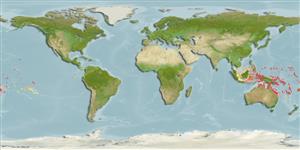
Pacific Ocean: Eastern Indonesia (Bali and Sulawesi eastward), south-eastern Philippines, Papua New Guinea, eastern Queensland, Coral Sea, Solomon Islands, Vanuatu, New Caledonia Palau and Islands of Micronesia.
Length at first maturity / Size / Vikt / Age
Könsmognad: Lm 5.0, range 5 - 5.5 cm
Max length : 12.0 cm TL hane/ej könsbestämd; (Ref. 9710); rapporterad maxålder: 5 år (Ref. 237)
Short description
Bestämningsnycklar | Morfologi | Morfometri
Taggstrålar i ryggfenan (totalt) : 10; Mjukstrålar i ryggfenan (totalt) : 16 - 18; Taggstrålar i analfenan: 2; Mjukstrålar i analfenan: 13 - 14.
Body shape (shape guide): short and / or deep; Cross section: oval.
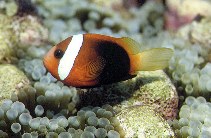
Adults inhabit lagoon and outer reef environments. Feed predominantly on planktonic copepods and algae. Oviparous, distinct pairing during breeding (Ref. 205). Eggs are demersal and adhere to the substrate (Ref. 205). Males guard and aerate the eggs (Ref. 205). Associated with the anemones: Entacmaea quadricolor (usually), Heteractis crispa (occasionally), and Heteractis magnifica (rarely) (Ref. 5911). Has been reared in captivity (Ref. 35404, 35413, 35420).
Benthic spawner. Oviparous, distinct pairing during breeding (Ref. 205). Eggs are demersal and adhere to the substrate (Ref. 205). Males guard and aerate the eggs (Ref. 205). Also Ref. 7471.
Allen, G.R., 1991. Damselfishes of the world. Mergus Publishers, Melle, Germany. 271 p. (Ref. 7247)
IUCN Red List Status (Ref. 130435: Version 2025-1)
Threat to humans
Harmless
Human uses
Fiskeri: husbehovsfiske; Akvarium: Kommersiell
Verktyg
Special reports
Download XML
Internet-källor
Estimates based on models
Preferred temperature (Ref.
123201): 25.1 - 29.3, mean 28.7 °C (based on 1672 cells).
Phylogenetic diversity index (Ref.
82804): PD
50 = 0.5000 [Uniqueness, from 0.5 = low to 2.0 = high].
Bayesian length-weight: a=0.02239 (0.01320 - 0.03796), b=3.03 (2.88 - 3.18), in cm total length, based on LWR estimates for this species & (Sub)family-body (Ref.
93245).
Trofisk nivå (Ref.
69278): 2.3 ±0.0 se; based on diet studies.
Generation time: 2.1 ( na - na) years. Estimated as median ln(3)/K based on 1
growth studies.
Resiliens (Ref.
120179): Mellan, lägsta populationsfördubblingstid 1,4-4,4 år (K=0.53; tm=1.67; tmax=5; Fec=7,200).
Fishing Vulnerability (Ref.
59153): Low vulnerability (25 of 100).
🛈
Nutrients (Ref.
124155): Calcium = 107 [53, 172] mg/100g; Iron = 0.751 [0.457, 1.271] mg/100g; Protein = 18 [17, 19] %; Omega3 = 0.101 [0.060, 0.166] g/100g; Selenium = 22.6 [12.3, 44.2] μg/100g; VitaminA = 84.9 [20.9, 314.2] μg/100g; Zinc = 1.93 [1.30, 2.86] mg/100g (wet weight);