Siganus luridus, Dusky spinefoot : fisheries

Siganus luridus (Rüppell, 1829)

Dusky spinefoot
Waarneming toevoegen in Fish Watcher
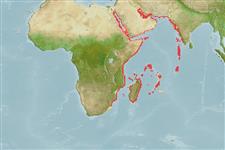
Native range | All suitable habitat | Point map | Year 2050
This map was computer-generated and has not yet been reviewed.
Siganus luridus   AquaMaps   Data sources: GBIF OBIS
Uploaden van uw Foto's en video's
Afbeeldingen | Google afbeelding

Classificatie / Namen Lokale namen | Synoniemen | Catalog of Fishes(Genus, Soort(en)) | ITIS | CoL | WoRMS | Cloffa

> Acanthuriformes (Surgeonfishes) > Siganidae (Rabbitfishes)
Etymology: Siganus: Latin, siganus = a fish, rabbit fish; by the similarity of the nose (Ref. 45335).
More on author: Rüppell.

Milieu: milieu / Klimaatzone / Diepte / verspreidingsgebied Ecologie

marien rifbewoner; diepte 2 - 40 m (Ref. 12382). Subtropical; 35°N - 35°S

Verspreiding Gebieden | FAO regio's | Ecosystemen | Voorkomen | Verspreidingskaart | Introducties | Faunafri

Western Indian Ocean: Persian Gulf (Ref.80050); Red Sea and East Africa to islands in the western Indian Ocean. Immigrant to Mediterranean via the Suez Canal.

Lengte bij maturiteit / Grootte / Gewicht / Leeftijd

Maturiteit: Lm 14.2  range ? - ? cm
Max length : 30.0 cm TL mannelijk / geslacht onbekend; (Ref. 30573); common length : 20.0 cm TL mannelijk / geslacht onbekend; (Ref. 30573)

Korte beschrijving Determinatiesleutels | Morfologie | Morfometrie

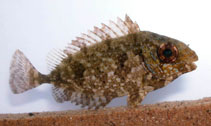
Dorsale stekels (totaal) : 13 - 14; Dorsale zachte stralen (totaal) : 10; Anale stekels: 7; Anale zachte stralen: 9; Wervels: 13. Regional variation in color exists. Anterior spines of median fins slender and pungent, posterior spines stout, all venomous including that on the nape. Preopercular angle 87-97 degrees. Anterior nostril with a long, broad flap covering posterior nostril when depressed. Variable cheek scalation. Midline of thorax devoid of scales between the pelvic ridges.
Body shape (shape guide): fusiform / normal; Cross section: compressed.

Biologie     Verklarende woordenlijst (bv. epibenthic)

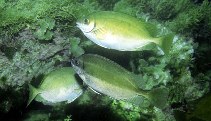
Found in small schools in very shallow water close to the bottom. Prefer hard bottoms of compacted sand with rock or coral debris. Solitary adults and groups of 3 or 4 adults have also been observed. Feed on a wide range of benthic algae. May suddenly stop and erect its fins (dorsal, anal and pelvic) presenting an encircling array of spines to potential predators; these spines are venomous. A food fish that is occasionally poisonous (Ref. 4537). Probably does not adapt well in captivity (Ref. 12382). A thermophilic species (Ref. 120766). Minimum depth from Ref. 9710.

Levenscyclus en paargedrag Maturiteit | Voortplanting | Paaien | Eieren | Fecunditeit | Larven

The larvae maintain themselves near the water surface (Ref. 1419). Feeding on phytoplankton and zooplankton begins 3 days after hatching (Ref. 1419).

Hoofdreferentie Upload uw referenties | Referenties | Coördinator : Woodland, David J. | Medewerkers

Woodland, D.J., 1990. Revision of the fish family Siganidae with descriptions of two new species and comments on distribution and biology. Indo-Pac. Fish. (19):136 p. (Ref. 1419)

Status op de Rode Lijst van het IUCN (Ref. 130435: Version 2025-2 (Global))

  Niet bedreigd (LC) ; Date assessed: 19 July 2017

CITES

Not Evaluated

CMS (Ref. 116361)

Not Evaluated

Gevaar voor de mens

  Venomous (Ref. 1419)


Gebruik door de mens

Visserij: van minder commercieel belang
FAO - Publication: search | FishSource | Sea Around Us

Meer informatie

Trofische ecologie
Voedsel (prooien)
Dieetsamenstelling
Voedselconsumptie
Voedselrantsoenen
Predatoren
Ecologie
Ecologie
Populatiedynamica
Groeiparameters
Max. leeftijden / maten
Lengte-gewicht rel.
Lengte-lengte rel.
Lengtefrequenties
Massaconversie
Rekrutering
Abundantie
Levenscyclus
Voortplanting
Maturiteit
Rijpheid/kieuwen rel.
Fecunditeit
Paaien
Paaibestanden
Eieren
Ontwikkeling van de eieren
Larven
Larvale populatiedynamiek
Verspreiding
Gebieden
FAO regio's
Ecosystemen
Voorkomen
Introducties
BRUVS - Video's
Anatomie
Kieuwoppervlak
Hersenen
Otoliet
Fysiologie
Lichaamssamenstelling
Voedingsstoffen
Zuurstofverbruik
Type zwemmen
Zwemsnelheid
Visuele pigmenten
Vis geluid
Ziekten en parasieten
Toxiciteit (LC50)
Genetica
genoom
Genetica
Heterozygositeit
Erfelijkheid
Genetische diversiteit
Menselijk gerelateerd
Aquacultuursystemen
Aquacultuurprofielen
Kweeklijnen
Ciguatera gevallen
Postzegels, munten, diversen.
Outreach
Medewerkers
Referenties
Referenties

Tools

Speciale rapporten

Download XML

Internetbronnen

Schattingen op basis van modellen

Gewenste temperatuur (Ref. 123201): 24.8 - 29.2, mean 27 °C (based on 294 cells).
Fylogenetische diversiteitsindex (Ref. 82804):  PD50 = 0.5000   [Uniqueness, from 0.5 = low to 2.0 = high].
Bayesian length-weight: a=0.01259 (0.01009 - 0.01571), b=2.99 (2.94 - 3.04), in cm total length, based on LWR estimates for this species (Ref. 93245).
Trofisch niveau (Ref. 69278):  2.0   ±0.0 se; based on diet studies.
Generation time: 5.2 ( na - na) years. Estimated as median ln(3)/K based on 1 growth studies.
Weerstandsvermogen (Ref. 120179):  Gemiddeld, minimale populatieverdubbelingstijd 1,4-4,4 jaar (K=0.3).
Kwetsbaarheid van de visserij (Ref. 59153):  Moderate vulnerability (39 of 100). 🛈
Prijsklasse (Ref. 80766):   High.
Voedingsstoffen (Ref. 124155):  Calcium = 20.3 [9.9, 51.9] mg/100g; Iron = 0.568 [0.259, 1.296] mg/100g; Protein = 19.3 [18.1, 20.4] %; Omega3 = 0.196 [0.099, 0.397] g/100g; Selenium = 8.35 [3.05, 21.97] μg/100g; VitaminA = 51.8 [13.7, 186.8] μg/100g; Zinc = 1.16 [0.45, 2.44] mg/100g (wet weight);