



Ajouter votre observation dans Fish Watcher
| Native range | All suitable habitat | Point map | Year 2050 |

|
| This map was computer-generated and has not yet been reviewed. |
| Pegasus laternarius AquaMaps Data sources: GBIF OBIS |
Envoyez vos Photos et vidéos
Images | Images Google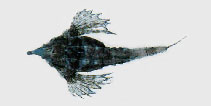 Pegasus laternarius
Photo de Yang, N.-S.
Images | Images Google
Photo de Yang, N.-S.
Classification / Noms Noms communs | Synonymes | Catalog of Fishes(Genre, Espèce) | ITIS | CoL | WoRMS | Cloffa
> Dactylopteriformes (Flying gurnards) > Pegasidae (Seamoths)
Etymology: Pegasus: Named after the winged horse sprung from the blood of Medusa (Ref. 1418); laternarius: From the Latin word 'later' meaning made of bricks.
More on author: Cuvier.
Etymology: Pegasus: Named after the winged horse sprung from the blood of Medusa (Ref. 1418); laternarius: From the Latin word 'later' meaning made of bricks.
More on author: Cuvier.
Environnement : milieu / zone climatique / profondeur / gamme de distribution Écologie
marin démersal; profondeur 30 - 100 m (Ref. 48635). Tropical; 35°N - 11°S, 77°E - 139°E
Distribution Territoires | Zones FAO | Écosystèmes | Occurrences | Carte par point | Introductions | Faunafri
Indo-West Pacific: Gulf of Manaar, Indian Ocean to the Western Pacific (Gulf of Thailand and South China Sea, along the coast of southern China and Taiwan, extending as far north as Suruga Bay, Japan).
Taille / Poids / Âge
Description synthétique Clés d'identification | Morphologie | Morphométrie
Épines dorsales (Total) : 0; Rayons mous dorsaux (Total) : 5; Épines anales: 0; Rayons mous anaux: 5; Vertèbres: 20. It has a variety of colors and can be dull to bright yellow or blue (Ref. 48635). Preserved body dark brown dorsally and laterally; lighter ventrally. Species with 4 pairs of dorsolateral body plates; 5 pairs ventrolateral body plates; deep pits on dorsal surface of head and within interorbital depression absent; 11 or more tail rings with 9th and 10th fused; suborbital shelf convex, obscuring eye from ventral view; last tail ring without spine on dorsal surface. 5th rays of pectorals stout, much thicker than other rays. No scales on orbit. Distal margin of dorsal and anal fins oblique to horizontal axis of body. Readily identified by its rather short rostrum when juvenile or female; it is more developed in males (Ref. 48635).
Body shape (shape guide): other; Cross section: flattened.
Body shape (shape guide): other; Cross section: flattened.
Adults lives on muddy bottoms, often collected at depths of about 50 m; larvae are planktonic. Rarely seen diving, except a few localities in Japan where they occur in sheltered muddy habitats (Ref. 48635).
Cycle de vie et comportement reproducteur Maturité | Reproduction | Frai | Œufs | Fécondité | Larves
Référence principale
Téléchargez vos références | Références | Coordinateur | Collaborateurs
Palsson, W.A. and T.W. Pietsch, 1989. Revision of the Acanthopterygian fish Family Pegasidae (Order Gasterosteiformes). Indo-Pac. Fish. (18):38 p. (Ref. 1418)
Statut dans la liste rouge de l'IUCN (Ref. 130435: Version 2025-2 (Global))
Données manquantes (DD) ; Date assessed: 11 May 2016
CITES
Not Evaluated
Menace pour l'homme
Harmless
Utilisations par l'homme
Pêcheries: d'intérêt potentiel
FAO - Publication: search | FishSource |
Plus d'informations
Écologie trophique
Aliments (proies)
Composition du régime alimentaire
Consommation alimentaire
Rations alimentaires
Prédateurs
Aliments (proies)
Composition du régime alimentaire
Consommation alimentaire
Rations alimentaires
Prédateurs
Écologie
Écologie
Écologie
Dynamique des populations
Paramètres de croissance
Âges / tailles maximales
Longueur-poids rel.
Rel. longueur-longueur.
Fréquences de longueurs
Conversion de masse
Recrutement
Abondance
Paramètres de croissance
Âges / tailles maximales
Longueur-poids rel.
Rel. longueur-longueur.
Fréquences de longueurs
Conversion de masse
Recrutement
Abondance
Cycle de vie
Reproduction
Maturité
Maturité/épines rel.
Fécondité
Frai
Agrégats de frai
Œufs
Développement de l'œuf
Larves
Dynamique des populations larvaires
Reproduction
Maturité
Maturité/épines rel.
Fécondité
Frai
Agrégats de frai
Œufs
Développement de l'œuf
Larves
Dynamique des populations larvaires
Anatomie
Surface branchiale
Cerveau
Otolithe
Surface branchiale
Cerveau
Otolithe
Physiologie
Composition corporelle
Nutriments
Consommation d'oxygène
Type de natation
Vitesse de nage
Pigments visuels
Son de poisson
Maladies et parasites
Toxicité (CL50)
Composition corporelle
Nutriments
Consommation d'oxygène
Type de natation
Vitesse de nage
Pigments visuels
Son de poisson
Maladies et parasites
Toxicité (CL50)
Génétique
génôme
Génétique
Hétérozygotie
Héritabilité
Diversité génétique
génôme
Génétique
Hétérozygotie
Héritabilité
Diversité génétique
Liées à l'homme
Systèmes d'aquaculture
Profils d'aquaculture
Souches
Cas de ciguatera
Timbres, pièces de monnaie, divers
Systèmes d'aquaculture
Profils d'aquaculture
Souches
Cas de ciguatera
Timbres, pièces de monnaie, divers
Outils
E-book | Guide de terrain | Générateur de fréquences de longueur | Outil de dynamique de population | Carte par point |
Capture-MSY |
Articles particuliers
Télécharger en XML
Sources Internet
AFORO (otoliths) | Aquatic Commons | BHL | Cloffa | Websites from users | FishWatcher | CISTI | Catalog of Fishes: Genre, Espèce | DiscoverLife | ECOTOX | FAO - Publication: search | Faunafri | Fishipedia | Fishtrace | GloBI | Google Books | Google Scholar | Google | IGFA World Record | Bases de données nationales | OneZoom | Open Tree of Life | Otolith Atlas of Taiwan Fishes | PubMed | Reef Life Survey | Socotra Atlas | TreeBase | Arbre de Vie | Wikipedia: aller à, chercher | World Records Freshwater Fishing | Zoobank | Zoological Record
Estimations basées sur des modèles
Température préférée (Réf. 123201): 23.4 - 28.4, mean 27.4 °C (based on 329 cells).
Indice de diversité phylogénétique (Réf. 82804): PD50 = 0.5391 [Uniqueness, from 0.5 = low to 2.0 = high].
Bayesian length-weight: a=0.01000 (0.00244 - 0.04107), b=3.04 (2.81 - 3.27), in cm total length, based on all LWR estimates for this body shape (Ref. 93245).
Niveau trophique (Réf. 69278): 3.3 ±0.4 se; based on size and trophs of closest relatives