



Neoceratodus forsteri (Krefft, 1870)
Australian lungfish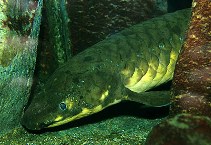
Classification / Noms Noms communs | Synonymes | Catalog of Fishes(Genre, Espèce) | ITIS | CoL | WoRMS | Cloffa
> Ceratodontiformes (Australian lungfishes) > Neoceratodontidae (Australian lungfish)
Etymology: Neoceratodus: Greek, neos = new + Greek, keras = horn + Greek, odous = teeth (Ref. 45335).
Eponymy: William Forster (1818–1882) was an Australian farmer, journalist, magistrate, poet and politician (1856–1876) who was Premier of New South Wales (1859–1860) once described by a fellow politician as: “disagreeable in opposition, insufferable as a [...] (Ref. 128868), visit book page.
Etymology: Neoceratodus: Greek, neos = new + Greek, keras = horn + Greek, odous = teeth (Ref. 45335).
Eponymy: William Forster (1818–1882) was an Australian farmer, journalist, magistrate, poet and politician (1856–1876) who was Premier of New South Wales (1859–1860) once described by a fellow politician as: “disagreeable in opposition, insufferable as a [...] (Ref. 128868), visit book page.
Environnement : milieu / zone climatique / profondeur / gamme de distribution Écologie
Distribution Territoires | Zones FAO | Écosystèmes | Occurrences | Carte par point | Introductions | Faunafri
Oceania: southern Queensland, Australia in Burnett and Mary River systems. Introduced successfully in southeastern Queensland.
Longueur à la première maturité / Taille / Poids / Âge
Maturité: Lm 83.4, range 81 - ? cm
Max length : 170 cm TL mâle / non sexé; (Ref. 26188); common length : 100.0 cm TL mâle / non sexé; (Ref. 5259); poids max. publié: 40.0 kg (Ref. 5259)
Max length : 170 cm TL mâle / non sexé; (Ref. 26188); common length : 100.0 cm TL mâle / non sexé; (Ref. 5259); poids max. publié: 40.0 kg (Ref. 5259)
Description synthétique Clés d'identification | Morphologie | Morphométrie
Épines dorsales (Total) : 0; Rayons mous dorsaux (Total) : 0; Épines anales: 0; Rayons mous anaux: 0. Body stout and elongate. Dorsal fin originating on the middle of the back, confluent with caudal and anal fins. Body covered with large, bony, overlapping scales. The head is flattened, with conical profile. The eyes are small; the mouth is reaching about half the distance to eye. The pectoral fins are large and flipper-like in ventral position just behind the head; the pelvic fins are also flipper-like, situated far back on the body.
Body shape (shape guide): elongated; Cross section: circular.
Body shape (shape guide): elongated; Cross section: circular.
Inhabits mud, sand or gravel bottoms (Ref. 44894). Sluggish species that prefers still or slow-flowing waters, usually in deep pools. During period of drought, it can tolerate stagnant conditions by breathing air, surfacing 1-2 times per hour; however, it lacks the ability to survive dry spells by aestivation; it is a facultative air-breather that will die if forced to depend on air breathing (Ref. 36739, 44894). The sound of the lungfish exhaling air at the surface prior to inhaling a fresh breath has been likened to that made by a small bellows. Nocturnally active (Ref. 44894). Feeds on frogs, tadpoles, fishes, shrimp, earthworms, snails, aquatic plants and native fruits fallen from trees overhanging the creeks (Ref. 36739, 44894). It browses among the detritus, using its electroreceptors to pick up hidden mollusks, worms or crustaceans. Protected by law. Fossil records show that this species remained virtually unchanged for over 380 million years. The Steinhart Aquarium in San Francisco had a specimen of 1 m length, 20 kg weight, and more than 65 years of age. In 1933, an Australian lungfish was transported as a fully mature male (10 yrs. old at maturity) to the Shedd Aquarium, Chicago (C. Skonieczny, pers. comm. 11/08, e-mail: CSkonieczny@sheddaquarium.org). But this fish named Granddad, died in 2017 at the age of 95 (Ref 125841). By default, another individual which was brought to the California Academy of Sciences Aquarium in 1938 from Australia becomes the oldest at the age of 90 years. Biologists at the aquarium believe that Methuselah, as it is fondly called, is a female which measures 120 m and weighs 18,100 g (Ref. 125841).
Cycle de vie et comportement reproducteur Maturité | Reproduction | Frai | Œufs | Fécondité | Larves
The lungfish spawns from August to October; the eggs resemble small transparent grapes and are frequently found attached to floating stands of water-hyacinth. Spawning appears to occur in a series of three phases: in the first, a pair of fish move together, roaming about an area, presumably in search of a suitable spawning site; in the second presumably the male follows the female, nudging her flanks; finally, the fish plunge through the surrounding weed, the male following the female and fertilising the eggs as they are shed.
Référence principale
Téléchargez vos références | Références | Coordinateur | Collaborateurs
Allen, G.R., 1989. Freshwater fishes of Australia. T.F.H. Publications, Inc., Neptune City, New Jersey. (Ref. 5259)
Statut dans la liste rouge de l'IUCN (Ref. 130435: Version 2025-2 (Global))
Menacé (EN) (B2ab(ii,iii)); Date assessed: 13 February 2019
Menace pour l'homme
Harmless
Utilisations par l'homme
Pêcheries: pêcheries vivrières
FAO - Publication: search | FishSource |
Plus d'informations
Écologie trophique
Aliments (proies)
Composition du régime alimentaire
Consommation alimentaire
Rations alimentaires
Prédateurs
Aliments (proies)
Composition du régime alimentaire
Consommation alimentaire
Rations alimentaires
Prédateurs
Dynamique des populations
Paramètres de croissance
Âges / tailles maximales
Longueur-poids rel.
Rel. longueur-longueur.
Fréquences de longueurs
Conversion de masse
Recrutement
Abondance
Paramètres de croissance
Âges / tailles maximales
Longueur-poids rel.
Rel. longueur-longueur.
Fréquences de longueurs
Conversion de masse
Recrutement
Abondance
Cycle de vie
Reproduction
Maturité
Maturité/épines rel.
Fécondité
Frai
Agrégats de frai
Œufs
Développement de l'œuf
Larves
Dynamique des populations larvaires
Reproduction
Maturité
Maturité/épines rel.
Fécondité
Frai
Agrégats de frai
Œufs
Développement de l'œuf
Larves
Dynamique des populations larvaires
Anatomie
Surface branchiale
Cerveau
Otolithe
Surface branchiale
Cerveau
Otolithe
Physiologie
Composition corporelle
Nutriments
Consommation d'oxygène
Type de natation
Vitesse de nage
Pigments visuels
Son de poisson
Maladies et parasites
Toxicité (CL50)
Composition corporelle
Nutriments
Consommation d'oxygène
Type de natation
Vitesse de nage
Pigments visuels
Son de poisson
Maladies et parasites
Toxicité (CL50)
Liées à l'homme
Systèmes d'aquaculture
Profils d'aquaculture
Souches
Cas de ciguatera
Timbres, pièces de monnaie, divers
Systèmes d'aquaculture
Profils d'aquaculture
Souches
Cas de ciguatera
Timbres, pièces de monnaie, divers
Outils
Quiz bio | E-book | Guide de terrain | Générateur de fréquences de longueur | Outil de dynamique de population | Carte par point |
Capture-MSY |
Articles particuliers
Télécharger en XML
Sources Internet
AFORO (otoliths) | Aquatic Commons | BHL | Cloffa | Websites from users | FishWatcher | CISTI | Catalog of Fishes: Genre, Espèce | DiscoverLife | ECOTOX | FAO - Publication: search | Faunafri | Fishipedia | Fishtrace | GloBI | Google Books | Google Scholar | Google | IGFA World Record | OneZoom | Open Tree of Life | Otolith Atlas of Taiwan Fishes | Aquariums publics | PubMed | Reef Life Survey | Socotra Atlas | TreeBase | Arbre de Vie | Wikipedia: aller à, chercher | World Records Freshwater Fishing | Zoological Record
Estimations basées sur des modèles
Indice de diversité phylogénétique (Réf. 82804): PD50 = 1.5312 [Uniqueness, from 0.5 = low to 2.0 = high].
Bayesian length-weight: a=0.00389 (0.00180 - 0.00842), b=3.12 (2.94 - 3.30), in cm total length, based on all LWR estimates for this body shape (Ref. 93245).
Niveau trophique (Réf. 69278): 3.4 ±0.54 se; based on food items.
Generation time: 10.3 ( na - na) years. Estimated as median ln(3)/K based on 2 growth studies.
Résilience (Réf. 120179): Très faible, temps minimum de doublement de population supérieur à 14 ans (K=0.11; tmax >30; tm approx. 15-20 yrs.).