This website uses cookies to enhance your browsing experience and ensure the functionality of our site. For more detailed information about the types of cookies we use and how we protect your privacy, please visit our Privacy Information page.
×
Cookie Settings
This website uses different types of cookies to enhance your experience. Please select your preferences below:
Europe: Caspian, Black, Baltic and North Sea basins; Great Britain; north to about 69° N in Scandinavia. Asia: Aral Sea basin, Arctic Ocean basin eastward to Kolyma drainage. Several countries report adverse ecological impact after introduction.
Länge bei der ersten Reifung / Größe / Gewicht / Alter
Geschlechtsreife: Lm10.5 range ? - ? cm Max length : 25.0 cm TL Männchen/unbestimmt; (Ref. 556); common length : 12.0 cm TL Männchen/unbestimmt; (Ref. 556); max. veröff. Gewicht: 400.00 g (Ref. 556); max. veröff. Alter: 10 Jahre (Ref. 59043)
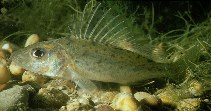
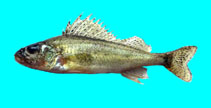
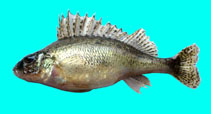
Rückenflossenstacheln (insgesamt) : 11 - 19; Rückenflossenweichstrahlen (insgesamt) : 11 - 16; Afterflossenstacheln: 2; Afterflossenweichstrahlen: 5 - 6; Wirbelzahl: 35 - 36. Distinguished uniquely from its congeners by its body depth 24-27% SL. Differs further from other members of the genus by the combination of having a flank yellowish with numerous, small, irregular, dark blotches and having 11-16 dorsal spines (Ref. 59043). Caudal fin with 16 to 17 rays (Ref. 40476). Dorsal fins are fused. Color brownish with dark spots (Ref. 35388). Body shape (shape guide): fusiform / normal.
Inhabits eutrophic lakes, lowland and piedmont rivers. Most abundant in estuaries
of large rivers, brackish lakes with salinities up to 10-12 ppt and reservoirs. In general, its abundance increases with increased eutrophication (Ref. 59043). Reported to prefer still or slow-flowing water with soft bottom and without vegetation (Ref. 59043) and deep water with deposits of sand and gravel (Ref. 9696). Can tolerate some degradation of the environment (Ref. 30578). Can co-exist in deep lakes with Perca fluviatilis. Both species partly occur at different depths with Gymnocephalus cernua being more abundant in deeper layers (Ref. 59043). The membranous external walls of the head canals of this species provide high directional sensitivity; can feed at night in the dark using the lateral line system; feeds on zooplankton, chironomids, oligochaetes and amphipods (Ref. 10999). Pelagic in coastal lakes and tidal estuaries, preying on zooplankton and fish. Spawns on a variety of substrates at depths of about 3 m or less (Ref. 59043). White to yellow eggs in sticky strands are found on rocks and weed in shallow water (Ref. 41678). Used as bait for pike (Ref. 6258). Females live up to 10 year while males up to 7 years (Ref. 59043).
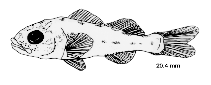
Eggs turn adhesive on contact with water and stick to stones or plants. Females lay eggs in two or more portions, usually separated by about 30 days in summer. First portion of eggs is larger the second portion. Larvae without or with only a brief, pelagic larval stage, switching early to benthic life, secretive and solitary, not forming schools. Larval survival is poor below 10°C and above 20°C (Ref. 59043).