



Envoyez vos Photos et vidéos
Images | vidéos | Timbres, pièces de monnaie, divers | Images Google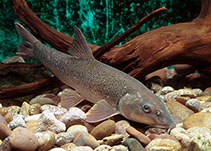 Barbus barbus
Photo de Muséum-Aquarium de Nancy/D. Terver
Images | vidéos | Timbres, pièces de monnaie, divers | Images Google
Photo de Muséum-Aquarium de Nancy/D. Terver
Classification / Noms Noms communs | Synonymes | Catalog of Fishes(Genre, Espèce) | ITIS | CoL | WoRMS | Cloffa
> Cypriniformes (Carps) > Cyprinidae (Minnows or carps) > Barbinae
Etymology: Barbus: Latin, barbus = barbel (Ref. 45335).
Eponymy: Sir Charles Alfred Payton (1843–1926) was a British adventurer, writer, fisherman and diplomat who was British Consul to Morocco, where this barb is found. [...] (Ref. 128868), visit book page.
More on author: Linnaeus.
Etymology: Barbus: Latin, barbus = barbel (Ref. 45335).
Eponymy: Sir Charles Alfred Payton (1843–1926) was a British adventurer, writer, fisherman and diplomat who was British Consul to Morocco, where this barb is found. [...] (Ref. 128868), visit book page.
More on author: Linnaeus.
Environnement : milieu / zone climatique / profondeur / gamme de distribution Écologie
; eau douce benthopélagique; potamodrome (Ref. 51243); profondeur 10 - ? m. Temperate; 10°C - 24°C (Ref. 2060); 57°N - 42°N, 5°W - 36°E
Distribution Territoires | Zones FAO | Écosystèmes | Occurrences | Carte par point | Introductions | Faunafri
Europe: North of the Pyrénées and Alps, from Adour (France) eastward to Neman (Lithuania, Russia) drainages, in rivers draining to Atlantic, North sea and southern Baltic Sea; Danube to Dniepr drainages in northern Black Sea basin; southeastern England north to Yorkshire. Found almost throughout Mediterranean drainages of France. Locally introduced in northern and central Italy, rivers Wear, Tees and Medway and most western drainages of England.
Taille / Poids / Âge
Maturité: Lm ? range ? - ? cm
Max length : 120 cm TL mâle / non sexé; (Ref. 31730); common length : 30.0 cm TL mâle / non sexé; (Ref. 556); poids max. publié: 12.0 kg (Ref. 31730); âge max. reporté: 15 années (Ref. 59043)
Max length : 120 cm TL mâle / non sexé; (Ref. 31730); common length : 30.0 cm TL mâle / non sexé; (Ref. 556); poids max. publié: 12.0 kg (Ref. 31730); âge max. reporté: 15 années (Ref. 59043)
Description synthétique Clés d'identification | Morphologie | Morphométrie
Épines dorsales (Total) : 3 - 4; Rayons mous dorsaux (Total) : 7 - 9; Épines anales: 2 - 3; Rayons mous anaux: 5 - 6; Vertèbres: 46 - 47. Diagnosed from its congeners in France, Great Britain, Black, North, Baltic and Adriatic Sea basins and Apennine Peninsula by having the following characters: lower lip thick with a median swollen pad; tip of dorsal pointed; posterior margin of dorsal concave; last simple dorsal ray spinous, serrated along entire posterior edge; flexible segmented part of last simple dorsal ray about 20-24% of its length; fine dark spots (or no spots) in individuals larger than 10 cm SL; 53-63 total scales on lateral line; 12-14 scale rows between dorsal origin and lateral line; pelvic origin about below dorsal origin; scales with free posterior part pointed; scales on back with 1-5 well developed median longitudinal epithelial crests (Ref. 59043). Caudal fin with 19-20 rays (Ref. 2196).
Body shape (shape guide): fusiform / normal.
Body shape (shape guide): fusiform / normal.
Inhabits from premontane to lowland reaches of clear, warm, medium sized to large rivers with fast current and gravel bottom. Occasionally found in lakes. Frequently overwinters in large group, inactive or active in slow-flowing river habitats. Adults often form shoal, hiding under overhanging trees or bridges during the day. Adults are encountered most active during dusk and dawn while larvae and juveniles are active during both day and night. Larvae and juvenile stay on the bottom in very shallow shoreline habitats and leave the shores for faster-flowing waters as they grow (Ref. 59043). Lives in the deeper, faster-flowing upper reaches of rivers with stony or gravel bottom (barbel zones). Feeds chiefly on benthic invertebrates, such as small crustaceans, insect larvae, mollusks, mayfly and midge larvae (Ref. 6258) and also on small fish and sometimes algae (Ref. 59043). Spawns usually in very shallow, fast-flowing riffles (Ref. 59043). Spawning occurs from May to July after the fish have migrated upriver (Ref. 556). Eggs are poisonous (Refs. 4537, 6258). Locally threatened due to water pollution and river regulation, especially in Baltic drainages, Elbe, South Bug and Dniepr, and heavily impacted by pollution in central Europe but recovering. Population has declined sharply due to construction of large reservoirs and pollution during 20th century and has stabilized at a moderate level since then (Ref. 59043).
Cycle de vie et comportement reproducteur Maturité | Reproduction | Frai | Œufs | Fécondité | Larves
"Individual females spawn with several males. Males assemble at spawning grounds and follow ripe females, often with much splashing, to shallow riffles. Males may exhibit courting or sneaking tactics in spawning site. Courting males follow females to spawning site and, during the spawning act, one male swims head to head with the female. Sneaking males, waiting in the spawning site, then join the couple and try to fertilize eggs. Up to 130 males have been reported to be involved in a single spawning act. Females deposit non-sticky eggs in 2-3 portions into excavations made in the gravel" (Ref. 59043).
Référence principale
Téléchargez vos références | Références | Coordinateur | Collaborateurs
Bianco, P.G., 1998. Diversity of Barbinae fishes in southern Europe with description of a new genus and a new species (Cyprinidae). Ital. J. Zool. 65:125-136. (Ref. 31730)
Statut dans la liste rouge de l'IUCN (Ref. 130435: Version 2025-2 (Global))
Préoccupation mineure (LC) ; Date assessed: 12 November 2022
CITES
Not Evaluated
Menace pour l'homme
Other (Ref. 4537)
Utilisations par l'homme
Pêcheries: intérêt commercial mineur; Aquaculture: probable utilisation future; pêche sportive: oui; Aquarium: Commercial
FAO - Systèmes d'aquaculture: production; pêcheries: débarquements; Publication: search | FishSource |
Plus d'informations
Écologie trophique
Aliments (proies)
Composition du régime alimentaire
Consommation alimentaire
Rations alimentaires
Prédateurs
Aliments (proies)
Composition du régime alimentaire
Consommation alimentaire
Rations alimentaires
Prédateurs
Dynamique des populations
Paramètres de croissance
Âges / tailles maximales
Longueur-poids rel.
Rel. longueur-longueur.
Fréquences de longueurs
Conversion de masse
Recrutement
Abondance
Paramètres de croissance
Âges / tailles maximales
Longueur-poids rel.
Rel. longueur-longueur.
Fréquences de longueurs
Conversion de masse
Recrutement
Abondance
Anatomie
Surface branchiale
Cerveau
Otolithe
Surface branchiale
Cerveau
Otolithe
Physiologie
Composition corporelle
Nutriments
Consommation d'oxygène
Type de natation
Vitesse de nage
Pigments visuels
Son de poisson
Maladies et parasites
Toxicité (CL50)
Composition corporelle
Nutriments
Consommation d'oxygène
Type de natation
Vitesse de nage
Pigments visuels
Son de poisson
Maladies et parasites
Toxicité (CL50)
Liées à l'homme
Systèmes d'aquaculture
Profils d'aquaculture
Souches
Cas de ciguatera
Timbres, pièces de monnaie, divers
Systèmes d'aquaculture
Profils d'aquaculture
Souches
Cas de ciguatera
Timbres, pièces de monnaie, divers
Outils
Quiz bio | E-book | Guide de terrain | Clés d'identification | Générateur de fréquences de longueur | Outil de dynamique de population | Carte par point |
Capture-MSY |
Articles particuliers
Télécharger en XML
Sources Internet
AFORO (otoliths) | Alien/Invasive Species database | Aquatic Commons | BHL | Cloffa | Websites from users | FishWatcher | CISTI | Catalog of Fishes: Genre, Espèce | DiscoverLife | DORIS | ECOTOX | FAO - Systèmes d'aquaculture: production; pêcheries: débarquements; Publication: search | Faunafri | Fishipedia | Fishtrace | GloBI | Google Books | Google Scholar | Google | IGFA World Record | Bases de données nationales | OneZoom | Open Tree of Life | Otolith Atlas of Taiwan Fishes | Aquariums publics | PubMed | Reef Life Survey | Socotra Atlas | TreeBase | Arbre de Vie | Wikipedia: aller à, chercher | World Records Freshwater Fishing | Zoological Record
Estimations basées sur des modèles
Indice de diversité phylogénétique (Réf. 82804): PD50 = 0.5000 [Uniqueness, from 0.5 = low to 2.0 = high].
Bayesian length-weight: a=0.00912 (0.00677 - 0.01229), b=2.98 (2.94 - 3.02), in cm total length, based on LWR estimates for this species (Ref. 93245).
Niveau trophique (Réf. 69278): 3.1 ±0.39 se; based on food items.
Résilience (Réf. 120179): Faible, temps minimum de doublement de population : 4,5 à 14 années (tm=3-5).
Nutriments (Ref. 124155): Calcium = 23.2 [13.3, 39.6] mg/100g; Iron = 0.391 [0.246, 0.620] mg/100g; Protein = 17.7 [16.8, 18.6] %; Omega3 = 0.972 [0.401, 2.502] g/100g; Selenium = 20.4 [7.7, 54.2] μg/100g; VitaminA = 33.1 [10.4, 106.8] μg/100g; Zinc = 0.811 [0.568, 1.154] mg/100g (wet weight);