



Epinephelus tauvina (Fabricius, 1775)
Greasy grouper
Ajouter votre observation dans Fish Watcher
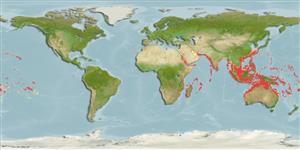
| Native range | All suitable habitat | Point map | Year 2050 |
|
| This map was computer-generated and has not yet been reviewed. |
| Epinephelus tauvina AquaMaps Data sources: GBIF OBIS |
Envoyez vos Photos et vidéos
Images | vidéos | Timbres, pièces de monnaie, divers | Images Google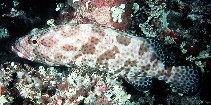 Epinephelus tauvina
Photo de Randall, J.E.
Images | vidéos | Timbres, pièces de monnaie, divers | Images Google
Photo de Randall, J.E.
Classification / Noms Noms communs | Synonymes | Catalog of Fishes(Genre, Espèce) | ITIS | CoL | WoRMS | Cloffa
> Perciformes/Serranoidei (Groupers) > Epinephelidae (Groupers)
Etymology: Epinephelus: Greek, epinephelos = cloudy (Ref. 45335).
Etymology: Epinephelus: Greek, epinephelos = cloudy (Ref. 45335).
Environnement : milieu / zone climatique / profondeur / gamme de distribution Écologie
marin récifal; océanodrome (Ref. 51243); profondeur 1 - 300 m (Ref. 28016). Subtropical; 30°N - 32°S, 29°E - 123°W (Ref. 5222)
Distribution Territoires | Zones FAO | Écosystèmes | Occurrences | Carte par point | Introductions | Faunafri
Indo-Pacific: Red Sea to South Africa and eastward to Ducie in the Pitcairn Group, north to Japan, south to New South Wales and Lord Howe Island. Migration report from the eastern Mediterranean Sea (Ref. 6489, 5385) may be based on Epinephelus coioides specimens.
Longueur à la première maturité / Taille / Poids / Âge
Maturité: Lm 61.1, range 61 - ? cm
Max length : 100.0 cm TL mâle / non sexé; (Ref. 89972); common length : 90.0 cm TL mâle / non sexé; (Ref. 5450)
Max length : 100.0 cm TL mâle / non sexé; (Ref. 89972); common length : 90.0 cm TL mâle / non sexé; (Ref. 5450)
Description synthétique Clés d'identification | Morphologie | Morphométrie
Épines dorsales (Total) : 11; Rayons mous dorsaux (Total) : 13 - 16; Épines anales: 3; Rayons mous anaux: 8. Color of head and body pale greenish grey or brown with round dark spots that vary from dull orange-red to dark brown, centers darker than the edges. A large black blotch (or group of black spots) often visible on body at the base of last 4 dorsal-fin spines. Five sub vertical dark bars may be present on body. Dark spots on soft dorsal, caudal and anal fins of juveniles are so close that the pale interspaces form a white reticulum. 95-112 scales in longitudinal series. Scales on body ctenoid in juveniles, becoming cycloid in adults except the area beneath and posterior to pectoral fins. Pyloric caeca 16-18. Further characterized by: elongate body, depth contained 3.0-3.6 times in SL; large head, length is 2.1-2.4 times in SL; snout length 2.0-2.4 times in upper-jaw length; interorbital area narrow, flat to slightly concave, interorbital width 6.8-8.1 times in HL and 3.1-4.0 times in upper jaw length; broadly rounded preopercle, serrae at angle of preopercle slightly enlarged; upper edge of operculum almost straight; posterior nostrils distinctly larger than anterior nostrils; maxilla reaching well past eye, greatest width about twice suborbital depth, maxilla width 6.8-8.1% of standard length; upper-jaw length 21-24% of SL; 2-5 rows of teeth on midlateral part of lower jaw; inner teeth at symphysis of upper jaw are longer than the fixed canines at front of jaw (Ref. 89707). Differs from E. howlandi by its more elongate body and closer-set spots (Ref. 37816).
Body shape (shape guide): fusiform / normal; Cross section: compressed.
Body shape (shape guide): fusiform / normal; Cross section: compressed.
Adults prefer clear water areas on coral reefs; juveniles have been taken from reef flats and in tide pools, adults found in deeper waters. Solitary and common in lightly fished areas (Ref. 37816). Adults from Oceania almost exclusively feed on fishes (holocentrids, mullid, and pomacentrid); and occasionally, crustaceans (Ref. 89707). Present in the Hong Kong live fish markets (Ref. 27253). Minimum depth reported taken from Ref. 30874. Occasionally ciguatoxic (Ref. 37816). Reports of sizes in excess of 80 cm total length for E. tauvina are probably based on misidentifications of E. coioides, E. malabaricus, and E. lanceolatus; these species grow much bigger than E. tauvina (Ref. 5222, Heemstra pers. comm. 09/04).
.
Cycle de vie et comportement reproducteur Maturité | Reproduction | Frai | Œufs | Fécondité | Larves
Référence principale
Téléchargez vos références | Références | Coordinateur | Collaborateurs
Heemstra, P.C. and J.E. Randall, 1993. FAO Species Catalogue. Vol. 16. Groupers of the world (family Serranidae, subfamily Epinephelinae). An annotated and illustrated catalogue of the grouper, rockcod, hind, coral grouper and lyretail species known to date. Rome: FAO. FAO Fish. Synop. 125(16):382 p. (Ref. 5222)
Statut dans la liste rouge de l'IUCN (Ref. 130435: Version 2025-2 (Global))
Données manquantes (DD) ; Date assessed: 21 November 2016
CITES
Not Evaluated
Menace pour l'homme
Reports of ciguatera poisoning (Ref. 9710)
Utilisations par l'homme
Pêcheries: intérêt commercial mineur; Aquaculture: commercial; pêche sportive: oui
FAO - Systèmes d'aquaculture: production; pêcheries: débarquements; Publication: search | FishSource | Sea Around Us
Plus d'informations
Écologie trophique
Aliments (proies)
Composition du régime alimentaire
Consommation alimentaire
Rations alimentaires
Prédateurs
Aliments (proies)
Composition du régime alimentaire
Consommation alimentaire
Rations alimentaires
Prédateurs
Dynamique des populations
Paramètres de croissance
Âges / tailles maximales
Longueur-poids rel.
Rel. longueur-longueur.
Fréquences de longueurs
Conversion de masse
Recrutement
Abondance
Paramètres de croissance
Âges / tailles maximales
Longueur-poids rel.
Rel. longueur-longueur.
Fréquences de longueurs
Conversion de masse
Recrutement
Abondance
Physiologie
Composition corporelle
Nutriments
Consommation d'oxygène
Type de natation
Vitesse de nage
Pigments visuels
Son de poisson
Maladies et parasites
Toxicité (CL50)
Composition corporelle
Nutriments
Consommation d'oxygène
Type de natation
Vitesse de nage
Pigments visuels
Son de poisson
Maladies et parasites
Toxicité (CL50)
Liées à l'homme
Systèmes d'aquaculture
Profils d'aquaculture
Souches
Cas de ciguatera
Timbres, pièces de monnaie, divers
Systèmes d'aquaculture
Profils d'aquaculture
Souches
Cas de ciguatera
Timbres, pièces de monnaie, divers
Outils
Quiz bio | E-book | Guide de terrain | Clés d'identification | Générateur de fréquences de longueur | Outil de dynamique de population | Carte par point |
Capture-MSY |
Articles particuliers
Télécharger en XML
Sources Internet
AFORO (otoliths) | Alien/Invasive Species database | Aquatic Commons | BHL | Cloffa | Websites from users | FishWatcher | CISTI | Catalog of Fishes: Genre, Espèce | DiscoverLife | DORIS | ECOTOX | FAO - Systèmes d'aquaculture: production; pêcheries: débarquements; Publication: search | Faunafri | Fishipedia | Fishtrace | GloBI | Google Books | Google Scholar | Google | IGFA World Record | Bases de données nationales | OneZoom | Open Tree of Life | Otolith Atlas of Taiwan Fishes | PubMed | Reef Life Survey | Socotra Atlas | TreeBase | Arbre de Vie | Wikipedia: aller à, chercher | World Records Freshwater Fishing | Zoological Record
Estimations basées sur des modèles
Température préférée (Réf. 123201): 19.6 - 28.2, mean 26.2 °C (based on 1115 cells).
Indice de diversité phylogénétique (Réf. 82804): PD50 = 0.5000 [Uniqueness, from 0.5 = low to 2.0 = high].
Bayesian length-weight: a=0.01175 (0.01020 - 0.01353), b=3.04 (3.02 - 3.06), in cm total length, based on LWR estimates for this species (Ref. 93245).
Niveau trophique (Réf. 69278): 4.1 ±0.68 se; based on food items.
Résilience (Réf. 120179): Faible, temps minimum de doublement de population : 4,5 à 14 années (K=0.1-0.17; tm=5-6; Fec = 354,989).
Nutriments (Ref. 124155): Calcium = 11.8 [4.7, 25.6] mg/100g; Iron = 0.477 [0.234, 1.002] mg/100g; Protein = 19.2 [17.5, 20.7] %; Omega3 = 0.195 [0.108, 0.367] g/100g; Selenium = 25.5 [12.4, 56.4] μg/100g; VitaminA = 117 [27, 467] μg/100g; Zinc = 0.625 [0.409, 0.950] mg/100g (wet weight); based on nutrient studies.