This website uses cookies to enhance your browsing experience and ensure the functionality of our site. For more detailed information about the types of cookies we use and how we protect your privacy, please visit our Privacy Information page.
×
Cookie Settings
This website uses different types of cookies to enhance your experience. Please select your preferences below:
Pagrus major, Red seabream : fisheries, aquaculture, gamefish, aquarium
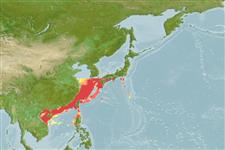
Northwest Pacific: northeastern part of South China Sea (Philippines excluded) northward to Japan.
Länge bei der ersten Reifung / Größe / Gewicht / Alter
Geschlechtsreife: Lm34.3 range ? - ? cm Max length : 100.0 cm SL Männchen/unbestimmt; (Ref. 559); common length : 30.0 cm TL Männchen/unbestimmt; (Ref. 2115); max. veröff. Gewicht: 9.7 kg (Ref. 40637); max. veröff. Alter: 26 Jahre (Ref. 56606)
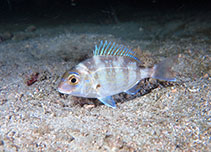
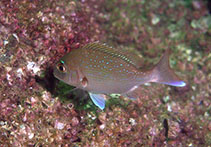
Rückenflossenstacheln (insgesamt) : 12; Rückenflossenweichstrahlen (insgesamt) : 10; Afterflossenstacheln: 3; Afterflossenweichstrahlen: 8. Body with many bluish dots when fresh. Shallow body, body depth 2 or more in SL. Transverse scales 6.5-7.5. All spines of dorsal fin tough and not elongated. Posterior margin of caudal fin black, lower margin white (Ref. 42199). Body shape (shape guide): fusiform / normal; Cross section: oval.
Occurs from 10 to 50 m depths, often on rough grounds, but also on softer bottoms. Also inhabits reefs (Ref. 9988). Adults migrate into shallower parts of their depth range to spawn in late spring and summer; juveniles occur mainly in the shallower areas. It is a popular food fish throughout its range. It is high-priced in Japan and used in various occasions such as wedding and festival. Feeds on benthic invertebrates, including echinoderms, worms, mollusks and crustaceans; also on fishes. Marketed live, fresh and frozen; eaten steamed, pan-fried, broiled, boiled and baked (Ref. 9988). Cultivated in cages (Ref. 9988). Used in Chinese medicine (Ref. 12166).
Conflicting descriptions of the reproductive style of this species have been reported, e.g., Ref. 34228 describe this species as being a gonochorist (Ref. 28504). After clarificatory analyses on the protogynous characteristics of this species, gonochorism is confirmed (Ref. 103751).
Eggleston, D., 1974. Sparidae. In W. Fischer and P.J.P. Whitehead (eds.) FAO species identification sheets for fishery purposes. Eastern Indian Ocean (Fishing Area 57) and Western Central Pacific (Fishing Area 71), Volume 4. FAO, Rome. (Ref. 2115)
IUCN Rote Liste Status (Ref. 130435: Version 2025-2 (Global))