Environment: milieu / climate zone / Tiefenbereich / distribution range
Ökologie
seewasser demersal; tiefenbereich 50 - 400 m (Ref. 11230). Tropical
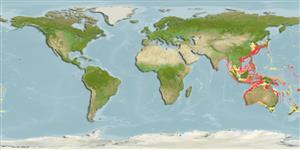
Indo-West Pacific: from the southeastern Indian Ocean, including the west coast of Australia and Indonesia to northwestern Pacific, ranging from the South China Sea north to Japan.
Size / Gewicht / Alter
Geschlechtsreife: Lm ? range ? - ? cm
Max length : 20.0 cm SL Männchen/unbestimmt; (Ref. 559)
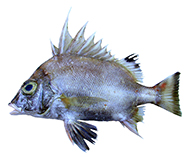
This species is distinguished from its congeners by the following set of characters: 0-22 serrae on ventral margin of lacrimal; in specimens 15.0-20.0 cm SL, 14-36 serrae on cleithrum; in specimens >10.0 cm SL, head length 33.2-39.6 (mean 36.5) % of SL, orbit diameter 11.2-16.6 (14.1) % of SL, vertical orbit diameter 9.5-14.9 (13.5) % of SL; least interorbital width 5.8-10.3 (mean 7.3) % of SL; postorbital length 11.5-15.7 (mean 13.3) % of SL; in specimens > 10.0 cm SL pre-pelvic-fin length 38.0-44.7 (mean 41.5) % of SL; first dorsal-fin spine length 4.5-11.7 (6.7) % of SL; second dorsal-fin spine length 11.2-22.7 (16.1) % of SL; in juveniles <7.0 cm SL, spine at angle of preopercle relatively short, moderately serrated and membrane of spinous dorsal-fin with broad central translucent area (Ref. 116322).
Body shape (shape guide): short and / or deep; Cross section: compressed.
Life cycle and mating behavior
Geschlechtsreife | Fortpflanzung | Ablaichen | Eier | Fecundity | Larven
Paxton, J.R., D.F. Hoese, G.R. Allen and J.E. Hanley, 1989. Pisces. Petromyzontidae to Carangidae. Zoological Catalogue of Australia, Vol. 7. Australian Government Publishing Service, Canberra, 665 p. (Ref. 7300)
IUCN Rote Liste Status (Ref. 130435: Version 2025-1)
Bedrohung für Menschen
Harmless
Nutzung durch Menschen
Fischereien: weniger kommerziell
Tools
Zusatzinformationen
Download XML
Internet Quellen
Estimates based on models
Preferred temperature (Ref.
123201): 13.6 - 26.5, mean 19.7 °C (based on 395 cells).
Phylogenetic diversity index (Ref.
82804): PD
50 = 0.7500 [Uniqueness, from 0.5 = low to 2.0 = high].
Bayesian length-weight: a=0.01995 (0.00906 - 0.04395), b=3.01 (2.83 - 3.19), in cm total length, based on all LWR estimates for this body shape (Ref.
93245).
Trophic level (Ref.
69278): 4.0 ±0.67 se; based on food items.
Fishing Vulnerability (Ref.
59153): Low vulnerability (14 of 100).
🛈