



Eumicrotremus derjugini Popov, 1926
Leatherfin lumpsucker
Добавить Ваши наблюдения в Fish Watcher
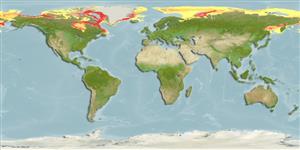
| Native range | All suitable habitat | Point map | Year 2050 |
|
| This map was computer-generated and has not yet been reviewed. |
| Eumicrotremus derjugini AquaMaps Data sources: GBIF OBIS |
Загрузить свой Фото и Видео
изображения | Изображение на Google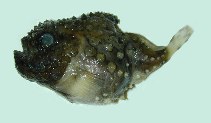 Eumicrotremus derjugini
Изображение сделано Byrkjedal, I.
изображения | Изображение на Google
Изображение сделано Byrkjedal, I.
Классификация / Имена народные названия | синонимы | Catalog of Fishes(род, виды) | ITIS | CoL | WoRMS | Cloffa
> Perciformes/Cottoidei (Sculpins) > Cyclopteridae (Lumpfishes) > Eumicrotreminae
Etymology: Eumicrotremus: Greek, eu = good + Greek, mikros = little, small + Greek, trema = hole (Ref. 45335).
Eponymy: Professor Dr Konstantin Michailovich Derjugin (1878–1938) was an oceanographer and marine zoologist at Leningrad State University, and manager of the Oceanic Division of the State Hydrological Institute in Leningrad. [...] (Ref. 128868), visit book page.
Etymology: Eumicrotremus: Greek, eu = good + Greek, mikros = little, small + Greek, trema = hole (Ref. 45335).
Eponymy: Professor Dr Konstantin Michailovich Derjugin (1878–1938) was an oceanographer and marine zoologist at Leningrad State University, and manager of the Oceanic Division of the State Hydrological Institute in Leningrad. [...] (Ref. 128868), visit book page.
Окружающая среда: среда / климатическая зона / пределы глубины / диапазон распространения экология
морской демерсальный; пределы глубины 5 - 1038 m (Ref. 117245), usually 5 - 575 m (Ref. 123372). Polar; 84°N - 50°N, 180°W - 180°E (Ref. 117245)
распространение Территории | регионы FAO | Экосистемы | места находок | карта точек | интродукции | Faunafri
Arctic Ocean: Barents-Laptev Sea and the Beaufort Sea-Greenland.
Barents Sea (except southwestern part while in the northern areas, it can be found up to Spitsbergen and Franz Josef Land); Kara Sea (reaches 80°32N); Laptev Sea (eastwards to 77°46N 131°52E; Beaufort Sea (waters of the Canadian Arctic
Arch., in the Hudson Bay and Baffin Bay off the shores of the Baffin Island); eastern
Greenland (northwards to the Danish Harbor). The southern boundary of the range in
the North-West Atlantic is 60°N.
Размер / Вес / Возраст
Краткое описание определительные ключи | морфология | морфометрия
колючие лучи спинного плавника (общее число) : 6 - 8; членистые (мягкие) лучи спинного плавника (общее число) : 10 - 13; членистые (мягкие) лучи анального плавника: 10 - 13. This species is distinguished by the following characters: first dorsal fin in the form of dense leathery process, does not bend down to the back, trapezoidal in shape; fish 4.0-8.5 cm TL, usually have seven rows of bony plaques in interorbital region; plaques in periorbital and preopercular rows are numerous; bare space in anus area bounded by semicircle of (6) 7-10 bony plaques; number of plaques on body and head (circumpectoral, postbranchial, supraorbital and postorbital, middle and interorbital rows) on average 32.7; distance from anus to beginning of anal fin on average 22% SL; pectoral fin short, on average 50–51% HL. Colouration: when alive (in Laptev Sea), body almost black, with slightly purple tint; without pronounced spots and stripes; lower side of head is dark, rays of D2, A, and P are dark gray; translucent fin membranes D2 and A are not colored; skin under upper caudal row of plaques light; it is a continuous dark band below it; bases of A and C with light spots; belly silvery; peritoneum (inner surface of abdominal cavity) is not pigmented; lining of oral cavity light, dotted (Ref. 123372).
Body shape (shape guide): short and / or deep; Cross section: circular.
Body shape (shape guide): short and / or deep; Cross section: circular.
Found on mud, gravel or stone bottoms at temperatures below 0° C, with the young occuring in shallower water (Ref. 4701). A benthic species feeding on crustaceans and oikopleura (Ref. 58426). This species usually occurs at depths from 5 to 575 m at high water salinity (34-35 psu), with water temperatures below zero (down to -2.0°С). Recorded in Baffin Bay, down to 1038 m, and the Canadian Arctic at water temperature up to +4.93°C; Barents–Laptev Sea region, usually at the depths from 6 to 280 m, at low (from -1.9° to +1.8°C) mostly negative water temperatures and high salinity (34.03-35.25 psu), often on silt or clay sediments. In the Olenek and Lena rivers' shoals, it is found in the waters with a reduced oxygen content (86-88%), on brown-black sediments, often with a pronounced odor of hydrogen sulfide. It has never been found in the pelagic trawls. The reproduction in the Barents–Laptev Sea region probably takes place in the autumn-winter period, since the females with mature eggs (4-5 mm) are caught in the autumn. In July, the female (6.3 cm TL) from the Barents Sea had immature eggs (<1.3 mm) in the ovaries. An individual (8.5 cm TL) caught in October was with large eggs (up to 4 mm). A female (8.2 cm TL) caught on September 1, 1980, southeast of Franz Josef Land (79°46 N, 63°08 E) was with large mature eggs. In the collections from the Laptev Sea performed in September, the diameter of the eggs in mature females (8.5-10.1 cm TL) was up to 3.5-5.0 mm (IV stage of maturity). For the Canadian Arctic, spawning is reported in late summer and autumn (Ref. 123372).
Жизненный цикл и брачное поведение половая зрелость | размножение | нерест | икра | Плодовитость | личинки
Основная ссылка
Загрузите свои рекомендации | ссылки | координатор | соавторы
Chernova, N.V., O.S. Voskoboinikova, O.Yu. Kudryavtseva, S.Yu. Orlova, O.A. Maznikova and A.M. Orlov, 2019. Taxonomic status of the Okhotsk lumpsucker Eumicrotremus ochotonensis (Cyclopteridae, Cottoidei) with redescription of E. derjugini. J. Ichthyol. 59(3):289-306. (Ref. 123372)
CITES
Not Evaluated
Угроза для людей
Harmless
Использование человеком
FAO - Publication: search | FishSource |
дополнительная информация
Трофическая экология
Пищевые предметы (добыча)
состав пищи
потребление пищи
Продовольственные пайки
хищники
Пищевые предметы (добыча)
состав пищи
потребление пищи
Продовольственные пайки
хищники
Динамика численности населения
Параметры роста
Макс. возраст / размер
Отношение длины к весу.
Отношение длины к длине.
Размерный состав
Преобразование массы
пополнение
численность
Параметры роста
Макс. возраст / размер
Отношение длины к весу.
Отношение длины к длине.
Размерный состав
Преобразование массы
пополнение
численность
Жизненный цикл
размножение
половая зрелость
Зрелость/Жиры относительно.
Плодовитость
нерест
Нерестовые скопления
икра
Развитие икры
личинки
динамика численности личинок
размножение
половая зрелость
Зрелость/Жиры относительно.
Плодовитость
нерест
Нерестовые скопления
икра
Развитие икры
личинки
динамика численности личинок
Анатомия
жаберная область
Мозг
Отолит
жаберная область
Мозг
Отолит
Физиология
Состав тела
Питательные вещества
Потребление кислорода
Тип плавания
Скорость плавания
Зрительные пигменты
Звук рыбы
Болезни и паразиты
Токсичность (LC50s)
Состав тела
Питательные вещества
Потребление кислорода
Тип плавания
Скорость плавания
Зрительные пигменты
Звук рыбы
Болезни и паразиты
Токсичность (LC50s)
Связанные с человеком
Системы аквакультуры
особенности рыбоводства
степень растяжения
Случаи заболевания сигуатерой
Марки, монеты и прочее.
Системы аквакультуры
особенности рыбоводства
степень растяжения
Случаи заболевания сигуатерой
Марки, монеты и прочее.
инструменты
Специальные отчеты
Проверить содержание в аквариумах | Проверить опубликованные видовые данные | Проверить опубликованные данные по аквакультуре
Скачать в формате XML
ресурсы в Интернет
AFORO (otoliths) | Aquatic Commons | BHL | Cloffa | Websites from users | Проверить FishWatcher | CISTI | Catalog of Fishes: род, виды | DiscoverLife | ECOTOX | FAO - Publication: search | Faunafri | Fishipedia | Fishtrace | GloBI | Google Books | Google Scholar | Google | IGFA World Record | OneZoom | Open Tree of Life | Otolith Atlas of Taiwan Fishes | PubMed | Reef Life Survey | Socotra Atlas | TreeBase | Tree of Life | Wikipedia: Вперёд, поиск | World Records Freshwater Fishing | Zoobank | Зоологическая летопись
Оценки, основанные на моделях
Предпочтительная температура (ссылка 123201): -1.2 - 2.9, mean 0.2 °C (based on 2662 cells).
Индекс филогенетического разнообразия (ссылка 82804): PD50 = 0.5000 [Uniqueness, from 0.5 = low to 2.0 = high].
Bayesian length-weight: a=0.02089 (0.00764 - 0.05716), b=3.03 (2.80 - 3.26), in cm total length, based on LWR estimates for this (Sub)family-body shape (Ref. 93245).
Трофический уровень (ссылка 69278): 3.3 ±0.34 se; based on food items.
устойчивость к внешним воздействиям (ссылка 120179): средний (среднего размера), минимальное время удвоения популяции 1.4-4.4 года (Fecundity assumed < 1000).