Gobioides broussonnetii, Violet goby : fisheries, bait

You can sponsor this page

Gobioides broussonnetii Lacepède, 1800

Violet goby
Ajouter votre observation dans Fish Watcher
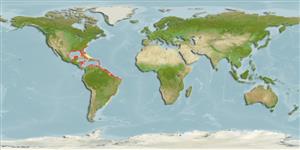
Native range | All suitable habitat | Point map | Year 2050
This map was computer-generated and has not yet been reviewed.
Gobioides broussonnetii   AquaMaps   Data sources: GBIF OBIS
Envoyez vos Photos et vidéos
Images | Images Google
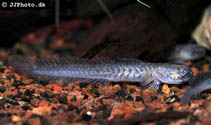
Image of Gobioides broussonnetii (Violet goby)
Gobioides broussonnetii
Photo de JJPhoto

Classification / Names Noms communs | Synonymes | Catalog of Fishes(Genre, Espèce) | ITIS | CoL | WoRMS | Cloffa

> Gobiiformes (Gobies) > Gobiidae (Gobies) > Gobionellinae
Etymology: Gobioides: Latin, gobius = gudgeon + suffix oides = similar to (Ref. 45335).
Eponymy: Dr Pierre Marie Auguste Broussonet (1761–1807) was a physician-naturalist. [...] (Ref. 128868), visit book page.
More on author: Lacepède.

Environment: milieu / climate zone / profondeur / distribution range Écologie

marin; eau douce; saumâtre démersal; amphidrome (Ref. 46888). Tropical; 14°C - 32°C (Ref. 97140)

Distribution Pays | Zones FAO | Écosystèmes | Occurrences | Carte par point | Introductions | Faunafri

Western Atlantic: Charleston, South Carolina southward to Florida, along the Gulf of Mexico coasts of Alabama, Mississippi, Louisiana, and eastern-central Texas; along the Caribbean coast of Colombia, eastward to Venezuela, Surinam, Guyana, French Guiana, and Brazil as far south as Rio Grande do Sul, Brazil.

Taille / Poids / Âge

Maturité: Lm ?  range ? - ? cm
Max length : 55.3 cm TL mâle / non sexé; (Ref. 13628); common length : 25.0 cm TL mâle / non sexé; (Ref. 6077); poids max. publié: 311.00 g (Ref. 13628)

Description synthétique Clés d'identification | Morphologie | Morphométrie

Épines dorsales (Total) : 7; Rayons mous dorsaux (Total) : 15 - 16; Épines anales: 1; Rayons mous anaux: 15 - 16. Scales in longitudinal series about 160 (Ref. 27974). With a continuous dorsal fin, and dorsal and anal fins joined with caudal fin (Ref. 26938).
Body shape (shape guide): eel-like.

Biologie     Glossaire (ex. epibenthic)

Adults prefer muddy bays and estuaries; encountered in fresh water (Ref. 13628), with a salinity range of 0.0 to 25.5 ppt (Ref. 97140). Also found offshore on muddy bottoms, off mouths of large rivers. Largest goby in the Caribbean, and the only one with this distinctive eel-like shape (Ref. 26938).

Life cycle and mating behavior Maturité | Reproduction | Frai | Œufs | Fécondité | Larves

Référence principale Upload your references | Références | Coordinateur | Collaborateurs

Murdy, E.O., 1998. A review of the gobioid fish genus Gobioides. Ichthyol. Res. 45(2):121-133. (Ref. 27974)

Statut dans la liste rouge de l'IUCN (Ref. 130435: Version 2025-1)

  Préoccupation mineure (LC) ; Date assessed: 28 February 2019

CITES

Not Evaluated

CMS (Ref. 116361)

Not Evaluated

Menace pour l'homme

  Harmless


Utilisations par l'homme

Pêcheries: intérêt commercial mineur; appât: occasionally
FAO - Publication: search | FishSource |

Plus d'informations

Écologie trophique
Food items (preys)
Composition du régime alimentaire
Consommation alimentaire
Food rations
Prédateurs
Écologie
Écologie
Home ranges
Population dynamics
Paramètres de croissance
Max. ages / sizes
Length-weight rel.
Length-length rel.
Fréquences de longueurs
Mass conversion
Recrutement
Abondance
Life cycle
Reproduction
Maturité
Maturity/Gills rel.
Fécondité
Frai
Spawning aggregations
Œufs
Développement de l'œuf
Larves
Dynamique des populations larvaires
Distribution
Pays
Zones FAO
Écosystèmes
Occurrences
Introductions
BRUVS - Videos
Anatomy
Surface branchiale
Brain
Otolith
Physiology
Body composition
Nutrients
Consommation d'oxygène
Type de nage
Vitesse de nage
Visual pigments
Fish sound
Diseases & Parasites
Toxicity (LC50s)
Génétique
génôme
Génétique
Heterozygosity
Héritabilité
Human related
Aquaculture systems
Profils d'aquaculture
Souches
Ciguatera cases
Stamps, coins, misc.
Outreach
Collaborateurs
Références
Références

Outils

Articles particuliers

Télécharger en XML

Sources Internet

AFORO (otoliths) | Aquatic Commons | BHL | Cloffa | Websites from users | FishWatcher | CISTI | Catalog of Fishes: Genre, Espèce | DiscoverLife | ECOTOX | FAO - Publication: search | Faunafri | Fishipedia | Fishtrace | GloBI | GoMexSI (interaction data) | Google Books | Google Scholar | Google | IGFA World Record | Bases de données nationales | OneZoom | Open Tree of Life | Otolith Atlas of Taiwan Fishes | Aquariums publics | PubMed | Reef Life Survey | Socotra Atlas | TreeBase | Arbre de Vie | Wikipedia: aller à, chercher | Zoobank | Zoological Record

Estimates based on models

Preferred temperature (Réf. 123201): 23.4 - 28, mean 25.9 °C (based on 452 cells).
Phylogenetic diversity index (Réf. 82804):  PD50 = 0.5312   [Uniqueness, from 0.5 = low to 2.0 = high].
Bayesian length-weight: a=0.00102 (0.00046 - 0.00225), b=3.06 (2.88 - 3.24), in cm total length, based on all LWR estimates for this body shape (Ref. 93245).
Niveau trophique (Réf. 69278):  3.8   ±0.6 se; based on size and trophs of closest relatives
Résilience (Réf. 120179):  Faible, temps minimum de doublement de population : 4,5 à 14 années (Preliminary K or Fecundity.).
Fishing Vulnerability (Ref. 59153):  Moderate vulnerability (42 of 100). 🛈
Catégorie de prix (Ref. 80766):   Very high.