Environment: milieu / climate zone / distribuzione batimetrica / distribution range
Ecologia
marino associati a barriera corallina; distribuzione batimetrica 50 - ? m (Ref. 86997). Tropical; 40°N - 35°S, 99°W - 15°E
Atlantic Ocean: oceanic islands and along the coast of west Africa from Senegal to Angola.
Size / Peso / Age
Maturità: Lm ? range ? - ? cm
Max length : 19.0 cm TL maschio/sesso non determinato; (Ref. 27000)
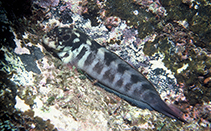
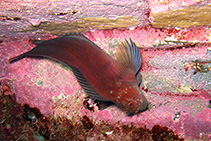
Spine dorsali (totale) : 12 - 13; Raggi dorsali molli (totale) : 21 - 23; Spine anali: 2; Raggi anali molli: 24. Head profile in front of eyes vertical; forehead projects in front of snout. Head, body and anal fin dark reddish brown, sometimes pale pinkish gray; lips and parts of pectoral and tail fins red (Ref. 26938). Larvae have terminal mouths and fang-like teeth for planktonic feeding; adults with comb teeth and ventrally located mouth for benthic feeding. Adult males with fleshy rugosities on anal-fin spines that secrete antimicrobial mucus (Ref. 94105).
Body shape (shape guide): fusiform / normal.
Adults are restricted to shallow waters and dwell among rocks and coral reefs (Ref. 5298), where there is considerable wave action (Ref. 26938). They bite very severely, with their two very long and sharp canine teeth (Ref. 3157). Are grazers feeding on filamentous algae (Ref. 13442) and detritus. Larvae feed on plankton; during larval metamorphosis to adult stage, there is no feeding and rely on lipids stored in the liver (Ref. 94105). Oviparous. Eggs are demersal and adhesive (Ref. 205), and are attached to the substrate via a filamentous, adhesive pad or pedestal (Ref. 94114). Ophioblennius larvae are frequently taken in deep water column (Ref. 5298). Adult males with fleshy rugosities on anal-fin spines that secrete antimicrobial mucus applied to eggs being guarded (Ref. 94102).
Life cycle and mating behavior
Maturità | Riproduzione | Deposizione | Uova | Fecundity | Larve
Oviparous, distinct pairing (Ref. 205).
Bath, H., 1990. Blenniidae. p. 905-915. In J.C. Quero, J.C. Hureau, C. Karrer, A. Post and L. Saldanha (eds.) Check-list of the fishes of the eastern tropical Atlantic (CLOFETA). JNICT, Lisbon; SEI, Paris; and UNESCO, Paris. Vol. 2. (Ref. 5298)
IUCN Red List Status (Ref. 130435: Version 2025-1)
Threat to humans
Traumatogenic (Ref. 3157)
Human uses
Pesca: di nessun interesse; Acquario: Commerciale
Strumenti
Special reports
Download XML
Fonti Internet
Estimates based on models
Phylogenetic diversity index (Fonte Biblio.
82804): PD
50 = 0.5312 [Uniqueness, from 0.5 = low to 2.0 = high].
Bayesian length-weight: a=0.01047 (0.00461 - 0.02381), b=2.98 (2.79 - 3.17), in cm total length, based on LWR estimates for this (Sub)family-body shape (Ref.
93245).
Trophic level (Fonte Biblio.
69278): 2.0 ±0.0 se; based on diet studies.
Resilienza (Fonte Biblio.
120179): Medio, tempo minimo di raddoppiamento della popolazione 1.4 - 4.4 anni (Preliminary K or Fecundity.).
Fishing Vulnerability (Ref.
59153): Low vulnerability (10 of 100).
🛈
Nutrients (Ref.
124155): Calcium = 85.2 [45.3, 132.6] mg/100g; Iron = 0.738 [0.452, 1.163] mg/100g; Protein = 18.4 [17.3, 19.5] %; Omega3 = 0.126 [0.081, 0.199] g/100g; Selenium = 27.4 [16.0, 51.2] μg/100g; VitaminA = 93.1 [27.5, 311.3] μg/100g; Zinc = 2.03 [1.42, 2.81] mg/100g (wet weight);