>
Ovalentaria/misc (Various families in series Ovalentaria) >
Pomacentridae (Damselfishes) > Chrominae
Etymology: Azurina: Latin, azurinus = blue, pale blue; the name of Leuciscus caeruleus, blue Roach; 1600 (Ref. 45335).
More on author: Poey.
Environment: milieu / Zona climática / intervalo de profundidade / distribution range
Ecologia
marinhas associadas(os) a recifes; não migratória; intervalo de profundidade 3 - 60 m (Ref. 9626), usually 10 - 20 m (Ref. 9626). Tropical; 34°N - 7°N, 100°W - 58°W
Western Atlantic: Bermuda, southern Florida (USA), and the Caribbean Sea. Including the Bahamas, Gulf of Mexico and Antilles (Ref. 26938).
Tamanho / Peso / Idade
Maturidade: Lm ? range ? - ? cm
Max length : 15.0 cm TL macho/indeterminado; (Ref. 27000)
Descrição suscinta
Chaves de identificação | Morfologia | Morfometria
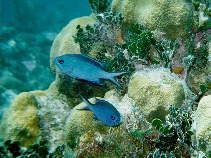
Espinhos dorsais (total) : 12; Raios dorsais (total) : 12; Espinhos anais: 2; Raios anais : 12. Body bright blue, scarcely paler below, with black stripe (Ref. 26938). Black margin on spinous dorsal fin, upper and lower lobes of caudal fin and front of anal fin; no black spot at pectoral base (Ref. 13442).
Body shape (shape guide): fusiform / normal; Cross section: oval.
Adults are common above deep outer reefs and feeds in aggregations of the small zooplankton, primarily copepods (Ref. 13442). Often with creole wrasse. They retreat into coral crevices when frightened (Ref. 9710). Oviparous, distinct pairing during breeding (Ref. 205). Eggs are demersal and adhere to the substrate (Ref. 205). Males guard and aerate the eggs (Ref. 205).
Ciclo de vida ou comportamento de acasalamento
Maturidade | Reprodução | Desova | Ovos | Fecundidade | Larvas
Oviparous, distinct pairing during breeding (Ref. 205). Eggs are demersal and adhere to the substrate (Ref. 205). Males guard and aerate the eggs (Ref. 205).
Allen, G.R., 1991. Damselfishes of the world. Mergus Publishers, Melle, Germany. 271 p. (Ref. 7247)
Status na Lista Vermelha da UICN (Ref. 130435: Version 2025-1)
Ameaça para os humanos
Harmless
Uso pelos humanos
Pescarias: espécies comerciais; Aquário: Espécies comerciais
Ferramentas
Relatórios especiais
Baixar XML
Fontes da internet
Estimates based on models
Preferred temperature (Ref.
123201): 25.6 - 28.1, mean 27 °C (based on 80 cells).
Índice de diversidade filogenética (Ref.
82804): PD
50 = 0.5010 [Uniqueness, from 0.5 = low to 2.0 = high].
Bayesian length-weight: a=0.01259 (0.00571 - 0.02773), b=3.03 (2.84 - 3.22), in cm total length, based on LWR estimates for this (Sub)family-body shape (Ref.
93245).
Nível Trófico (Ref.
69278): 3.7 ±0.36 se; based on food items.
Resiliência (Ref.
120179): Elevada, tempo mínimo de duplicação da população menor que 15 meses (Preliminary K or Fecundity.).
Fishing Vulnerability (Ref.
59153): Low vulnerability (10 of 100).
🛈
Nutrients (Ref.
124155): Calcium = 81.4 [50.7, 134.7] mg/100g; Iron = 0.772 [0.498, 1.182] mg/100g; Protein = 18.8 [17.8, 19.8] %; Omega3 = 0.167 [0.107, 0.258] g/100g; Selenium = 24.9 [14.6, 45.3] μg/100g; VitaminA = 217 [83, 551] μg/100g; Zinc = 1.4 [1.0, 1.9] mg/100g (wet weight);