Environment: milieu / climate zone / ระดับความลึก / distribution range
นิเวศวิทยา
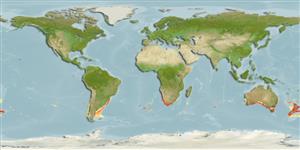
เกี่ยวกับทะเล,น้ำเค็ม สัตว์น้ำหน้าดิน; ระดับความลึก 50 - 854 m (Ref. 52581). Subtropical; 28°S - 50°S, 180°W - 180°E
Circumglobal in southern waters: (Ref. 7300): South Africa, Australia, New Zealand, Kermadec I., Desventuradas Is., Juan Fernandez Is., Chile, north to southern Brazil, Tristan da Cunha.
Length at first maturity / ขนาด / น้ำหนัก / Age
วัยเจริญพันธุ์: Lm 88.0 range ? - ? cm
Max length : 160 cm TL เพศผู้/กระเทย; (Ref. 89467); common length : 100.0 cm TL เพศผู้/กระเทย; (Ref. 9258); น้ำหนักสูงสุดที่มีการรายงาน: 100.0 kg (Ref. 4537); อายุสูงสุดที่ได้รายงาน: 60 ปี (Ref. 41439)
Short description
เครื่องมือที่ใช้ในการแยกชนิดสัตว์,สิ่งมีชีวิตออกจากกัน | สัณฐานวิทยา | ความยาวต่างๆ
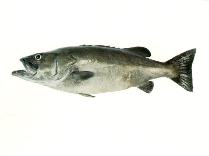
เงี่ยงครีบหลัง (รวม) : 9 - 12; ก้านครีบอ่อนที่หาง (รวม) : 12; เงี่ยงครีบก้น: 3; ก้านครีบอ่อนที่ก้น: 7 - 9.
Body shape (shape guide): fusiform / normal.
A deepwater species, occurs in seamounts (Ref. 89357). Adults occur generally over rough ground from the central shelf (about 100 m) to the shelf edge and down to the upper slope. Juveniles are found in surface waters, perhaps school in association with drifting weed. Feed on barracouta and pilchards, in addition to various bottom-dwelling fish. Are primary gonochorists (Ref. 58421). Preyed upon by sperm whales (Ref. 9072). It is taken by droplining down to 400 m, and is sometimes seen in the trawled catch. Utilized fresh and frozen; can be steamed, fried, broiled, boiled, microwaved and baked (Ref. 9988). Severely overfished (Ref. 89357).
Are primary gonochorists (Ref. 58421).
Paxton, J.R., D.F. Hoese, G.R. Allen and J.E. Hanley, 1989. Pisces. Petromyzontidae to Carangidae. Zoological Catalogue of Australia, Vol. 7. Australian Government Publishing Service, Canberra, 665 p. (Ref. 7300)
IUCN Red List Status (Ref. 130435: Version 2025-1)
Threat to humans
Harmless
Human uses
การประมง: การค้า; การตกปลาเป็นกีฬา: ใช่
เครื่องมือ
Special reports
Download XML
แหล่งที่มาจากอินเตอร์เน็ต
Estimates based on models
Preferred temperature (อ้างอิง
123201): 8.6 - 16, mean 11.7 °C (based on 143 cells).
Phylogenetic diversity index (อ้างอิง
82804): PD
50 = 1.0000 [Uniqueness, from 0.5 = low to 2.0 = high].
Bayesian length-weight: a=0.01072 (0.00765 - 0.01501), b=3.00 (2.90 - 3.10), in cm total length, based on LWR estimates for this species (Ref.
93245).
ระดับชั้นอาหาร (อ้างอิง
69278): 4.5 ±0.77 se; based on food items.
ความสามารถในการกลับคืนสู่ปกติ (อ้างอิง
120179): ต่ำมาก, เวลาต่ำสุดที่จะทำให้ประชากรเพิ่มขึ้นเป็น 2 เท่าใช้เวลามากกว่า 14 ปี (tm=10-13; tmax=60).
Fishing Vulnerability (Ref.
59153): High vulnerability (59 of 100).
🛈
Climate Vulnerability (Ref.
125649): High to very high vulnerability (70 of 100).
🛈
Nutrients (Ref.
124155): Calcium = 34 [20, 61] mg/100g; Iron = 0.904 [0.538, 1.528] mg/100g; Protein = 21 [20, 22] %; Omega3 = 0.563 [0.318, 1.046] g/100g; Selenium = 55.6 [29.6, 108.8] μg/100g; VitaminA = 9.09 [3.16, 24.94] μg/100g; Zinc = 0.368 [0.267, 0.532] mg/100g (wet weight); based on
nutrient studies.