



Pollachius pollachius (Linnaeus, 1758)
Pollack
Beobachtung melden im Fish Watcher
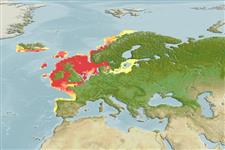
| Native range | All suitable habitat | Point map | Year 2050 |
|
| This map was computer-generated and has not yet been reviewed. |
| Pollachius pollachius AquaMaps Data sources: GBIF OBIS |
Hochladen Photos und videos
Bilder | videos | Google Bild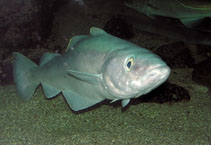 Pollachius pollachius
Photo von Ueberschär, B.
Bilder | videos | Google Bild
Photo von Ueberschär, B.
Klassifizierung / Names Namen | Synonyme | Catalog of Fishes(Gattung, Arten) | ITIS | CoL | WoRMS | Cloffa
> Gadiformes (Cods) > Gadidae (Cods and haddocks)
Etymology: Pollachius: Scottish dialect, podlock, paddle = bumpfish (Ref. 45335).
More on author: Linnaeus.
Etymology: Pollachius: Scottish dialect, podlock, paddle = bumpfish (Ref. 45335).
More on author: Linnaeus.
Umwelt: Milieu / Klimazone / Tiefenbereich / Verbreitungsgebiet Ökologie
seewasser benthopelagisch; ozeanodrom (Ref. 51243); tiefenbereich 40 - 200 m (Ref. 6302), usually 40 - 100 m (Ref. 54707). Temperate; 72°N - 36°N, 25°W - 28°E
Verbreitung Territorien | FAO Gebiete | Ökosysteme | Vorkommen | Punkt Karte | Einführungen | Faunafri
Northeast Atlantic: Iceland, the Faeroes and Norway to the Bay of Biscay (Ref. 1371); also southern Baltic Sea (Ref. 89342) with records from Poland, Latvia and Estonia (Refs. 36252, 52079).
Länge bei der ersten Reifung / Größe / Gewicht / Alter
Geschlechtsreife: Lm 41.0, range 42 - ? cm
Max length : 130 cm TL Männchen/unbestimmt; (Ref. 1371); common length : 75.0 cm TL Männchen/unbestimmt; (Ref. 1371); max. veröff. Gewicht: 18.1 kg (Ref. 40637); max. veröff. Alter: 8 Jahre (Ref. 1371)
Max length : 130 cm TL Männchen/unbestimmt; (Ref. 1371); common length : 75.0 cm TL Männchen/unbestimmt; (Ref. 1371); max. veröff. Gewicht: 18.1 kg (Ref. 40637); max. veröff. Alter: 8 Jahre (Ref. 1371)
Kurzbeschreibung Bestimmungsschlüssel | Morphologie | Morphometrie
Rückenflossenstacheln (insgesamt) : 0; Rückenflossenweichstrahlen (insgesamt) : 29 - 33; Afterflossenweichstrahlen: 27 - 30; Wirbelzahl: 52 - 55. Lower jaw distinctly projecting beyond upper ones. Lacks a chin barbel. Dark lateral line that sharply curves over the pectoral fin and continues over whole body. No dark spot at pectoral fin base. Dorsal and anal fin interspaces short. Sensory canals with large pores on head. Body color is variable; dark dorsally, sharply distinguished from silver-gray sides and belly; the upper part of the body with yellow to orange streaks or blotches; the lateral line greenish. The fins uniformly dark except for the pelvic fins which are yellowish.
Body shape (shape guide): fusiform / normal; Cross section: circular.
Body shape (shape guide): fusiform / normal; Cross section: circular.
Found in inshore waters but also down to 200 m depth, in areas with hard bottoms. Juveniles are pelagic, spending 2-3 years near the coast including rocky areas, kelp beds, sandy shores and estuaries (Ref. 1371, 58137, 89343, 89362). Juveniles may form schools with saithe (Pollachius virens) (Ref. 88187), and have also been found solitary and defending their feeding territory (Refs. 42174, 89363). Larger individuals move to the open sea and are often found around rocky areas at 40-100 m depth (Ref. 1371). Also observed around shipwrecks and oil platforms (Ref. 88187). Adults occur singly or in small dispersed shoals but is known to form dense shoals on spawning grounds (Ref. 89364). Suggested to undertake spawning migrations (Ref. 88171). Caught as bycatch in cod and saithe fisheries. Flesh is dry but of good flavor (Ref. 35388). Classified as a "hearing generalist" (89365); has also been found to produce sound. Juveniles have been reported to make repeated short grunts during competitive feeding and aggressive encounters (89366).
Lebenszyklus und Paarungsverhalten Geschlechtsreife | Fortpflanzung | Ablaichen | Eier | Fruchtbarkeit | Larven
Oviparous and gonochorous (Ref. 205).
Hauptreferenz
Laden Sie Ihre Referenzen hoch | Referenzen | Koordinator | Partner
Cohen, D.M., T. Inada, T. Iwamoto and N. Scialabba, 1990. FAO species catalogue. Vol. 10. Gadiform fishes of the world (Order Gadiformes). An annotated and illustrated catalogue of cods, hakes, grenadiers and other gadiform fishes known to date. FAO Fish. Synop. 125(10). Rome: FAO. 442 p. (Ref. 1371)
IUCN Rote Liste Status (Ref. 130435: Version 2025-2 (Global))
nicht bedroht (LC) ; Date assessed: 16 October 2013
CITES
Not Evaluated
Bedrohung für Menschen
Harmless
Nutzung durch Menschen
Fischereien: kommerziell; Sportfisch: ja
FAO - Aquakultur-Systeme: produktion; Fischereien: landungen, Artbeschreibung; Publication: search | FishSource | Das Meer um uns herum
Mehr Information
Trophische Ökologie
Lebensmittel (Beutetiere)
Nahrungszusammensetzung
Nahrungsaufnahme
Lebensmittelrationen
Räuber
Lebensmittel (Beutetiere)
Nahrungszusammensetzung
Nahrungsaufnahme
Lebensmittelrationen
Räuber
Populationsdynamik
Wachstumsparameter
Max. Alter/Größen
Länge-Gewicht-Rel.
Länge-Länge-Verhältnis.
Längenhäufigkeiten
Massenkonvertierung
Rekrutierung
Dichte
Wachstumsparameter
Max. Alter/Größen
Länge-Gewicht-Rel.
Länge-Länge-Verhältnis.
Längenhäufigkeiten
Massenkonvertierung
Rekrutierung
Dichte
Lebenszyklus
Fortpflanzung
Geschlechtsreife
Reifung/Kiemen rel.
Fruchtbarkeit
Ablaichen
Laichaggregationen
Eier
Eientwicklung
Larven
Larven Pop.Dyn.
Fortpflanzung
Geschlechtsreife
Reifung/Kiemen rel.
Fruchtbarkeit
Ablaichen
Laichaggregationen
Eier
Eientwicklung
Larven
Larven Pop.Dyn.
Physiologie
Körperliche Zusammensetzung
Nährstoffe
Sauerstoffverbrauch
Schwimmart
Schwimmgeschwindigkeit
Visuelle Pigmente
Fischgeräusche
Krankheiten und Parasiten
Toxizität (LC50s)
Körperliche Zusammensetzung
Nährstoffe
Sauerstoffverbrauch
Schwimmart
Schwimmgeschwindigkeit
Visuelle Pigmente
Fischgeräusche
Krankheiten und Parasiten
Toxizität (LC50s)
Menschenbezogen
Aquakultur-Systeme
Aquakultur Profile
Zuchtlinien
Ciguatera-Fälle
Briefmarken, Münzen, Verschiedenes.
Aquakultur-Systeme
Aquakultur Profile
Zuchtlinien
Ciguatera-Fälle
Briefmarken, Münzen, Verschiedenes.
Tools
Bio-Quiz | E-Book | Feldführer | Bestimmungsschlüssel | Längenhäufigkeits Tool | Lebensdaten Tool | Punkt Karte |
Catch-MSY |
Zusatzinformationen
Download XML
Zusammenfassung | Punktdaten | Namen | Photos
Internet Quellen
AFORO (otoliths) | Aquatic Commons | BHL | Cloffa | Websites from users | FishWatcher Einträge suchen | CISTI | Catalog of Fishes: Gattung, Arten | DiscoverLife | DORIS | ECOTOX | FAO - Aquakultur-Systeme: produktion; Fischereien: landungen, Artbeschreibung; Publication: search | Faunafri | Fishipedia | Fishtrace | GloBI | Google Books | Google Scholar | Google | IGFA World Record | Nationale Datenbanken | OneZoom | Open Tree of Life | Otolith Atlas of Taiwan Fishes | Öffentliche Aquarien | PubMed | Reef Life Survey | Socotra Atlas | TreeBase | Tree of Life | Wikipedia: Gehe zu, Suchen | World Records Freshwater Fishing | Zoologischer Rekord
Schätzungen auf der Grundlage von Modellen
Bevorzugte Temperatur (Ref. 123201): 7 - 11.9, mean 8.9 °C (based on 283 cells).
Phylogenetischer Diversitätsindex (Ref. 82804): PD50 = 0.7500 [Uniqueness, from 0.5 = low to 2.0 = high].
Bayesian length-weight: a=0.00708 (0.00605 - 0.00829), b=3.08 (3.04 - 3.12), in cm total length, based on LWR estimates for this species (Ref. 93245).
Trophische Ebene (Ref. 69278): 4.3 ±0.3 se; based on diet studies.
Generation time: 5.9 ( na - na) years. Estimated as median ln(3)/K based on 1 growth studies.
Widerstandsfähigkeit (Ref. 120179): mittel, Verdopplung der Population dauert 1,4 - 4,4 Jahre. (K=0.19; tmax=8).
Prior r = 0.63, 95% CL = 0.42 - 0.95, Based on 3 data-limited stock assessments.
Nährstoffe (Ref. 124155): Calcium = 8.53 [3.62, 29.51] mg/100g; Iron = 0.222 [0.085, 0.575] mg/100g; Protein = 17.7 [15.7, 19.8] %; Omega3 = 0.544 [0.279, 1.082] g/100g; Selenium = 25.4 [8.6, 76.9] μg/100g; VitaminA = 17.8 [4.6, 71.0] μg/100g; Zinc = 0.401 [0.206, 0.797] mg/100g (wet weight);