Teleostei (teleosts) >
Syngnathiformes (Pipefishes and seahorses) >
Syngnathidae (Pipefishes and seahorses) > Syngnathinae
Etymology: Syngnathus: Greek, syn, symphysis = grown together + Greek, gnathos = jaw (Ref. 45335).
More on authors: Jordan & Gilbert.
Environment: milieu / climate zone / depth range / distribution range
Ecology
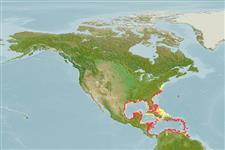
Marine; demersal; depth range 18 - 55 m (Ref. 126547), usually ? - 5 m (Ref. 126547). Subtropical; 40°N - 8°N
Western Atlantic: disjunct distribution from Bermuda and Chesapeake Bay (USA), including the northern Gulf of Mexico, the Bahamas, and the western Caribbean Sea (Ref. 37039), to Panama.
Size / Weight / Age
Maturity: Lm ? range ? - ? cm
Max length : 26.0 cm TL male/unsexed; (Ref. 27549)
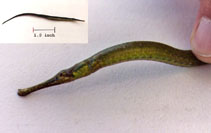
Abundant in seagrass beds along coasts. Northern populations move offshore during colder months (Ref. 26938). Found mostly at 5 m or less (Ref. 126547). Ovoviviparous (Ref. 205). The male carries the eggs in a brood pouch which is found under the tail (Ref. 205). Feeds mostly on small grass shrimp and other small crustaceans (Ref. 93252).
Life cycle and mating behavior
Maturity | Reproduction | Spawning | Eggs | Fecundity | Larvae
Male carries the eggs in a brood pouch (Ref. 205, 53335).
Robins, C.R. and G.C. Ray, 1986. A field guide to Atlantic coast fishes of North America. Houghton Mifflin Company, Boston, U.S.A. 354 p. (Ref. 7251)
IUCN Red List Status (Ref. 130435: Version 2025-2)
Threat to humans
Harmless
Human uses
Tools
Special reports
Download XML
Internet sources