



Uploaden van uw Foto's en video's
Afbeeldingen | Google afbeelding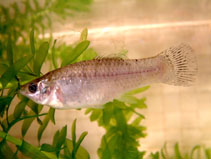 Poecilia formosa
Female Afbeelding van Slaboch, R.
Afbeeldingen | Google afbeelding
Female Afbeelding van Slaboch, R.
Classificatie / Namen Lokale namen | Synoniemen | Catalog of Fishes(Genus, Soort(en)) | ITIS | CoL | WoRMS | Cloffa
> Cyprinodontiformes (Rivulines, killifishes and live bearers) > Poeciliidae (Poeciliids) > Poeciliinae
Etymology: Poecilia: Greek, poikilos = with a lot of colours (Ref. 45335).
More on author: Girard.
Etymology: Poecilia: Greek, poikilos = with a lot of colours (Ref. 45335).
More on author: Girard.
Milieu: milieu / Klimaatzone / Diepte / verspreidingsgebied Ecologie
; zoet water; brak water benthopelagisch; standvastig (Ref. 126106). Subtropical; 27°N - 25°N
Verspreiding Gebieden | FAO regio's | Ecosystemen | Voorkomen | Verspreidingskaart | Introducties | Faunafri
North America: lower Nueces River (where possibly introduced) and lower Rio Grande, extreme southern Texas, to Veracruz in Mexico. Introduced populations at San Antonio and San Marcos, Texas.
Grootte / Gewicht / Leeftijd
Maturiteit: Lm ? range ? - ? cm
Max length : 9.6 cm TL mannelijk / geslacht onbekend; (Ref. 5723); common length : 5.5 cm TL mannelijk / geslacht onbekend; (Ref. 12193)
Max length : 9.6 cm TL mannelijk / geslacht onbekend; (Ref. 5723); common length : 5.5 cm TL mannelijk / geslacht onbekend; (Ref. 12193)
Korte beschrijving Determinatiesleutels | Morfologie | Morfometrie
Dorsale stekels (totaal) : 0; Dorsale zachte stralen (totaal) : 10 - 12. Similar to females of P. latipinna but lacks rows of brown spots on side (may have row of dusky black spots).
Body shape (shape guide): fusiform / normal; Cross section: oval.
Body shape (shape guide): fusiform / normal; Cross section: oval.
Adults are found in backwaters and quiet pools of streams, sloughs, and ditches, usually over mud. This is an all-female species thought to have originated as a result of hybridization between P. latipinna and P. sphenops. Gynogenesis reproduction is triggered by copulation and stimulation by sperm from males of other species in the genus, either P. latipinna, P. mexicana, P. latipunctata, or rarely P. sphenops.
Levenscyclus en paargedrag Maturiteit | Voortplanting | Paaien | Eieren | Fecunditeit | Larven
Reproduces gynogenetically (Refs. 8601, 8602, 8605, 5723, 125602), meaning once the sperm has penetrated the egg membrane, it takes no further part in the development of the embryo. Eggs develop following copulation and stimulation by sperm from males of other species in the genus, either P. latipinna, P. mexicana, P. latipunctata, or rarely P. sphenops. Viviparous (Ref. 8601), but there is no nutritional contribution by the mother during embryonic development to compensate for the depletion of stored reserves in the egg as embryos develop (Ref. 8606).
Hoofdreferentie
Upload uw referenties | Referenties | Coördinator | Medewerkers
Meyer, M.K. and A.C. Radda, 2000. Notes on the subgenus Mollienesia Lesueur,1821, with a description of a new species of Poecilia Bloch & Schneider, 1801 (Cyprinodontiformes: Poeciliidae) from Venezuela. Ann. Naturhist. Mus. Wien 102B:75-81. (Ref. 42987)
Status op de Rode Lijst van het IUCN (Ref. 130435: Version 2025-2 (Global))
Niet bedreigd (LC) ; Date assessed: 26 February 2019
CITES
Not Evaluated
Gevaar voor de mens
Harmless
Gebruik door de mens
Visserij: van geen belang; Aquarium: Commercieel
FAO - Publication: search | FishSource |
Meer informatie
Trofische ecologie
Voedsel (prooien)
Dieetsamenstelling
Voedselconsumptie
Voedselrantsoenen
Predatoren
Voedsel (prooien)
Dieetsamenstelling
Voedselconsumptie
Voedselrantsoenen
Predatoren
Ecologie
Ecologie
Ecologie
Populatiedynamica
Groeiparameters
Max. leeftijden / maten
Lengte-gewicht rel.
Lengte-lengte rel.
Lengtefrequenties
Massaconversie
Rekrutering
Abundantie
Groeiparameters
Max. leeftijden / maten
Lengte-gewicht rel.
Lengte-lengte rel.
Lengtefrequenties
Massaconversie
Rekrutering
Abundantie
Levenscyclus
Voortplanting
Maturiteit
Rijpheid/kieuwen rel.
Fecunditeit
Paaien
Paaibestanden
Eieren
Ontwikkeling van de eieren
Larven
Larvale populatiedynamiek
Voortplanting
Maturiteit
Rijpheid/kieuwen rel.
Fecunditeit
Paaien
Paaibestanden
Eieren
Ontwikkeling van de eieren
Larven
Larvale populatiedynamiek
Anatomie
Kieuwoppervlak
Hersenen
Otoliet
Kieuwoppervlak
Hersenen
Otoliet
Fysiologie
Lichaamssamenstelling
Voedingsstoffen
Zuurstofverbruik
Type zwemmen
Zwemsnelheid
Visuele pigmenten
Vis geluid
Ziekten en parasieten
Toxiciteit (LC50)
Lichaamssamenstelling
Voedingsstoffen
Zuurstofverbruik
Type zwemmen
Zwemsnelheid
Visuele pigmenten
Vis geluid
Ziekten en parasieten
Toxiciteit (LC50)
Menselijk gerelateerd
Aquacultuursystemen
Aquacultuurprofielen
Kweeklijnen
Ciguatera gevallen
Postzegels, munten, diversen.
Aquacultuursystemen
Aquacultuurprofielen
Kweeklijnen
Ciguatera gevallen
Postzegels, munten, diversen.
Tools
Speciale rapporten
Bekijk gegevens voor het houden in een aquarium | Bekijk Fact Sheets voor de soort | Bekijk Aquacultuur Fact Sheets
Download XML
Internetbronnen
AFORO (otoliths) | Exoten/Invasieve soorten database | Aquatic Commons | BHL | Cloffa | Websites from users | Bekijk FishWatcher | CISTI | Catalog of Fishes: Genus, Soort(en) | DiscoverLife | ECOTOX | FAO - Publication: search | Faunafri | Fishipedia | Fishtrace | GloBI | Google Books | Google Scholar | Google | IGFA World Record | OneZoom | Open Tree of Life | Otolith Atlas of Taiwan Fishes | PubMed | Reef Life Survey | Socotra Atlas | TreeBase | Tree of Life | Wikipedia: ga naar, zoek | World Records Freshwater Fishing | Zoological Record
Schattingen op basis van modellen
Fylogenetische diversiteitsindex (Ref. 82804): PD50 = 0.5000 [Uniqueness, from 0.5 = low to 2.0 = high].
Bayesian length-weight: a=0.01288 (0.00551 - 0.03009), b=3.14 (2.96 - 3.32), in cm total length, based on LWR estimates for this Genus-body shape (Ref. 93245).
Trofisch niveau (Ref. 69278): 2.5 ±0.3 se; based on size and trophs of closest relatives
Weerstandsvermogen (Ref. 120179): Gemiddeld, minimale populatieverdubbelingstijd 1,4-4,4 jaar (Preliminary K or Fecundity.).