>
Cyprinodontiformes (Rivulines, killifishes and live bearers) >
Poeciliidae (Poeciliids) > Poeciliinae
Etymology: Heterandria: Greek, heteros = other + Greek, andros = male (Ref. 45335).
More on author: Girard.
Environment: milieu / climate zone / distribuzione batimetrica / distribution range
Ecologia
; acqua dolce; salmastro benthopelagico; pH range: 7.0 - 8.0; dH range: 9 - 19; non migratori. Tropical; 20°C - 26°C (Ref. 1672); 35°N - 25°N
North America: occurs only in the USA from Cape Fear River drainage in North Carolina to southern Louisiana.
Length at first maturity / Size / Peso / Age
Maturità: Lm 1.1, range 1 - 1.4 cm
Max length : 3.6 cm TL maschio/sesso non determinato; (Ref. 5723); common length : 2.1 cm TL maschio/sesso non determinato; (Ref. 12193)
Short description
Chiavi di identificazione | Morfologia | Morfometria
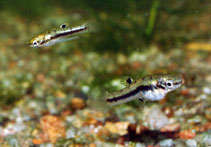
Adults inhabit heavily vegetated standing to slow-flowing fresh and brackish water. They feed on worms, crustaceans and plant matter (Ref. 7020). A truly viviparous fish (Ref. 45952).
A truly viviparous fish, embryo derives nearly all of its nourishment from the mother (Ref. 45952).
Page, L.M. and B.M. Burr, 1991. A field guide to freshwater fishes of North America north of Mexico. Houghton Mifflin Company, Boston. 432 p. (Ref. 5723)
IUCN Red List Status (Ref. 130435: Version 2025-1)
Threat to humans
Harmless
Human uses
Pesca: commerciale; Acquario: Commerciale
Strumenti
Special reports
Download XML
Fonti Internet
Estimates based on models
Phylogenetic diversity index (Fonte Biblio.
82804): PD
50 = 0.6250 [Uniqueness, from 0.5 = low to 2.0 = high].
Bayesian length-weight: a=0.01000 (0.00527 - 0.01898), b=3.09 (2.93 - 3.25), in cm total length, based on LWR estimates for this species & (Sub)family-body (Ref.
93245).
Trophic level (Fonte Biblio.
69278): 2.7 ±0.22 se; based on food items.
Resilienza (Fonte Biblio.
120179): Alto, tempo minimo di raddoppiamento della popolazione meno di 15 mesi (tm = 0.13; tmax = 0.33; Batch Fec = 1-7;).
Fishing Vulnerability (Ref.
59153): Low vulnerability (10 of 100).
🛈