>
Gadiformes (Cods) >
Phycidae (Phycid hakes)
Etymology: Urophycis: Greek, oura = tail + Greek, phyke, pykis, -idos = the female of a fish that lives among algae (Greek = phykon), related with the gudgeon (Ref. 45335).
More on author: Walbaum.
Environment: milieu / climate zone / Mức độ sâu / distribution range
Sinh thái học
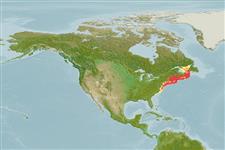
Biển gần đáy; Ở đại duơng, biển (Ref. 51243); Mức độ sâu 35 - 1152 m (Ref. 57178), usually 110 - 130 m. Temperate; 51°N - 33°N, 79°W - 58°W
Northwest Atlantic: North Carolina to southern Nova Scotia, straying to the Gulf of St. Lawrence. Rare European records are probably misidentifications of Urophycis tenuis.
Length at first maturity / Bộ gần gũi / Khối lượng (Trọng lượng) / Age
Chín muồi sinh dục: Lm 26.0 range ? - ? cm
Max length : 66.0 cm TL con đực/không giới tính; (Ref. 40637); Khối lượng cực đại được công bố: 3.6 kg (Ref. 40637)
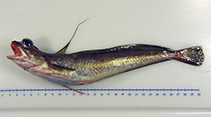
Các tia vây lưng cứng (tổng cộng) : 0; Tia cứng vây hậu môn: 0. First dorsal fin ray elongated. Pelvic fins also reaching about the anal fin origin. Body color variable, reddish to olive brown dorsally, sometimes very dark or mottled; lower sides paler, sometimes with dusky dots; belly and underside of the head pale. A dusky blotch present on the opercle. The fins are generally dark, except for the pelvic fins, which are pale.
Body shape (shape guide): elongated; Cross section: circular.
Found on soft muddy and sandy bottoms, but never on rocks, gravel or shells. Juveniles live along the coasts at shallow depths (4-6 m); adults migrate to deeper waters, generally to between 110 and 130 m, and in some instances, to over 550 m. Juveniles live in scallops (Placopecten magellanicus) and remain close to scallop beds until they mature (Ref. 9988). They prefer temperatures of 8-10°C (Ref. 5951). Feed on shrimps, amphipods and other crustaceans, also on squid and herring, flatfish, mackerel and others. Utilized fresh, dried or salted and frozen; also small fish are used for fishmeal ; eaten steamed, microwaved and baked (Ref. 9988). Maximum depth reported from Ref. 57178.
Cohen, D.M., T. Inada, T. Iwamoto and N. Scialabba, 1990. FAO species catalogue. Vol. 10. Gadiform fishes of the world (Order Gadiformes). An annotated and illustrated catalogue of cods, hakes, grenadiers and other gadiform fishes known to date. FAO Fish. Synop. 125(10). Rome: FAO. 442 p. (Ref. 1371)
IUCN Red List Status (Ref. 130435: Version 2025-1)
Threat to humans
Harmless
Human uses
Các nghề cá: Tính thương mại; cá để chơi: đúng
Các công cụ
Special reports
Download XML
Các nguồn internet
Estimates based on models
Preferred temperature (Tài liệu tham khảo
123201): 1.6 - 11.1, mean 5 °C (based on 23 cells).
Phylogenetic diversity index (Tài liệu tham khảo
82804): PD
50 = 0.5044 [Uniqueness, from 0.5 = low to 2.0 = high].
Bayesian length-weight: a=0.00407 (0.00319 - 0.00520), b=3.11 (3.04 - 3.18), in cm total length, based on LWR estimates for this species (Ref.
93245).
Mức dinh dưỡng (Tài liệu tham khảo
69278): 3.7 ±0.3 se; based on diet studies.
Generation time: 5.8 ( na - na) years. Estimated as median ln(3)/K based on 1
growth studies.
Thích nghi nhanh (Tài liệu tham khảo
120179): Trung bình, thời gian nhân đôi của chủng quần tối thiểu là 1.4 - 4.4 năm (K=0.19; tm=2-3).
Prior r = 0.20, 95% CL = 0.13 - 0.30, Based on 3 full stock assessments.
Fishing Vulnerability (Ref.
59153): Moderate to high vulnerability (51 of 100).
🛈
Climate Vulnerability (Ref.
125649): Moderate to high vulnerability (52 of 100).
🛈
Nutrients (Ref.
124155): Calcium = 27.7 [17.1, 58.1] mg/100g; Iron = 0.353 [0.196, 0.651] mg/100g; Protein = 17.2 [16.0, 18.5] %; Omega3 = 0.412 [0.217, 0.750] g/100g; Selenium = 25.8 [13.2, 49.7] μg/100g; VitaminA = 16.2 [4.3, 55.6] μg/100g; Zinc = 0.435 [0.306, 0.627] mg/100g (wet weight);