Issue
This species is often confused with Nezumia aequalis (Günther, 1878).
Environment: milieu / Zona climática / intervalo de profundidade / distribution range
Ecologia
marinhas batipelágico; não migratória; intervalo de profundidade 130 - 3200 m (Ref. 3587), usually 450 - 730 m (Ref. 1371). Deep-water; 43°N - 4°N, 81°W - 36°E
Atlantic Ocean: North Atlantic south to the northern part of the Gulf of Guinea in the east, into the Mediterranean Sea, and north of Straits of Florida in the west.
Comprimento de primeira maturação / Tamanho / Peso / Idade
Maturidade: Lm 15.0, range 13 - 17 cm
Max length : 36.0 cm TL macho/indeterminado; (Ref. 3587)
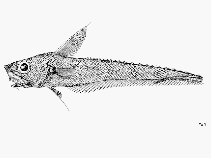
Espinhos dorsais (total) : 2; Espinhos anais: 0. Snout short, bluntly acute; terminal scute broad, blunt; ventral surface of snout without scales posteriorly including most of suborbital, mandible mostly naked, pores prominent on head. Pyloric caeca 22 to 29. Body scales with slender, conical, slanting spinules arranged in converging rows. Color in alcohol brownish, paler on head, with violet tinge on abdomen, some silvery reflections; fins pale to blackish; first dorsal fin uniformly blackish; mouth and gill cavity mostly black.
Body shape (shape guide): elongated; Cross section: oval.
Most numerous at 450 to 730 m in the open Atlantic and at 500 to 800 m in the Mediterranean. Feeds on small crustaceans (copepods, amphipods, decapods, mysids, etc.) and polychaetes (Ref. 1371)
Ciclo de vida ou comportamento de acasalamento
Maturidade | Reprodução | Desova | Ovos | Fecundidade | Larvas
Cohen, D.M., T. Inada, T. Iwamoto and N. Scialabba, 1990. FAO species catalogue. Vol. 10. Gadiform fishes of the world (Order Gadiformes). An annotated and illustrated catalogue of cods, hakes, grenadiers and other gadiform fishes known to date. FAO Fish. Synop. 125(10). Rome: FAO. 442 p. (Ref. 1371)
Status na Lista Vermelha da UICN (Ref. 130435: Version 2025-1)
Ameaça para os humanos
Harmless
Uso pelos humanos
Pescarias: pouco comercial
Ferramentas
Relatórios especiais
Baixar XML
Fontes da internet
Estimates based on models
Preferred temperature (Ref.
123201): 6.3 - 14, mean 12.3 °C (based on 169 cells).
Índice de diversidade filogenética (Ref.
82804): PD
50 = 0.5000 [Uniqueness, from 0.5 = low to 2.0 = high].
Bayesian length-weight: a=0.00129 (0.00076 - 0.00217), b=3.14 (2.99 - 3.29), in cm total length, based on LWR estimates for this species & (Sub)family-body (Ref.
93245).
Nível Trófico (Ref.
69278): 3.2 ±0.34 se; based on food items.
Generation time: 6.9 ( na - na) years. Estimated as median ln(3)/K based on 1
growth studies.
Resiliência (Ref.
120179): médio(a), tempo mínimo de duplicação da população 1,4 - 4,4 anos (K=0.10-0.16; tmax=9).
Fishing Vulnerability (Ref.
59153): Moderate to high vulnerability (48 of 100).
🛈
Nutrients (Ref.
124155): Calcium = 28.8 [7.6, 70.7] mg/100g; Iron = 0.294 [0.121, 0.874] mg/100g; Protein = 16.9 [15.0, 18.7] %; Omega3 = 0.119 [0.042, 0.315] g/100g; Selenium = 22.1 [6.4, 62.2] μg/100g; VitaminA = 31.3 [3.4, 282.7] μg/100g; Zinc = 0.713 [0.371, 1.463] mg/100g (wet weight);