>
Lophiiformes (Anglerfishes) >
Antennariidae (Frogfishes)
Etymology: Histrio: Latin, histrionicus = related with actors; because of the movements of that mekaes this fish before catching its preys (Ref. 45335).
More on author: Linnaeus.
Environment: milieu / climate zone / ระดับความลึก / distribution range
นิเวศวิทยา
เกี่ยวกับทะเล,น้ำเค็ม เกี่ยวกับหินโสโครก; สัตว์น้ำที่อาศัยและอพยพภายในทะเลเท่านั้น (Ref. 51243); ระดับความลึก 0 - 50 m (Ref. 58302), usually 0 - 2 m (Ref. 58302). Subtropical; 46°N - 36°S, -180°W - 180°E
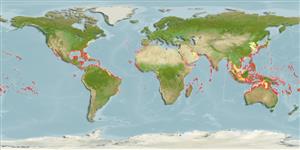
Western Atlantic: Rio de la Plata estuary, Uruguay, to Canada (Ref. 5951). Eastern Atlantic: Azores and off West Africa; Gulf Stream drift stray in Norway (Ref. 28571). Indian Ocean: South Africa to Red Sea, Madagascar, Réunion and Mauritius, eastward to India and Sri Lanka. Western Pacific: Hokkaido to tropical Australia (as far south as Perth in the west and Sydney in the east), Taiwan, Philippines, Moluccas, southern Papua New Guinea, Guam, Tonga, New Caledonia and New Zealand; Mariana Islands in Micronesia (Ref. 1602). Occurrence in the eastern Pacific remains to be verifed and confirmed.
ขนาด / น้ำหนัก / Age
วัยเจริญพันธุ์: Lm ? range ? - ? cm
Max length : 20.0 cm TL เพศผู้/กระเทย; (Ref. 7251)
Short description
เครื่องมือที่ใช้ในการแยกชนิดสัตว์,สิ่งมีชีวิตออกจากกัน | สัณฐานวิทยา | ความยาวต่างๆ
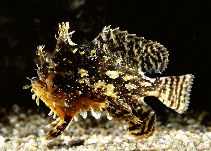
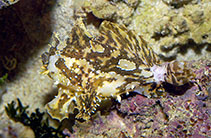
เงี่ยงครีบหลัง (รวม) : 3; ก้านครีบอ่อนที่หาง (รวม) : 11 - 13; เงี่ยงครีบก้น: 0; ก้านครีบอ่อนที่ก้น: 6 - 13. Diagnosis: body short and globose; mouth large with many small, villiform teeth; skin naked, but head, body and fins covered with numerous skin flaps; very long pelvic fins (> 25% SL); unprotected illicium or lure attains less than half of second dorsal-fin spine and 4.5-9.3% of SL (Ref. 57225).
Body shape (shape guide): short and / or deep; Cross section: compressed.
Found near the surface, usually associated with floating objects (Ref. 26340) or Sargassum. Found near shore and occasionally among floating seaweeds (Ref. 57225). Commonly blown into shore and bay waters during storms (Ref. 7251). Epipelagic (Ref. 58302). A solitary (Ref. 26340) and voracious predator (Ref. 5521). They feed on fishes and shrimps that seek refuge in the floating weeds (Ref. 48635). Oviparous. Eggs are bound in ribbon-like sheath or mass of gelatinous mucus called 'egg raft' or 'veil' (Ref. 6773, 48635). Solitary or loose groups among floating seaweed (Ref 90102).
Oviparous. During courtship, the male follows the female closely then both rush to the surface to spawn (Ref. 205). At this point, eggs are produced in a gelatinous floating mass or 'raft' and inseminated by the male. The eggs remain embedded in this raft until hatching (Ref. 240).
Pietsch, T.W. and D.B. Grobecker, 1987. Frogfishes of the world. Systematics, zoogeography, and behavioral ecology. Stanford University Press, Stanford, California. 420 p. (Ref. 6773)
IUCN Red List Status (Ref. 130435: Version 2025-1)
Threat to humans
Reports of ciguatera poisoning (Ref. 30911)
Human uses
การประมง: การประมงยังชีพ; สถานที่แสดงสัตว์และพืชน้ำ: การค้า
เครื่องมือ
Special reports
Download XML
แหล่งที่มาจากอินเตอร์เน็ต
Estimates based on models
Preferred temperature (อ้างอิง
123201): 21.4 - 29.2, mean 27.7 °C (based on 4840 cells).
Phylogenetic diversity index (อ้างอิง
82804): PD
50 = 1.0000 [Uniqueness, from 0.5 = low to 2.0 = high].
Bayesian length-weight: a=0.02630 (0.01029 - 0.06725), b=2.96 (2.73 - 3.19), in cm total length, based on LWR estimates for this (Sub)family-body shape (Ref.
93245).
ระดับชั้นอาหาร (อ้างอิง
69278): 3.9 ±0.63 se; based on food items.
ความสามารถในการกลับคืนสู่ปกติ (อ้างอิง
120179): ความสูง, เวลาต่ำสุดที่จะทำให้ประชากรเพิ่มขึ้นเป็น 2 เท่าใช้เวลาน้อยกว่า 15 เดือน (Fec assumed to be > 10,000).
Fishing Vulnerability (Ref.
59153): Low vulnerability (10 of 100).
🛈
Nutrients (Ref.
124155): Calcium = 35.4 [15.8, 77.9] mg/100g; Iron = 0.641 [0.325, 1.216] mg/100g; Protein = 19.4 [16.9, 22.5] %; Omega3 = 0.169 [0.062, 0.449] g/100g; Selenium = 12 [5, 31] μg/100g; VitaminA = 107 [26, 451] μg/100g; Zinc = 0.751 [0.443, 1.227] mg/100g (wet weight);