



Forbesichthys agassizii (Putnam, 1872)
Spring cavefish
Carregue seu(sua) Fotos e vídeos
Fotos | Imagem do Google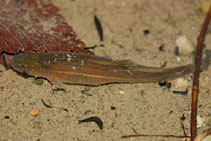 Forbesichthys agassizii
Foto de Niemiller, M.L.
Fotos | Imagem do Google
Foto de Niemiller, M.L.
Classificação / Nomes Nomes comuns | Sinônimos | Catalog of Fishes(Gênero, Espécies) | ITIS | CoL | WoRMS | Cloffa
> Percopsiformes (Trout-perches, pirate perches and cavefishes) > Amblyopsidae (Cavefishes)
Etymology: agassizii: Named after the great naturalist Louis Agassiz (Ref. 10294).
Eponymy: Stephen Alfred Forbes (1844–1930) was an entomologist, self-taught naturalist, farmer and ecologist. [...] Jean Louis Rudolphe Agassiz (1807–1873) was a Swiss-American geologist, glaciologist and zoologist whose speciality was ichthyology. [...] (Ref. 128868), visit book page.
Etymology: agassizii: Named after the great naturalist Louis Agassiz (Ref. 10294).
Eponymy: Stephen Alfred Forbes (1844–1930) was an entomologist, self-taught naturalist, farmer and ecologist. [...] Jean Louis Rudolphe Agassiz (1807–1873) was a Swiss-American geologist, glaciologist and zoologist whose speciality was ichthyology. [...] (Ref. 128868), visit book page.
Meio ambiente: milieu / Zona climática / intervalo de profundidade / faixa de distribuição Ecologia
; Água doce demersal; não migratória (Ref. 126106). Temperate; 39°N - 35°N
Distribuição Territórios | Áreas da FAO | Ecossistemas | Ocorrências | Mapa de pontos | Introduções | Faunafri
North America: portions of Tennessee, Kentucky, Illinois and Missouri, U.S.A.
Tamanho / Peso / Idade
Maturidade: Lm ? range ? - ? cm
Max length : 9.0 cm TL macho/indeterminado; (Ref. 10294); common length : 5.3 cm TL macho/indeterminado; (Ref. 12193); idade máx. registrada: 3.00 anos (Ref. 10294)
Max length : 9.0 cm TL macho/indeterminado; (Ref. 10294); common length : 5.3 cm TL macho/indeterminado; (Ref. 12193); idade máx. registrada: 3.00 anos (Ref. 10294)
Descrição suscinta Chaves de identificação | Morfologia | Morfometria
Raios dorsais (total) : 9 - 11; Raios anais : 9 - 11; Vértebras: 33 - 35. Scales minute and embedded. Pelvic fins absent. Branched caudal fin rays 11-17; branchiostegal rays 6. Triads of sensory papillae occur midlaterally and scattered clusters of neuromasts are present on the head. Coloration uniform dark gray to back with paler venter.
Body shape (shape guide): elongated.
Body shape (shape guide): elongated.
Adults occur in springs and caves (but almost always near surface). They live underground but emerge above ground in springs (Ref. 5723). Active in springs at night and usually retreat underground during the day. The few individuals which venture into the spring portions of their habitat may show strong rheotaxis for half to one-minute periods but usually show strong thigmotaxis and hide under rocks or debris (Ref. 34868). Feed at night on amphipods, midge larvae, tiny worms and micro-crustaceans. Fecundity averages about 100 eggs per female (Ref. 10294). Eggs are carried in gill chambers of females (Ref. 205).
Ciclo de vida ou comportamento de acasalamento Maturidade | Reprodução | Desova | Ovos | Fecundidade | Larvas
Incubates eggs in gill chamber of females (Ref. 205).
Referência principal
Carregar suas referências | Referências | Coordenador | Colaboradores
Etnier, D.A. and W.C. Starnes, 1993. The fishes of Tennessee. The University of Tennessee Press, Knoxville, Tennessee, USA. (pls. check date). (Ref. 10294)
Status na Lista Vermelha da UICN (Ref. 130435: Version 2025-2 (Global))
Segura ou pouco preocupante (LC) ; Date assessed: 27 January 2012
CITES
Not Evaluated
Ameaça para os humanos
Harmless
Uso pelos humanos
FAO - Publication: search | FishSource |
Mais informação
Ecologia Trófica
Itens alimentares (presas)
Composição da dieta
Consumo alimentar
Rações alimentares
Predadores
Itens alimentares (presas)
Composição da dieta
Consumo alimentar
Rações alimentares
Predadores
Dinâmica populacional
Parâmetros de crescimento
Idade máxima / tamanhos
Relação comprimento-peso.
Relação comprimento-comprimento.
Frequências de comprimento
Conversão de massa
Recrutamento
Abundância
Parâmetros de crescimento
Idade máxima / tamanhos
Relação comprimento-peso.
Relação comprimento-comprimento.
Frequências de comprimento
Conversão de massa
Recrutamento
Abundância
Ciclo de vida
Reprodução
Maturidade
Maturidade/Rel. das guelras
Fecundidade
Desova
Agregações de desova
Ovos
Desenvolvimento dos ovos
Larvas
Dinâmica larval
Reprodução
Maturidade
Maturidade/Rel. das guelras
Fecundidade
Desova
Agregações de desova
Ovos
Desenvolvimento dos ovos
Larvas
Dinâmica larval
Anatomia
Área branquial
Cérebro
Otólito
Área branquial
Cérebro
Otólito
Fisiologia
Composição corporal
Nutrientes
Consumo de oxigênio
Tipo de natação
Velocidade de natação
Pigmentos visuais
Som de peixe
Doenças e Parasitas
Toxicidade (LC50s)
Composição corporal
Nutrientes
Consumo de oxigênio
Tipo de natação
Velocidade de natação
Pigmentos visuais
Som de peixe
Doenças e Parasitas
Toxicidade (LC50s)
Genética
genoma
Genética
Heterozigosidade
Hereditariedade
Diversidade genética
genoma
Genética
Heterozigosidade
Hereditariedade
Diversidade genética
Relacionado a humanos
Sistemas de aquicultura
Perfis para aquacultura
Estirpes
Casos de Ciguatera
Selos, moedas, diversos.
Sistemas de aquicultura
Perfis para aquacultura
Estirpes
Casos de Ciguatera
Selos, moedas, diversos.
Ferramentas
Livro eletrônico | Guia de campo | Ferramenta auxiliar de frequências de comprimento | Ferramenta sobre a história de vida | Mapa de pontos |
Catch-MSY |
Relatórios especiais
Checar Manutenção em Aquário | Checar Planilhas de Fatos sobre as Espécies | Checar Planilhas de Fatos sobre Aquicultura
Baixar XML
Fontes da internet
AFORO (otoliths) | Banco de dados para Espécies Aliens/Invasivas | Aquatic Commons | BHL | Cloffa | Websites from users | Checar Observador de Peixes (FishWatcher) | CISTI | Catalog of Fishes: Gênero, Espécies | DiscoverLife | ECOTOX | FAO - Publication: search | Faunafri | Fishipedia | Fishtrace | GloBI | Google Books | Google Scholar | Google | IGFA World Record | OneZoom | Open Tree of Life | Otolith Atlas of Taiwan Fishes | PubMed | Reef Life Survey | Socotra Atlas | TreeBase | Árvore da vida | Wikipedia: Ir para, procura | World Records Freshwater Fishing | Registro zoológico
Estimativas baseadas em modelos
Índice de diversidade filogenética (Ref. 82804): PD50 = 1.0081 [Uniqueness, from 0.5 = low to 2.0 = high].
Bayesian length-weight: a=0.00389 (0.00180 - 0.00842), b=3.12 (2.94 - 3.30), in cm total length, based on all LWR estimates for this body shape (Ref. 93245).
Nível Trófico (Ref. 69278): 3.3 ±0.44 se; based on food items.
Generation time: 1.6 ( na - na) years. Estimated as median ln(3)/K based on 1 growth studies.
Resiliência (Ref. 120179): Elevada, tempo mínimo de duplicação da população menor que 15 meses (K=0.67; tm=1; tmax=3; Fec = 100).