Conger oceanicus, American conger : fisheries, gamefish

You can sponsor this page

Conger oceanicus (Mitchill, 1818)

American conger
Add your observation in Fish Watcher
Native range | All suitable habitat | Point map | Year 2050
This map was computer-generated and has not yet been reviewed.
Conger oceanicus   AquaMaps   Data sources: GBIF OBIS
Upload your photos and videos
Bilder | Google image
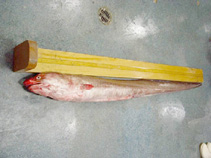
Image of Conger oceanicus (American conger)
Conger oceanicus
Picture by NOAA\NMFS\Mississippi Laboratory

Classification / Names Populärnamn | synonymer | Catalog of Fishes(Släkte, Arter) | ITIS | CoL | WoRMS | Cloffa

> Anguilliformes (Eels and morays) > Congridae (Conger and garden eels) > Congrinae
Etymology: Conger: Latin, conger = conger (Ref. 45335).
More on author: Mitchill.

Environment: milieu / climate zone / djupintervall / distribution range Ekologi

marina bottenlevande; havsvandrande (Ref. 51243); djupintervall 1 - 477 m (Ref. 5951), usually 75 - 150 m (Ref. 5951). Subtropical; 46°N - 16°S, 97°W - 5°W

Utbredning Länder | FAO områden | Ekosystem | Förekomster | Prickkarta | Utplanteringar | Faunafri

Western Atlantic: Cape Cod in Massachusetts to northeastern Florida in USA and northern Gulf of Mexico. Reported in eastern Atlantic: St. Helena (Ref. 5288). Northwest Atlantic: Canada (Ref. 5951).

Size / Vikt / Age

Könsmognad: Lm ?  range ? - ? cm
Max length : 230 cm TL hane/ej könsbestämd; (Ref. 7251); common length : 100.0 cm TL hane/ej könsbestämd; (Ref. 3715); publicerad maxvikt: 40.0 kg (Ref. 7251)

Short description Bestämningsnycklar | Morfologi | Morfometri


Body shape (shape guide): eel-like.

Biologi     Ordlista (t.ex. epibenthic)

Occurs from shallow inshore waters to depths of 477 m and up to 260 m in the Gulf of Maine (Ref. 7135). Benthic (Ref. 5951). Nocturnal predators (Ref. 93252). Feeds mainly on fishes, but also on shrimps and small shellfish. Commonly caught by anglers along piers, docks and jetties in middle Atlantic states.

Life cycle and mating behavior Könsmognad | Reproduktion | Lek | Ägg | Fecundity | Larver

Main reference Upload your references | referenser | Koordinator | Medarbetare

Robins, C.R. and G.C. Ray, 1986. A field guide to Atlantic coast fishes of North America. Houghton Mifflin Company, Boston, U.S.A. 354 p. (Ref. 7251)

IUCN Red List Status (Ref. 130435: Version 2025-1)

  Least Concern (LC) ; Date assessed: 10 September 2014

CITES

Not Evaluated

CMS (Ref. 116361)

Not Evaluated

Threat to humans

  Harmless


Human uses

Fiskeri: mindre kommeriell; sportfisk: ja
FAO - fiskeri: landings; Publication: search | FishSource | Sea Around Us

Ytterligare information

Trophic ecology
Food items (preys)
Födosammansättning
Födointag
Food rations
Predatorer
Ekologi
Ekologi
Home ranges
Population dynamics
Tillväxtparametrar
Max. ages / sizes
Length-weight rel.
Length-length rel.
Length-frequencies
Mass conversion
Rekrytering
Abundans
Life cycle
Reproduktion
Könsmognad
Maturity/Gills rel.
Fecundity
Lek
Spawning aggregations
Ägg
Egg development
Larver
Larvdynamik
Utbredning
Länder
FAO områden
Ekosystem
Förekomster
Utplanteringar
BRUVS - Videos
Anatomy
Gälyta
Brain
Otolith
Physiology
Body composition
Nutrients
Syreförbrukning
Swimming type
Simhastighet
Visual pigments
Fish sound
Diseases & Parasites
Toxicity (LC50s)
Genetik
Genome
Genetik
Heterozygosity
Ärftlighet
Human related
Aquaculture systems
Vattenbruksprofiler
Avelslinjer
Ciguatera cases
Stamps, coins, misc.
Outreach
Medarbetare
Taxonomy
Populärnamn
synonymer
Morfologi
Morfometri
Bilder
referenser
referenser

Verktyg

Special reports

Download XML

Internet-källor

AFORO (otoliths) | Aquatic Commons | BHL | Cloffa | Websites from users | Check FishWatcher | CISTI | Catalog of Fishes: Släkte, Arter | DiscoverLife | ECOTOX | FAO - fiskeri: landings; Publication: search | Faunafri | Fishipedia | Fishtrace | GloBI | Google Books | Google Scholar | Google | IGFA World Record | OceanAdapt | OneZoom | Open Tree of Life | Otolith Atlas of Taiwan Fishes | Offentliga akvarier | PubMed | Reef Life Survey | Socotra Atlas | TreeBase | Tree of Life | Wikipedia: Go, sök | Zoological Record

Estimates based on models

Preferred temperature (Ref. 123201): 7.1 - 25.2, mean 19.7 °C (based on 61 cells).
Phylogenetic diversity index (Ref. 82804):  PD50 = 0.5000   [Uniqueness, from 0.5 = low to 2.0 = high].
Bayesian length-weight: a=0.00050 (0.00028 - 0.00089), b=3.24 (3.09 - 3.39), in cm total length, based on LWR estimates for this species & Genus-body shape (Ref. 93245).
Trofisk nivå (Ref. 69278):  4.5   ±0.8 se; based on diet studies.
Resiliens (Ref. 120179):  Låg, lägsta populationsfördubblingstid 4,5-14 år (Assuming tm>4).
Fishing Vulnerability (Ref. 59153):  Very high vulnerability (90 of 100). 🛈
Climate Vulnerability (Ref. 125649):  High vulnerability (60 of 100). 🛈
Price category (Ref. 80766):   Low.
Nutrients (Ref. 124155):  Calcium = 27.1 [15.1, 52.3] mg/100g; Iron = 0.781 [0.431, 1.338] mg/100g; Protein = 18.8 [15.9, 21.7] %; Omega3 = 0.284 [0.126, 0.807] g/100g; Selenium = 62.7 [30.7, 130.0] μg/100g; VitaminA = 9.12 [2.53, 34.69] μg/100g; Zinc = 0.384 [0.274, 0.565] mg/100g (wet weight);