>
Cypriniformes (Carps) >
Catostomidae (Suckers) > Catostominae
Etymology: Catostomus: Greek, kata = down + Greek, stoma = mouth (Ref. 45335); catostomus: catostomus meaning inferior mouth, alluding to the ventral position of the mouth.
More on author: Forster.
Environment: milieu / climate zone / Mức độ sâu / distribution range
Sinh thái học
; Nước ngọt; Thuộc về nước lợ gần đáy; pH range: 6.5 - 7.8; dH range: 5 - 25; Mức độ sâu ? - 180 m (Ref. 1998). Temperate; 0°C - 15°C (Ref. 12468); 38°N - 32°N
North America: throughout most of Canada and Alaska; Atlantic Slope south to Delaware River drainage in New York, USA; Great Lakes basin; upper Monongahela River drainage in Maryland and West Virginia, USA; Missouri River drainage south to Nebraska and Colorado, USA. Also in Arctic basin of Siberia in Russia. Occurs in Columbia River System (Molly Hallock, pers. comm.).
Length at first maturity / Bộ gần gũi / Khối lượng (Trọng lượng) / Age
Chín muồi sinh dục: Lm ? range ? - ? cm
Max length : 64.0 cm TL con đực/không giới tính; (Ref. 5723); common length : 22.5 cm TL con đực/không giới tính; (Ref. 12193); Khối lượng cực đại được công bố: 3.3 kg (Ref. 28924); Tuổi cực đại được báo cáo: 20 các năm (Ref. 12193)
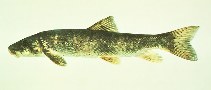
Các tia vây lưng cứng (tổng cộng) : 0; Các vây lưng mềm (tổng cộng) : 9 - 11; Tia cứng vây hậu môn: 0; Tia mềm vây hậu môn: 7; Động vật có xương sống: 45 - 47. Distinguished by the sucking mouth located on the ventral sides of the head and thick papillose lips (Ref. 27547). Gill rakers short; lateral line complete, inconspicuous; caudal tips slightly rounded (Ref. 27547). Adults may be reddish brown, dark brassy green or black above, paler on the lower sides, with the ventral parts white; young fish are usually dark gray with small black spots; breeding males are usually dark above with a brilliant reddish stripe along each side, while females are greenish gold to copper, with a less brilliant red stripe; breeding males show prominent tubercles on the rays of the anal and caudal fins and also on the head (Ref. 27547).
Body shape (shape guide): fusiform / normal.
Found in clear, cold, deep water of lakes and tributary streams; occasionally found in brackish water in the Arctic (Ref. 5723). Moves from lakes into inlet streams or from slow, deep pools into shallow, gravel-bottomed portions of streams to spawn (Ref. 27547). Feeds on benthic invertebrates (Ref. 1998). Young are preyed upon by other fishes and fish-eating birds; while adults in spawning streams are taken by mammals, osprey and eagles (Ref. 1998). Utilized as a food fish or as dog food (Ref. 27547).
Spawns only during daytime (Ref. 27547). At spawning, males lie close to the bottom in the current of the spawning area while females stay along the banks and in still water (Ref. 27547). A female moves from the bank of the stream usually escorted by 2-4 males to the spawning area at the center of the stream. The males crowd beside her; egg deposition occurs as the males try to clasp the female with their pelvic fins or vibrate against her with their anal fins. This spawning act lasts for 3-5 seconds and may occur as often as 6-40 times per hour. After the eggs are deposited, the sexes separate and return to their previous stream positions (Ref.1998). Fish that moved out of a lake to spawn generally return to the lake a few days after spawning. However, river-resident fish may stay on or near the spawning area for much of the summer (Ref. 27547). Many spawn in two or even three consecutive years but others may skip one or two years between spawning (Ref. 10928).
Page, L.M. and B.M. Burr, 1991. A field guide to freshwater fishes of North America north of Mexico. Houghton Mifflin Company, Boston. 432 p. (Ref. 5723)
IUCN Red List Status (Ref. 130435: Version 2025-1)
Threat to humans
Harmless
Human uses
Các nghề cá: buôn bán nhỏ; cá để chơi: đúng; Bể nuôi cá: Bể cá công cộng
Các công cụ
Special reports
Download XML
Các nguồn internet
Estimates based on models
Phylogenetic diversity index (Tài liệu tham khảo
82804): PD
50 = 0.5000 [Uniqueness, from 0.5 = low to 2.0 = high].
Bayesian length-weight: a=0.01288 (0.00760 - 0.02184), b=3.00 (2.85 - 3.15), in cm total length, based on LWR estimates for this species & (Sub)family-body (Ref.
93245).
Mức dinh dưỡng (Tài liệu tham khảo
69278): 2.5 ±0.3 se; based on diet studies.
Thích nghi nhanh (Tài liệu tham khảo
120179): thấp, thời gian nhân đôi của chủng quần tối thiểu là 4.5 - 14 năm (tm=2-10; tm=20).
Fishing Vulnerability (Ref.
59153): Moderate to high vulnerability (46 of 100).
🛈