



Ptychocheilus oregonensis (Richardson, 1836)
Northern pikeminnow
Uploaden van uw Foto's en video's
Afbeeldingen | Google afbeelding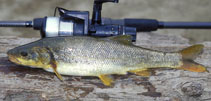 Ptychocheilus oregonensis
Afbeelding van JJPhoto
Afbeeldingen | Google afbeelding
Afbeelding van JJPhoto
Classificatie / Namen Lokale namen | Synoniemen | Catalog of Fishes(Genus, Soort(en)) | ITIS | CoL | WoRMS | Cloffa
> Cypriniformes (Carps) > Leuciscidae (Minnows) > Laviniinae
Etymology: Ptychocheilus: Greek, ptyx, ptychos = fold + Greek, cheilos = lip (Ref. 45335); oregonensis: oregonensis meaning - of Oregon (Ref. 1998).
More on author: Richardson.
Etymology: Ptychocheilus: Greek, ptyx, ptychos = fold + Greek, cheilos = lip (Ref. 45335); oregonensis: oregonensis meaning - of Oregon (Ref. 1998).
More on author: Richardson.
Milieu: milieu / Klimaatzone / Diepte / verspreidingsgebied Ecologie
; zoet water benthopelagisch; potamodroom (Ref. 126106). Temperate; 55°N - 39°N
Verspreiding Gebieden | FAO regio's | Ecosystemen | Voorkomen | Verspreidingskaart | Introducties | Faunafri
North America: Pacific drainages from Nass River in British Columbia, Canada to Columbia River in Nevada, USA; Harney River basin in Oregon, USA; Peace River system (Arctic basin) in British Columbia and Alberta, Canada.
Grootte / Gewicht / Leeftijd
Maturiteit: Lm ? range ? - ? cm
Max length : 63.0 cm TL mannelijk / geslacht onbekend; (Ref. 5723); common length : 22.0 cm TL mannelijk / geslacht onbekend; (Ref. 12193); max. gepubliceerd gewicht: 13.0 kg (Ref. 1998); max. gerapporteerde leeftijd: 11 Jaren (Ref. 72462)
Max length : 63.0 cm TL mannelijk / geslacht onbekend; (Ref. 5723); common length : 22.0 cm TL mannelijk / geslacht onbekend; (Ref. 12193); max. gepubliceerd gewicht: 13.0 kg (Ref. 1998); max. gerapporteerde leeftijd: 11 Jaren (Ref. 72462)
Korte beschrijving Determinatiesleutels | Morfologie | Morfometrie
Dorsale zachte stralen (totaal) : 9 - 10; Anale zachte stralen: 8 - 9; Wervels: 44 - 46. Mot deep bodied, greatest depth 16.6% (TL), belly gently rounded in mature individuals. Head moderately long, its length 22.8% (TL); eye small in adults, 17.6% of head length, but larger in young 7.6 cm long, when 25.2% of head length; snout long, 33.1% of head length of adults; interorbital width 29.6% of head length; mouth large, extending back to below anterior margin of eye. All fins clear. Pelvic axillary process usually a ridge. Peritoneum present. Nuptial tubercles fine, on head and back, on pectoral and pelvic fins and sometimes on the caudal fin. Dark green or green-brown dorsally becoming silvery white or cream ventrally. The lower fins of the males become yellow or yellow-orange during spawning period (Ref. 1998). Dorsal fin usually with 9 rays; anal fin with 8 rays; 48-72, usually 51-62, scales on back from head to dorsal fin; 64-79, usually 66-75, scales on lateral line; and 12-20 scales above lateral line (Ref. 86798).
Body shape (shape guide): fusiform / normal.
Body shape (shape guide): fusiform / normal.
Found in lakes, pools and occasionally in runs of small to large rivers. Large individuals occur in deep water (Ref. 5723, 86798). They feed on fishes, terrestrial insects, plankton, aquatic insect larvae, and crustaceans while inshore; and on fishes while offshore (Ref. 1998). Male squawfish, prickly sculpins, and newts prey on the eggs (Ref. 1998). Edible but not well appreciated (1998).
Levenscyclus en paargedrag Maturiteit | Voortplanting | Paaien | Eieren | Fecunditeit | Larven
A female is surrounded by males close to the bottom; eggs and sperm are released at the same time and eggs settle in the gravel.
Hoofdreferentie
Upload uw referenties | Referenties | Coördinator | Medewerkers
Page, L.M. and B.M. Burr, 2011. A field guide to freshwater fishes of North America north of Mexico. Boston : Houghton Mifflin Harcourt, 663p. (Ref. 86798)
Status op de Rode Lijst van het IUCN (Ref. 130435: Version 2025-2 (Global))
Niet bedreigd (LC) ; Date assessed: 01 March 2012
CITES
Not Evaluated
Gevaar voor de mens
Harmless
Gebruik door de mens
Visserij: commercieel; sportvis: ja; Aquarium: Publieke aquaria
FAO - Publication: search | FishSource |
Meer informatie
Trofische ecologie
Voedsel (prooien)
Dieetsamenstelling
Voedselconsumptie
Voedselrantsoenen
Predatoren
Voedsel (prooien)
Dieetsamenstelling
Voedselconsumptie
Voedselrantsoenen
Predatoren
Populatiedynamica
Groeiparameters
Max. leeftijden / maten
Lengte-gewicht rel.
Lengte-lengte rel.
Lengtefrequenties
Massaconversie
Rekrutering
Abundantie
Groeiparameters
Max. leeftijden / maten
Lengte-gewicht rel.
Lengte-lengte rel.
Lengtefrequenties
Massaconversie
Rekrutering
Abundantie
Levenscyclus
Voortplanting
Maturiteit
Rijpheid/kieuwen rel.
Fecunditeit
Paaien
Paaibestanden
Eieren
Ontwikkeling van de eieren
Larven
Larvale populatiedynamiek
Voortplanting
Maturiteit
Rijpheid/kieuwen rel.
Fecunditeit
Paaien
Paaibestanden
Eieren
Ontwikkeling van de eieren
Larven
Larvale populatiedynamiek
Anatomie
Kieuwoppervlak
Hersenen
Otoliet
Kieuwoppervlak
Hersenen
Otoliet
Fysiologie
Lichaamssamenstelling
Voedingsstoffen
Zuurstofverbruik
Type zwemmen
Zwemsnelheid
Visuele pigmenten
Vis geluid
Ziekten en parasieten
Toxiciteit (LC50)
Lichaamssamenstelling
Voedingsstoffen
Zuurstofverbruik
Type zwemmen
Zwemsnelheid
Visuele pigmenten
Vis geluid
Ziekten en parasieten
Toxiciteit (LC50)
Menselijk gerelateerd
Aquacultuursystemen
Aquacultuurprofielen
Kweeklijnen
Ciguatera gevallen
Postzegels, munten, diversen.
Aquacultuursystemen
Aquacultuurprofielen
Kweeklijnen
Ciguatera gevallen
Postzegels, munten, diversen.
Tools
E-boek | Veldgids | Determinatiesleutels | Lengtefrequentie Tool | Levenscyclus tool | Verspreidingskaart |
Vangst-MSY |
Speciale rapporten
Bekijk gegevens voor het houden in een aquarium | Bekijk Fact Sheets voor de soort | Bekijk Aquacultuur Fact Sheets
Download XML
Internetbronnen
AFORO (otoliths) | Exoten/Invasieve soorten database | Aquatic Commons | BHL | Cloffa | Websites from users | Bekijk FishWatcher | CISTI | Catalog of Fishes: Genus, Soort(en) | DiscoverLife | ECOTOX | FAO - Publication: search | Faunafri | Fishipedia | Fishtrace | GloBI | Google Books | Google Scholar | Google | IGFA World Record | OneZoom | Open Tree of Life | Otolith Atlas of Taiwan Fishes | Publieke aquaria | PubMed | Reef Life Survey | Socotra Atlas | TreeBase | Tree of Life | Wikipedia: ga naar, zoek | World Records Freshwater Fishing | Zoological Record
Schattingen op basis van modellen
Fylogenetische diversiteitsindex (Ref. 82804): PD50 = 0.5625 [Uniqueness, from 0.5 = low to 2.0 = high].
Bayesian length-weight: a=0.01072 (0.00435 - 0.02642), b=3.02 (2.80 - 3.24), in cm total length, based on LWR estimates for this species & (Sub)family-body (Ref. 93245).
Trofisch niveau (Ref. 69278): 4.2 ±0.4 se; based on diet studies.
Generation time: 13.6 ( na - na) years. Estimated as median ln(3)/K based on 2 growth studies.
Weerstandsvermogen (Ref. 120179): laag, minimale populatieverdubbelingstijd 4,5-14 jaar (K=0.08-0.21).