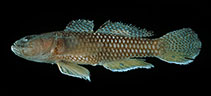
Environment: milieu / climate zone / profondeur / distribution range
Écologie
marin démersal; non migrateur; profondeur 0 - 40 m (Ref. 89467). Subtropical
Pacific Ocean: Kermadec, Lord Howe, Pitcairn, Easter Island and French Polynesia (Rapa).
Taille / Poids / Âge
Maturité: Lm ? range ? - ? cm
Max length : 4.7 cm NG mâle / non sexé; (Ref. 89467)
Description synthétique
Clés d'identification | Morphologie | Morphométrie
Épines dorsales (Total) : 7; Rayons mous dorsaux (Total) : 11; Vertèbres: 26. This species is distinguished by the following characters: interorbital trench absent, merely a slight depression between and behind eyes; incomplete squamation on predorsal, a naked triangular area behind eyes and interorbital area, and a naked bar extending forward from origin of first dorsal fin; in specimens below 20 mm SL midline usually naked, anterior extent of predorsal scales on sides of nape increasing with increasing size; no opercular scales; no scales on cheek; D2 modally I,11; A modally I,9; pectoral rays usually 19-20; reduced transverse pattern of sensory papillae on cheek; pelvic fins connected to form a plate, no interspinal membrane, fifth ray branched; each scale pocket with concentrated melanophores along margin forming a diamond-shaped mark; preserved specimens with vertical bands on head, often none on body; in life, 1-2 very faint vertical bars under first dorsal fin; mouth oblique, forming an angle of 35°-45° with body axis (Ref. 85603).
Body shape (shape guide): fusiform / normal.
Occurs in rocky and coral reefs from the intertidal to depths of over 20 m (Ref. 85603).
Life cycle and mating behavior
Maturité | Reproduction | Frai | Œufs | Fécondité | Larves
Winterbottom, R. and M. Burridge, 1993. A new species of Priolepis (Teleostei; Gobiidae) from the Kermadec Islands, southwest Pacific Ocean, with comments on relationships. Can. J. Zool. 71:2077-2079. (Ref. 13685)
Statut dans la liste rouge de l'IUCN (Ref. 130435: Version 2025-1)
Menace pour l'homme
Harmless
Utilisations par l'homme
Outils
Articles particuliers
Télécharger en XML
Sources Internet
Estimates based on models
Preferred temperature (Réf.
123201): 21.2 - 23.6, mean 22.6 °C (based on 4 cells).
Phylogenetic diversity index (Réf.
82804): PD
50 = 0.5000 [Uniqueness, from 0.5 = low to 2.0 = high].
Bayesian length-weight: a=0.01023 (0.00477 - 0.02194), b=3.01 (2.83 - 3.19), in cm total length, based on LWR estimates for this (Sub)family-body shape (Ref.
93245).
Niveau trophique (Réf.
69278): 3.2 ±0.3 se; based on size and trophs of closest relatives
Résilience (Réf.
120179): Haut, temps minimum de doublement de population inférieur à 15 mois (Preliminary K or Fecundity.).
Fishing Vulnerability (Ref.
59153): Low vulnerability (10 of 100).
🛈