



Uploaden van uw Foto's en video's
Afbeeldingen | Google afbeelding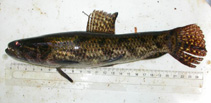 Hoplias aimara
Afbeelding van Brosse, S.
Afbeeldingen | Google afbeelding
Afbeelding van Brosse, S.
Classificatie / Namen Lokale namen | Synoniemen | Catalog of Fishes(Genus, Soort(en)) | ITIS | CoL | WoRMS | Cloffa
> Characiformes (Characins) > Erythrinidae (Trahiras)
Etymology: Hoplias: Greek, hoplon = weapon (Ref. 45335).
More on author: Valenciennes.
Etymology: Hoplias: Greek, hoplon = weapon (Ref. 45335).
More on author: Valenciennes.
Taxonomic Remarks
No recent work, see original description.
Milieu: milieu / Klimaatzone / Diepte / verspreidingsgebied Ecologie
; zoet water benthopelagisch; potamodroom (Ref. 51243). Tropical
Verspreiding Gebieden | FAO regio's | Ecosystemen | Voorkomen | Verspreidingskaart | Introducties | Faunafri
South America: Tributaries of middle and lower Amazon basin, including Rios Trombretas, Jari, Tapajós, Xingu, Tocantins, and in the coastal rivers of Guyana, Suriname, Fr Guiana; Rios Araguari and Amapá, state of Amapá, Brazil; lower reaches of Río Orinoco, Venezuela.
Lengte bij maturiteit / Grootte / Gewicht / Leeftijd
Maturiteit: Lm 22.0, range 22 - 22 cm
Max length : 100.0 cm SL mannelijk / geslacht onbekend; (Ref. 12225); max. gepubliceerd gewicht: 40.0 kg (Ref. 12225)
Max length : 100.0 cm SL mannelijk / geslacht onbekend; (Ref. 12225); max. gepubliceerd gewicht: 40.0 kg (Ref. 12225)
Frequently occurs in counter current zones of principal rivers and creeks. Feeds mainly on fish but also on other animals that fall into the water like small terrestrial invertebrates. Is active at dusk and at night. Reproduction takes place at the onset of the rainy season from December to March. Depending on the size, the female can carry around 6,000 to 60,000 eggs (Ref. 12225). Known for the quality of its flesh (Ref. 27188).
Levenscyclus en paargedrag Maturiteit | Voortplanting | Paaien | Eieren | Fecunditeit | Larven
Hoofdreferentie
Upload uw referenties | Referenties | Coördinator : Oyakawa, Osvaldo T. | Medewerkers
Planquette, P., P. Keith and P.-Y. Le Bail, 1996. Atlas des poissons d'eau douce de Guyane. Tome 1. Collection du Patrimoine Naturel Volume 22, MNHN, Paris & INRA, Paris. 429 p. (Ref. 12225)
Status op de Rode Lijst van het IUCN (Ref. 130435: Version 2025-2 (Global))
Niet bedreigd (LC) ; Date assessed: 07 August 2020
CITES
Not Evaluated
Gevaar voor de mens
Harmless
Gebruik door de mens
Visserij: commercieel; Aquarium: Commercieel
FAO - Publication: search | FishSource |
Meer informatie
Trofische ecologie
Voedsel (prooien)
Dieetsamenstelling
Voedselconsumptie
Voedselrantsoenen
Predatoren
Voedsel (prooien)
Dieetsamenstelling
Voedselconsumptie
Voedselrantsoenen
Predatoren
Populatiedynamica
Groeiparameters
Max. leeftijden / maten
Lengte-gewicht rel.
Lengte-lengte rel.
Lengtefrequenties
Massaconversie
Rekrutering
Abundantie
Groeiparameters
Max. leeftijden / maten
Lengte-gewicht rel.
Lengte-lengte rel.
Lengtefrequenties
Massaconversie
Rekrutering
Abundantie
Levenscyclus
Voortplanting
Maturiteit
Rijpheid/kieuwen rel.
Fecunditeit
Paaien
Paaibestanden
Eieren
Ontwikkeling van de eieren
Larven
Larvale populatiedynamiek
Voortplanting
Maturiteit
Rijpheid/kieuwen rel.
Fecunditeit
Paaien
Paaibestanden
Eieren
Ontwikkeling van de eieren
Larven
Larvale populatiedynamiek
Anatomie
Kieuwoppervlak
Hersenen
Otoliet
Kieuwoppervlak
Hersenen
Otoliet
Fysiologie
Lichaamssamenstelling
Voedingsstoffen
Zuurstofverbruik
Type zwemmen
Zwemsnelheid
Visuele pigmenten
Vis geluid
Ziekten en parasieten
Toxiciteit (LC50)
Lichaamssamenstelling
Voedingsstoffen
Zuurstofverbruik
Type zwemmen
Zwemsnelheid
Visuele pigmenten
Vis geluid
Ziekten en parasieten
Toxiciteit (LC50)
Genetica
genoom
Genetica
Heterozygositeit
Erfelijkheid
Genetische diversiteit
genoom
Genetica
Heterozygositeit
Erfelijkheid
Genetische diversiteit
Menselijk gerelateerd
Aquacultuursystemen
Aquacultuurprofielen
Kweeklijnen
Ciguatera gevallen
Postzegels, munten, diversen.
Aquacultuursystemen
Aquacultuurprofielen
Kweeklijnen
Ciguatera gevallen
Postzegels, munten, diversen.
Tools
Speciale rapporten
Bekijk gegevens voor het houden in een aquarium | Bekijk Fact Sheets voor de soort | Bekijk Aquacultuur Fact Sheets
Download XML
Internetbronnen
AFORO (otoliths) | Aquatic Commons | BHL | Cloffa | Websites from users | Bekijk FishWatcher | CISTI | Catalog of Fishes: Genus, Soort(en) | DiscoverLife | ECOTOX | FAO - Publication: search | Faunafri | Fishipedia | Fishtrace | GloBI | Google Books | Google Scholar | Google | IGFA World Record | OneZoom | Open Tree of Life | Otolith Atlas of Taiwan Fishes | PubMed | Reef Life Survey | Socotra Atlas | TreeBase | Tree of Life | Wikipedia: ga naar, zoek | World Records Freshwater Fishing | Zoological Record
Schattingen op basis van modellen
Fylogenetische diversiteitsindex (Ref. 82804): PD50 = 0.5000 [Uniqueness, from 0.5 = low to 2.0 = high].
Bayesian length-weight: a=0.00741 (0.00445 - 0.01234), b=3.13 (2.98 - 3.28), in cm total length, based on LWR estimates for this species & (Sub)family-body (Ref. 93245).
Trofisch niveau (Ref. 69278): 3.7 ±0.55 se; based on food items.
Weerstandsvermogen (Ref. 120179): Gemiddeld, minimale populatieverdubbelingstijd 1,4-4,4 jaar (tm=1; Fec=6,000).