>
Cypriniformes (Carps) >
Leuciscidae (Minnows) > Laviniinae
Etymology: Gila: A river flowing from Southwest New Mexico westward across south Arizona into the Colorado River.
More on author: Girard.
Environment: milieu / climate zone / profondeur / distribution range
Écologie
; eau douce benthopélagique. Temperate; 48°N - 38°N
North America: Snake River system above Shoshone Falls in Wyoming and Idaho; Lake Bonneville basin (including Great Salt Lake drainage and Sevier River system) in southeastern Idaho and Utah, USA. Introduced into east Nevada, upper Missouri River basin in Montana, and Colorado River drainage in Wyoming and Utah.
Taille / Poids / Âge
Maturité: Lm ? range ? - ? cm
Max length : 56.0 cm TL mâle / non sexé; (Ref. 86798); common length : 17.5 cm TL mâle / non sexé; (Ref. 12193); âge max. reporté: 12 années (Ref. 126511)
Description synthétique
Clés d'identification | Morphologie | Morphométrie
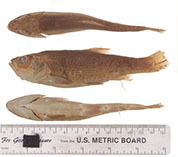
Rayons mous dorsaux (Total) : 9; Rayons mous anaux: 8 - 9. Gila atraria can be distinguished by the following characters: deep, compressed body; large eye; short, blunt snout; 45-65 scales on lateral line; dorsal fin usually with 9 rays; anal fin with 8 rays; pharyngeal teeth 2,5-4,2; olive-brown to blue-black above; yellow to brassy side; clear to olive-yellow fins; and large males with yellow to gold-fin bases, mouth and side of the head, may be gold overall (Ref. 86798).
Body shape (shape guide): fusiform / normal.
Occurs in lakes, quiet pools of headwaters, creeks and small to medium rivers. Often found in vegetation over mud or sand (Ref. 86798).
Life cycle and mating behavior
Maturité | Reproduction | Frai | Œufs | Fécondité | Larves
Page, L.M. and B.M. Burr, 2011. A field guide to freshwater fishes of North America north of Mexico. Boston : Houghton Mifflin Harcourt, 663p. (Ref. 86798)
Statut dans la liste rouge de l'IUCN (Ref. 130435: Version 2025-1)
Menace pour l'homme
Harmless
Utilisations par l'homme
Outils
Articles particuliers
Télécharger en XML
Sources Internet
Estimates based on models
Phylogenetic diversity index (Réf.
82804): PD
50 = 0.5000 [Uniqueness, from 0.5 = low to 2.0 = high].
Bayesian length-weight: a=0.01122 (0.00439 - 0.02869), b=3.04 (2.82 - 3.26), in cm total length, based on LWR estimates for this (Sub)family-body shape (Ref.
93245).
Niveau trophique (Réf.
69278): 2.0 ±0.2 se; based on size and trophs of closest relatives
Résilience (Réf.
120179): Faible, temps minimum de doublement de population : 4,5 à 14 années (K=0.12-0.28).
Fishing Vulnerability (Ref.
59153): Moderate to high vulnerability (53 of 100).
🛈