



Norfolkia squamiceps (McCulloch & Waite, 1916)
Scalyhead Triplefin
Aggiungete la vostra osservazione in Fish Watcher
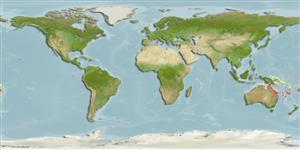
| Native range | All suitable habitat | Point map | Year 2050 |
|
| This map was computer-generated and has not yet been reviewed. |
| Norfolkia squamiceps AquaMaps Data sources: GBIF OBIS |
Carica il tuo foto e Video
Immagini | Video | Google image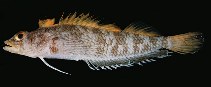 Norfolkia squamiceps
Immagine di Randall, J.E.
Immagini | Video | Google image
Immagine di Randall, J.E.
Classificazione / Nomi Nomi Comuni | Sinonimi | Catalog of Fishes(Genere, Specie) | ITIS | CoL | WoRMS | Cloffa
> Blenniiformes (Blennies) > Tripterygiidae (Triplefin blennies) > Tripterygiinae
Etymology: Norfolkia: Named for the Norfolk Island ( In 1953 Henry W. Fowler named this new genus on a Collection of Fishes Made by Dr. Marshall Laird at Norfolk Island) (R.Bajol, pers.comm. 04/2016).
More on authors: McCulloch & Waite.
Etymology: Norfolkia: Named for the Norfolk Island ( In 1953 Henry W. Fowler named this new genus on a Collection of Fishes Made by Dr. Marshall Laird at Norfolk Island) (R.Bajol, pers.comm. 04/2016).
More on authors: McCulloch & Waite.
Ambiente: milieu / zona climatica / distribuzione batimetrica / gamma di distribuzione Ecologia
marino associati a barriera corallina; distribuzione batimetrica 0 - 12 m (Ref. 13227). Subtropical
Distribuzione Territories | Aree FAO | Ecosistemi | Presenze | Mappa dei ritrovamenti | Introduzioni | Faunafri
Southwest Pacific: Australia, including Lord Howe Island, Norfolk Island, Middleton Reef, and Elizabeth Reef; and New Caledonia.
Dimensione / Peso / Età
Breve descrizione Chiavi di identificazione | Morfologia | Morfometria
Spine dorsali (totale) : 18 - 19; Raggi dorsali molli (totale) : 10 - 11; Spine anali: 2; Raggi anali molli: 20 - 21. Head to eye and preopercle with scales; small and palmate supraorbital tentacle; light gray or light brown body with 2 linear series of uneven brown blotches with larger dorsal series and some upper blotches joining with lower; below eye is an oblique, dark brown bar with white margin; remainder of head dark brown, blending to white ventrally; females with oblique dark bands on second and third dorsal fins, darkening as they cross rays; uneven, vertical dark bars on caudal fin; yellow or orange dorsal and caudal fins in males. Dorsal rays IV + XIV-XV (typically XV) + 10-11 (typically 11); lateral line discontinuous, 21-24 + 14-19; mandibular pores 5-6 + 1 + 5-6 (Ref. 54980).
Body shape (shape guide): elongated.
Body shape (shape guide): elongated.
Adults are found in intertidal pools in coral reef areas (Ref. 13227). Eggs are hemispherical and covered with numerous sticky threads that anchor them in the algae on the nesting sites (Ref. 240). Larvae are planktonic which occur primarily in shallow, nearshore waters (Ref. 94114).
Ciclo vitale e comportamento di accoppiamento Maturità | Riproduzione | Deposizione | Uova | Fecondità | Larve
Riferimento principale
Caricare le referenze | Bibliografia | Coordinatore : Fricke, Ronald | Collaboratori
Fricke, R., 1994. Tripterygiid fishes of Australia, New Zealand and the southwest Pacific Ocean (Teleostei). Theses Zool. 24:1-585. (Ref. 13227)
Stato della Lista Rossa IUCN (Ref. 130435: Version 2025-2 (Global))
Least Concern (LC) ; Date assessed: 06 May 2010
CITES
Not Evaluated
Minaccia per l'uomo
Harmless
Usi umani
Pesca: di nessun interesse
FAO - Publication: search | FishSource |
Informazioni ulteriori
Ecologia trofica
Articoli alimentari (prede)
Alimentazione
Consumo di cibo
Razioni alimentari
Predatori
Articoli alimentari (prede)
Alimentazione
Consumo di cibo
Razioni alimentari
Predatori
Ecologia
Ecologia
Ecologia
Dinamica della popolazione
Parametri di crescita
Età massima / dimensioni massime
Rapporto lunghezza-peso.
Lunghezza-lunghezza rel.
Lunghezza-frequenze
Conversione di massa
Reclutamento
Abbondanza
Parametri di crescita
Età massima / dimensioni massime
Rapporto lunghezza-peso.
Lunghezza-lunghezza rel.
Lunghezza-frequenze
Conversione di massa
Reclutamento
Abbondanza
Anatomia
Area branchiale
Cervello
Otolite
Area branchiale
Cervello
Otolite
Fisiologia
Composizione corporea
Nutrienti
Consumo di ossigeno
Tipo di nuoto
Velocità di nuoto
Pigmenti visivi
Suono del pesce
Malattie e parassiti
Tossicità (LC50)
Composizione corporea
Nutrienti
Consumo di ossigeno
Tipo di nuoto
Velocità di nuoto
Pigmenti visivi
Suono del pesce
Malattie e parassiti
Tossicità (LC50)
Genetica
Genome
Genetica
Eterozigosi
Ereditarietà
Diversità genetica
Genome
Genetica
Eterozigosi
Ereditarietà
Diversità genetica
Legato all'uomo
Sistemi di acquacoltura
Profili di acquacoltura
Varietà
Casi di Ciguatera
Francobolli, monete, materiale vario.
Sistemi di acquacoltura
Profili di acquacoltura
Varietà
Casi di Ciguatera
Francobolli, monete, materiale vario.
Strumenti
Libro elettronico | Giuda pratica | Generatore frequenze di lunghezza | Strumento Parametri Biologici | Mappa dei ritrovamenti |
Cattura-MSY |
Rapporti speciali
Controllo della manutenzione dell'acquario | Verificare la presenza di schede informative sulle specie | Verifica delle schede informative sull'acquacoltura
Scarica XML
Fonti Internet
AFORO (otoliths) | Aquatic Commons | BHL | Cloffa | Websites from users | Check FishWatcher | CISTI | Catalog of Fishes: Genere, Specie | DiscoverLife | ECOTOX | FAO - Publication: search | Faunafri | Fishipedia | Fishtrace | GloBI | Google Books | Google Scholar | Google | IGFA World Record | OneZoom | Open Tree of Life | Otolith Atlas of Taiwan Fishes | PubMed | Reef Life Survey | Socotra Atlas | TreeBase | Tree of Life | Wikipedia: Go, ricerca | World Records Freshwater Fishing | Record zoologico
Stime basate su modelli
Temperatura preferita (Fonte Biblio. 123201): 23.2 - 27.9, mean 26.4 °C (based on 383 cells).
Indice di diversità filogenetica (Fonte Biblio. 82804): PD50 = 0.5625 [Uniqueness, from 0.5 = low to 2.0 = high].
Bayesian length-weight: a=0.00617 (0.00290 - 0.01310), b=3.04 (2.86 - 3.22), in cm total length, based on LWR estimates for this (Sub)family-body shape (Ref. 93245).
Livello trofico (Fonte Biblio. 69278): 3.2 ±0.4 se; based on size and trophs of closest relatives
Resilienza (Fonte Biblio. 120179): Alto, tempo minimo di raddoppiamento della popolazione meno di 15 mesi (Preliminary K or Fecundity.).
Nutrienti (Ref. 124155): Calcium = 167 [66, 399] mg/100g; Iron = 1.29 [0.60, 2.61] mg/100g; Protein = 19.1 [17.8, 20.4] %; Omega3 = 0.147 [0.060, 0.365] g/100g; Selenium = 15.4 [4.9, 42.6] μg/100g; VitaminA = 47.7 [11.0, 220.5] μg/100g; Zinc = 2 [1, 3] mg/100g (wet weight);