



Dallia pectoralis Bean, 1880
Alaska blackfish
Hochladen Photos und videos
Bilder | Google Bild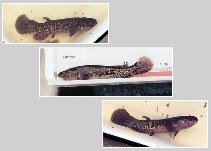 Dallia pectoralis
Photo von Whitman, M.
Bilder | Google Bild
Photo von Whitman, M.
Klassifizierung / Names Namen | Synonyme | Catalog of Fishes(Gattung, Arten) | ITIS | CoL | WoRMS | Cloffa
> Esociformes (Pikes and mudminnows) > Umbridae (Mudminnows)
Eponymy: William Healey Dall (1845–1927) was an America naturalist. [...] (Ref. 128868), visit book page.
More on author: Bean.
Eponymy: William Healey Dall (1845–1927) was an America naturalist. [...] (Ref. 128868), visit book page.
More on author: Bean.
Umwelt: Milieu / Klimazone / Tiefenbereich / Verbreitungsgebiet Ökologie
Verbreitung Territorien | FAO Gebiete | Ökosysteme | Vorkommen | Punkt Karte | Einführungen | Faunafri
North America: Alaska from Colville River delta south to central Alaska Peninsula near Chignik; upstream in Yukon-Tanana drainage to near Fairbanks. Also Bering Sea islands and northeastern Siberia, Russia.
Größe / Gewicht / Alter
Geschlechtsreife: Lm ? range ? - ? cm
Max length : 33.0 cm TL Männchen/unbestimmt; (Ref. 5723); common length : 10.8 cm TL Männchen/unbestimmt; (Ref. 12193); max. veröff. Gewicht: 366.00 g (Ref. 28675); max. veröff. Alter: 8 Jahre (Ref. 12193)
Max length : 33.0 cm TL Männchen/unbestimmt; (Ref. 5723); common length : 10.8 cm TL Männchen/unbestimmt; (Ref. 12193); max. veröff. Gewicht: 366.00 g (Ref. 28675); max. veröff. Alter: 8 Jahre (Ref. 12193)
Kurzbeschreibung Bestimmungsschlüssel | Morphologie | Morphometrie
Rückenflossenstacheln (insgesamt) : 0; Rückenflossenweichstrahlen (insgesamt) : 10 - 14; Afterflossenstacheln: 0; Afterflossenweichstrahlen: 12 - 16; Wirbelzahl: 40 - 42. Identified by its short, flattened snout, the rearward location of the dorsal and anal fins, the presence of about 33 rays in the pectorals, and the presence of a pelvic fin that has only 3 rays (Ref. 27547). Gill rakers short; lateral line with minute pores: 76 to 100 scales in midlateral series (Ref. 27547). Dorsal located far back on body; anal more or less under dorsal; edge of pectorals rounded; pelvic fins very small and located just before anus; caudal broad and rounded (Ref. 27547). Dark green or brown above and on upper sides, pale below with dark speckles; four to six irregular dark bars or blotches on sides; fins have dark brownish specklings; dorsal, anal and caudal fins with pale margin, which are pink to red in spawning adults (Ref. 27547).
Body shape (shape guide): fusiform / normal.
Body shape (shape guide): fusiform / normal.
Facultative air-breathing (Ref. 126274); Usually found in heavily vegetated swamps and ponds; occasionally in medium to large rivers and lakes with abundant vegetation (Ref. 5723). Migrations appear to be limited to inshore or upstream movements to spawning grounds in the spring and (presumably) reverse migrations to deeper water in the fall (Ref. 27547). Oviparous, batch spawner (Ref. 205). Known for their tolerance to cold water: survives exposures to -20°C for up to 40 minutes, and can survive for a few days after complete freezing of parts of the body, even the head (Ref. 28673, 28674). Uses its esophagus as auxiliary breathing organ (Ref. 27797).
Lebenszyklus und Paarungsverhalten Geschlechtsreife | Fortpflanzung | Ablaichen | Eier | Fruchtbarkeit | Larven
Upstream movement appears to coincide with a rise of water temperature to 10° to 15°C (Ref. 3829). Females normally contain two sets of eggs, the smaller group presumably being the set which will be spawned the following year. Females deposit 40 to 300 eggs, the number increasing with size. A female probably spawns over a period of several days, possibly longer, with only a few eggs being extruded at each spawning act. (Ref. 27547).
Hauptreferenz
Laden Sie Ihre Referenzen hoch | Referenzen | Koordinator | Partner
Page, L.M. and B.M. Burr, 1991. A field guide to freshwater fishes of North America north of Mexico. Houghton Mifflin Company, Boston. 432 p. (Ref. 5723)
IUCN Rote Liste Status (Ref. 130435: Version 2025-2 (Global))
nicht bedroht (LC) ; Date assessed: 13 March 2020
CITES
Not Evaluated
Bedrohung für Menschen
Harmless
Nutzung durch Menschen
Fischereien: kleinfischerei; Aquarium: Kommerziell
FAO - Publication: search | FishSource |
Mehr Information
Trophische Ökologie
Lebensmittel (Beutetiere)
Nahrungszusammensetzung
Nahrungsaufnahme
Lebensmittelrationen
Räuber
Lebensmittel (Beutetiere)
Nahrungszusammensetzung
Nahrungsaufnahme
Lebensmittelrationen
Räuber
Populationsdynamik
Wachstumsparameter
Max. Alter/Größen
Länge-Gewicht-Rel.
Länge-Länge-Verhältnis.
Längenhäufigkeiten
Massenkonvertierung
Rekrutierung
Dichte
Wachstumsparameter
Max. Alter/Größen
Länge-Gewicht-Rel.
Länge-Länge-Verhältnis.
Längenhäufigkeiten
Massenkonvertierung
Rekrutierung
Dichte
Lebenszyklus
Fortpflanzung
Geschlechtsreife
Reifung/Kiemen rel.
Fruchtbarkeit
Ablaichen
Laichaggregationen
Eier
Eientwicklung
Larven
Larven Pop.Dyn.
Fortpflanzung
Geschlechtsreife
Reifung/Kiemen rel.
Fruchtbarkeit
Ablaichen
Laichaggregationen
Eier
Eientwicklung
Larven
Larven Pop.Dyn.
Anatomie
Kiemenoberfläche
Gehirn
Otolith
Kiemenoberfläche
Gehirn
Otolith
Physiologie
Körperliche Zusammensetzung
Nährstoffe
Sauerstoffverbrauch
Schwimmart
Schwimmgeschwindigkeit
Visuelle Pigmente
Fischgeräusche
Krankheiten und Parasiten
Toxizität (LC50s)
Körperliche Zusammensetzung
Nährstoffe
Sauerstoffverbrauch
Schwimmart
Schwimmgeschwindigkeit
Visuelle Pigmente
Fischgeräusche
Krankheiten und Parasiten
Toxizität (LC50s)
Menschenbezogen
Aquakultur-Systeme
Aquakultur Profile
Zuchtlinien
Ciguatera-Fälle
Briefmarken, Münzen, Verschiedenes.
Aquakultur-Systeme
Aquakultur Profile
Zuchtlinien
Ciguatera-Fälle
Briefmarken, Münzen, Verschiedenes.
Tools
E-Book | Feldführer | Bestimmungsschlüssel | Längenhäufigkeits Tool | Lebensdaten Tool | Punkt Karte |
Catch-MSY |
Zusatzinformationen
Download XML
Zusammenfassung | Punktdaten | Namen | Photos
Internet Quellen
AFORO (otoliths) | Alien/Invasive Species database | Aquatic Commons | BHL | Cloffa | Websites from users | FishWatcher Einträge suchen | CISTI | Catalog of Fishes: Gattung, Arten | DiscoverLife | ECOTOX | FAO - Publication: search | Faunafri | Fishipedia | Fishtrace | GloBI | Google Books | Google Scholar | Google | IGFA World Record | OneZoom | Open Tree of Life | Otolith Atlas of Taiwan Fishes | PubMed | Reef Life Survey | Socotra Atlas | TreeBase | Tree of Life | Wikipedia: Gehe zu, Suchen | World Records Freshwater Fishing | Zoobank | Zoologischer Rekord
Schätzungen auf der Grundlage von Modellen
Phylogenetischer Diversitätsindex (Ref. 82804): PD50 = 0.6329 [Uniqueness, from 0.5 = low to 2.0 = high].
Bayesian length-weight: a=0.00871 (0.00419 - 0.01809), b=3.10 (2.91 - 3.29), in cm total length, based on LWR estimates for this species & (Sub)family-body (Ref. 93245).
Trophische Ebene (Ref. 69278): 3.3 ±0.44 se; based on food items.
Widerstandsfähigkeit (Ref. 120179): mittel, Verdopplung der Population dauert 1,4 - 4,4 Jahre. (tm=2-3; tmax=8; Fec=40-300).