>
Salmoniformes (Salmons) >
Salmonidae (Salmonids) > Coregoninae
Etymology: Prosopium: Greek, prosopon = face (Ref. 45335); williamsoni: Named after Lieut. R. S. Williamson of the U.S. Pacific Railroad Exploration.
Eponymy: Lieutenant Robert Stockton Williamson (1825–1882) was an American soldier and engineer in the US Army Corps of Topographical Engineers. [...] (Ref. 128868), visit book page.
More on author: Girard.
Environment: milieu / climate zone / profondeur / distribution range
Écologie
; eau douce benthopélagique; profondeur 5 - 20 m (Ref. 1998), usually 5 - 6 m (Ref. 1998). Temperate; ? - 23°C (Ref. 12741); 68°N - 39°N
North America: Mackenzie River drainage in Northwest Territory, Canada south through western Canada and northwestern USA in the Pacific, Hudson Bay and upper Missouri River basins to Truckee River drainage in Nevada and Sevier River drainage in Utah, USA.
Taille / Poids / Âge
Maturité: Lm ? range ? - ? cm
Max length : 70.0 cm TL mâle / non sexé; (Ref. 40637); common length : 23.4 cm TL mâle / non sexé; (Ref. 12193); poids max. publié: 2.9 kg (Ref. 40637); âge max. reporté: 17 années (Ref. 72462)
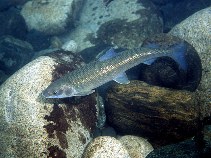
Épines dorsales (Total) : 0; Rayons mous dorsaux (Total) : 11 - 15; Épines anales: 0; Rayons mous anaux: 10 - 13; Vertèbres: 53 - 61. Body slender, elongate, nearly cylindrical in cross section but variable, more compressed laterally than round whitefish. Head short; eye moderate, its diameter less than snout length; snout more or less pointed, compressed laterally, pinched, rounded in lateral view, a single flap of skin present between nostrils. Mouth small, ventral in position, overhung by snout; maxillaries extending posteriorly almost to anterior margin of eye in adults. Teeth small, restricted to a small patch on tongue and on gill rakers in adults, although small teeth may be present on the premaxillaries in young, but absent from jaws, vomer, palatines and pre maxillae in adults. Overall coloration silvery, but light or dark brown or olive on back, becoming silvery in sides and white below. Scales, specially on back, may have pigmented borders. dorsal fin often dusky, pelvic and pectoral fins in adults with amber tint.
Body shape (shape guide): fusiform / normal; Cross section: compressed.
Occurs in lakes and fast, clear or silty streams. Feeds mainly on benthic organisms such as aquatic insect larvae, mollusks, fishes, and fish eggs (including their own) but may feed on plankton and surface insects when the need arises (Ref. 1998).
Life cycle and mating behavior
Maturité | Reproduction | Frai | Œufs | Fécondité | Larves
Page, L.M. and B.M. Burr, 1991. A field guide to freshwater fishes of North America north of Mexico. Houghton Mifflin Company, Boston. 432 p. (Ref. 5723)
Statut dans la liste rouge de l'IUCN (Ref. 130435: Version 2025-1)
Menace pour l'homme
Harmless
Utilisations par l'homme
Pêcheries: intérêt commercial mineur; pêche sportive: oui
Outils
Articles particuliers
Télécharger en XML
Sources Internet
Estimates based on models
Phylogenetic diversity index (Réf.
82804): PD
50 = 0.5156 [Uniqueness, from 0.5 = low to 2.0 = high].
Bayesian length-weight: a=0.00501 (0.00409 - 0.00614), b=3.19 (3.14 - 3.24), in cm total length, based on LWR estimates for this species (Ref.
93245).
Niveau trophique (Réf.
69278): 3.7 ±0.1 se; based on diet studies.
Generation time: 6.8 ( na - na) years. Estimated as median ln(3)/K based on 1
growth studies.
Résilience (Réf.
120179): Faible, temps minimum de doublement de population : 4,5 à 14 années (tmax=14).
Fishing Vulnerability (Ref.
59153): High vulnerability (55 of 100).
🛈