>
Tetraodontiformes (Puffers and filefishes) >
Monacanthidae (Filefishes)
Etymology: Paramonacanthus: Greek, para = the side of + Greek, monos = one + Greek, akantha ) thorn (Ref. 45335).
More on author: Bleeker.
Environment: milieu / climate zone / distribuzione batimetrica / distribution range
Ecologia
marino demersale; distribuzione batimetrica 3 - 25 m (Ref. 90102). Tropical
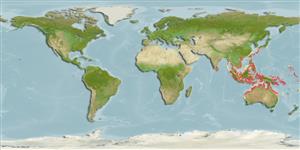
Western Pacific: Thailand, Malaysia, northwestern Australia, Philippines, Indonesia, and New Guinea.
Size / Peso / Age
Maturità: Lm ? range ? - ? cm
Max length : 11.0 cm SL maschio/sesso non determinato; (Ref. 33065)
Short description
Chiavi di identificazione | Morfologia | Morfometria
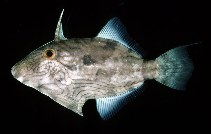
Spine dorsali (totale) : 2; Raggi dorsali molli (totale) : 27 - 31; Spine anali: 0; Raggi anali molli: 28 - 32; Vertebre: 19. Dorsal profile of snout straight to convex in male, small hump sometimes over or slightly in advance of nostrils; straight to concave in female and juvenile, without hump. First dorsal spine originating over posterior half of eye, or slightly behind eye. With dark brown to dusky blotches, sometimes tending to form two curved, oblique stripes on body, first from rear of soft dorsal fin to pectoral fin, second from caudal fin base to ventral flap; three dark brown blotches nearly always present.
Body shape (shape guide): short and / or deep.
Inhabits sheltered coastal reefs, usually forming small aggregations (Ref. 48637). Also found in mud and sand bottoms of trawling grounds (Ref. 90102).
Life cycle and mating behavior
Maturità | Riproduzione | Deposizione | Uova | Fecundity | Larve
Hutchins, J.B., 1997. Review of the monacanthid fish genus Paramonacanthus, with descriptions of three new species. Rec. West. Aust. Mus. Suppl. No. 54:1-57. (Ref. 33065)
IUCN Red List Status (Ref. 130435: Version 2025-1)
Threat to humans
Harmless
Human uses
Strumenti
Special reports
Download XML
Fonti Internet
Estimates based on models
Preferred temperature (Fonte Biblio.
123201): 25.2 - 29.3, mean 28.6 °C (based on 2286 cells).
Phylogenetic diversity index (Fonte Biblio.
82804): PD
50 = 0.5000 [Uniqueness, from 0.5 = low to 2.0 = high].
Bayesian length-weight: a=0.01995 (0.00956 - 0.04164), b=2.93 (2.76 - 3.10), in cm total length, based on LWR estimates for this (Sub)family-body shape (Ref.
93245).
Trophic level (Fonte Biblio.
69278): 3.1 ±0.3 se; based on size and trophs of closest relatives
Resilienza (Fonte Biblio.
120179): Alto, tempo minimo di raddoppiamento della popolazione meno di 15 mesi (Preliminary K or Fecundity.).
Fishing Vulnerability (Ref.
59153): Low vulnerability (10 of 100).
🛈