



Lägg till din observation i Fish Watcher
| Native range | All suitable habitat | Point map | Year 2050 |

|
| This map was computer-generated and has not yet been reviewed. |
| Echidna catenata AquaMaps Data sources: GBIF OBIS |
Ladda upp din foton och Videor
Bilder | Google image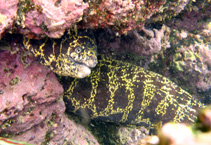 Echidna catenata
Bild av Wirtz, P.
Bilder | Google image
Bild av Wirtz, P.
Klassificering / Namn Populärnamn | synonymer | Catalog of Fishes(Släkte, Arter) | ITIS | CoL | WoRMS | Cloffa
> Anguilliformes (Eels and morays) > Muraenidae (Moray eels) > Muraeninae
Etymology: Echidna: Greek, echidna = viper, 1847 (Ref. 45335).
Eponymy: In Greek mythology Echidna was a female monster, and mother of many other monsters including the Hydra. Hesiod described her as “half a nymph with glancing eyes and fair cheeks, and half again a huge snake, great and awful, with speckled skin.” (Ref. 128868), visit book page.
More on author: Bloch.
Etymology: Echidna: Greek, echidna = viper, 1847 (Ref. 45335).
Eponymy: In Greek mythology Echidna was a female monster, and mother of many other monsters including the Hydra. Hesiod described her as “half a nymph with glancing eyes and fair cheeks, and half again a huge snake, great and awful, with speckled skin.” (Ref. 128868), visit book page.
More on author: Bloch.
Miljö: miljö / Klimatzon / djupintervall / distributionsområde Ekologi
marina revassocierade; djupintervall 0 - 12 m (Ref. 9710), usually 0 - 2 m (Ref. 40849). Tropical; 33°N - 30°S, 82°W - 14°W
Utbredning Territorier | FAO områden | Ekosystem | Förekomster | Prickkarta | Utplanteringar | Faunafri
Western Atlantic: Bermuda, Florida (USA), and the Bahamas to the Antilles (Ref. 26340) and Brazil. Eastern Atlantic: Cape Verde (Ref. 34514) and Ascension Island (Ref. 4450). The only record from West Africa is probably erroneous (Ref. 4450). Also southern Atlantic islands (Ref. 26938).
Storlek / Vikt / Ålder
Könsmognad: Lm ? range ? - ? cm
Max length : 165 cm TL hane/ej könsbestämd; (Ref. 26340); common length : 40.0 cm TL hane/ej könsbestämd; (Ref. 5217)
Max length : 165 cm TL hane/ej könsbestämd; (Ref. 26340); common length : 40.0 cm TL hane/ej könsbestämd; (Ref. 5217)
Kort beskrivning Bestämningsnycklar | Morfologi | Morfometri
With short blunt snout, yellow chain-like markings, teeth bluntly pointed or molar-like especially on roof of mouth (Ref. 26938).
Body shape (shape guide): eel-like.
Body shape (shape guide): eel-like.
A benthic and solitary species (Ref. 26340) found commonly on reefs and rocky shore areas. Feeds on small fishes and crustaceans (Ref. 5521). At Fernando de Noronha Archipelago, off NE Brazil, forages for sally lightfoot crabs (Grapsus grapsus) on exposed reefs at ebb tide and in tide-pools mostly at daytime. Able to withstand up to 30 minutes out of water while foraging, uses four main tactics both in and out of the water. Searches for prey at pool rims and rock bases poking into crevices and holes, stealthily approaches previously sighted prey, chases prey and ambushes prey from under rocks and crevices. Hunting success varies with employed tactic, but overall success is about 50%. May move up to 6 meters in about 1 hour while foraging on the exposed reef. Its crab hunting is mostly visually guided and a fish darting nearby a stealthily foraging moray may cause it to miss the strike; the missed crab may be chased up to 5 m on the reef. Able to strike with its body partly or entirely out of the water, usually strikes from a distance of 5 to10 centimeters. Small crabs are swallowed whole, whereas larger ones are torn apart by a combination of tugging, rotating, knotting, and thrashing movements. Handling time is related to prey size, the largest crabs (carapace width 2.3-3.2 times larger than moray’s head width) broken up and swallowed within 90 to 240 seconds. Attracted to plastic or rubber decoys dragged on a nylon string nearby, striking at these (Ref. 50922).
Livscykel och parningsbeteende Könsmognad | Reproduktion | Lek | Ägg | Fekunditet | Larver
Oviparous (Ref. 35581).
Huvudreferens
Ladda upp dina referenser | referenser | Koordinator | Medarbetare
Robins, C.R. and G.C. Ray, 1986. A field guide to Atlantic coast fishes of North America. Houghton Mifflin Company, Boston, U.S.A. 354 p. (Ref. 7251)
Status på IUCN:s rödlista (Ref. 130435: Version 2025-2 (Global))
Least Concern (LC) ; Date assessed: 16 August 2011
CITES
Not Evaluated
Hot mot människor
Harmless
Mänskliga användningsområden
Fiskeri: mindre kommeriell; Akvarium: Kommersiell
FAO - Publication: search | FishSource |
Ytterligare information
Populationsdynamik
Tillväxtparametrar
Max. åldrar / storlekar
Längd-vikt rel.
Längd-längd rel.
Längd-frekvenser
Massakonvertering
Rekrytering
Abundans
Tillväxtparametrar
Max. åldrar / storlekar
Längd-vikt rel.
Längd-längd rel.
Längd-frekvenser
Massakonvertering
Rekrytering
Abundans
Livscykel
Reproduktion
Könsmognad
Mognad/Gills rel.
Fekunditet
Lek
Lekande aggregat
Ägg
Utveckling av ägg
Larver
Larvdynamik
Reproduktion
Könsmognad
Mognad/Gills rel.
Fekunditet
Lek
Lekande aggregat
Ägg
Utveckling av ägg
Larver
Larvdynamik
Anatomi
Gälyta
Hjärna
Otolit
Gälyta
Hjärna
Otolit
Fysiologi
Kroppssammansättning
Näringsämnen
Syreförbrukning
Typ av simning
Simhastighet
Visuella pigment
Ljud från fisk
Sjukdomar & Parasiter
Toxicitet (LC50)
Kroppssammansättning
Näringsämnen
Syreförbrukning
Typ av simning
Simhastighet
Visuella pigment
Ljud från fisk
Sjukdomar & Parasiter
Toxicitet (LC50)
Genetik
Genom
Genetik
Heterozygositet
Ärftlighet
Genetisk mångfald
Genom
Genetik
Heterozygositet
Ärftlighet
Genetisk mångfald
Människorelaterad
Vattenbrukssystem
Vattenbruksprofiler
Avelslinjer
Ciguatera-fall
Frimärken, mynt, diverse.
Vattenbrukssystem
Vattenbruksprofiler
Avelslinjer
Ciguatera-fall
Frimärken, mynt, diverse.
Verktyg
Organisk frågesport | E-bok | Fälthandbok | Bestämningsnycklar | Längdfördelnings-verktyg | Livshistorie-verktyg | Prickkarta |
Fångst-MSY |
Särskilda rapporter
Kontrollera för underhåll av akvarium | Kontrollera om det finns faktablad om arter | Kontrollera om det finns faktablad om vattenbruk
Ladda ner XML
Internet-källor
AFORO (otoliths) | Aquatic Commons | BHL | Cloffa | Websites from users | Check FishWatcher | CISTI | Catalog of Fishes: Släkte, Arter | DiscoverLife | ECOTOX | FAO - Publication: search | Faunafri | Fishipedia | Fishtrace | GloBI | Google Books | Google Scholar | Google | IGFA World Record | Nationella databaser | OneZoom | Open Tree of Life | Otolith Atlas of Taiwan Fishes | PubMed | Reef Life Survey | Socotra Atlas | TreeBase | Tree of Life | Wikipedia: Go, sök | World Records Freshwater Fishing | Zoologiskt register
Uppskattningar baserade på modeller
Önskad temperatur (Ref. 123201): 26.1 - 28.1, mean 27.4 °C (based on 527 cells).
Index för fylogenetisk mångfald (Ref. 82804): PD50 = 0.5005 [Uniqueness, from 0.5 = low to 2.0 = high].
Bayesian length-weight: a=0.00049 (0.00024 - 0.00099), b=3.26 (3.09 - 3.43), in cm total length, based on LWR estimates for this (Sub)family-body shape (Ref. 93245).
Trofisk nivå (Ref. 69278): 3.6 ±0.59 se; based on food items.
Resiliens (Ref. 120179): Mycket låg, lägsta populationsfördubblingstid mer än 14 år (Preliminary K or Fecundity.).
Näringsämnen (Ref. 124155): Calcium = 22.6 [11.1, 35.5] mg/100g; Iron = 0.395 [0.221, 0.871] mg/100g; Protein = 18.8 [16.4, 21.4] %; Omega3 = 0.0759 [, ] g/100g; Selenium = 41.4 [20.4, 88.3] μg/100g; VitaminA = 44.8 [10.8, 165.3] μg/100g; Zinc = 0.937 [0.641, 1.355] mg/100g (wet weight);