>
Petromyzontiformes (Lampreys) >
Petromyzontidae (Northern lampreys) > Lampetrinae
Etymology: Tetrapleurodon: tetra (Gr.) four; pleura, (Gr.) side, odon (Gr.), tooth. i.e., lateral teeth, referring to four enlarged teeth on each side of mouth of T. spadiceus (See ETYFish); geminis: Latin for twin, the non-parasitic “twin” of the parasitic T. spadiceus [date often given as 1964] (See ETYFish).
Environment: milieu / climate zone / distribuzione batimetrica / distribution range
Ecologia
; acqua dolce demersale; non migratori. Tropical; 21°N - 19°N
North America: Celio and Duero rivers in Mexico.
Size / Peso / Age
Maturità: Lm ? range ? - ? cm
Max length : 14.3 cm TL maschio/sesso non determinato; (Ref. 12268)
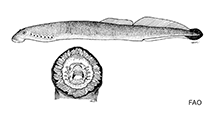
Adults: 10.6-14.8 cm TL. Body wet weight of individuals measuring 10.8-14.8 cm TL, 4.3-7.0 g. Body proportions, as percentage of TL [based on 22 specimens, TL range inferred to be 10.6-14.8 cm, Álvarez del Villar (1966)]: prebranchial length, 12.0-14.2; branchial length, 9.3-11.6; trunk length, 40.3-50.7; tail length, 26.7-32.9; eye length, 2.0 (holotype); disc length, 5.7 (holotype). Urogenital papilla length, as a percentage of branchial length, in four spawning males measuring 11.5-12.6 cm TL, 7.7-12.5. Trunk myomeres, 60-65. Dentition: supraoral lamina, 2 unicuspid teeth; infraoral lamina, 5-9 unicuspid teeth of which 5 are large and 0-4 are small (87% of specimens possess both large and small cusps); endolaterals on each side 3-4; endolateral formula, typically 2-2-2-2 or 1-1-1, but one to six endolaterals may be missing; 3 rows of anterials; first row of anterials, 2 unicuspid teeth; 1 row of exolaterals; 1 row of posterials; first row of posterials, 8 unicuspid and 1 bicuspid teeth; transverse lingual lamina, 19 unicuspid teeth, the median one slightly enlarged; longitudinal lingual laminae with undetermined number of teeth. Extent of caudal fin pigmentation,75% or more (Ref. 89241).
Body shape (shape guide): eel-like.
Freshwater, in rivers. Spawning habitat is a fast-flowing, clear-water stream with a stony substrate. Eggs hatch between the months of November and January and ammocoetes undergo metamorphosis at the end of three years. Ammocoetes live in the mud and feed on plankton (algae of the genera Rhizosolenia, Pleurosigma, Pinularia, Stauroneis, Amphora, and Cocconema, filamentous Chlorophyceae, rotifers, ciliates, and occasionally euglenoid flagellates). The mean total length reached at the end of the first year of larval life is 83 mm; at the end of two years, 135 mm; and at the end of three years, 146 mm. During the rainy season (July) of their first year, ammocoetes exhibit shrinkage in their total length. Metamorphosis occurs in April-August (Ref. 89241). Adults nonparasitic (Ref. 12268, 89241). After 3-4 months of adult life, spent downstream in the Duero River, they migrate a short distance (3 km) upstream to the spawning grounds in the upper reaches of the Celio River and die after spawning. The duration of the adult life is therefore at most six months. Spawning period between 19 November (when the water temperature reaches about 20°C) and 3 January. Fecundity, 990-3,456 eggs/female. Egg diameter, 0.7-0.8 mm (Ref. 89241).
Hardisty, M.W., 1986. A general introduction to lampreys. p. 19-84. In J. Holcík (ed.) The Freshwater fishes of Europe. Vol. 1, Part 1. Petromyzontiformes. AULA-Verlag GmbH, Wiesbaden. 313 p. (Ref. 12268)
IUCN Red List Status (Ref. 130435: Version 2025-1)
Threat to humans
Harmless
Human uses
Strumenti
Special reports
Download XML
Fonti Internet
Estimates based on models
Phylogenetic diversity index (Fonte Biblio.
82804): PD
50 = 0.7500 [Uniqueness, from 0.5 = low to 2.0 = high].
Bayesian length-weight: a=0.00138 (0.00062 - 0.00310), b=2.97 (2.78 - 3.16), in cm total length, based on LWR estimates for this (Sub)family-body shape (Ref.
93245).
Trophic level (Fonte Biblio.
69278): 3.8 ±0.8 se; based on size and trophs of closest relatives
Resilienza (Fonte Biblio.
120179): Basso, tempo minimo di raddoppiamento della popolazione 4.5 - 14 anni (Semelparous species, assuming tm (= tmax) > 4).
Fishing Vulnerability (Ref.
59153): Low vulnerability (10 of 100).
🛈