Ελασμοβράγχιοι (καρχαρίες και σαλάχια) (sharks and rays) >
Myliobatiformes (Stingrays) >
Urotrygonidae (American round stingrays)
Etymology: Urobatis: Greek,oura = tail + Greek, batis, batidos = a ray (Raja sp.) (Ref. 45335).
More on author: Cuvier.
Environment: milieu / climate zone / εύρος βάθους / distribution range
Οικολογία
Θαλασσινό(ά) Υφαλόφιλο(α); εύρος βάθους 1 - 25 m (Ref. 9710). Tropical; 37°N - 7°N, 100°W - 59°W (Ref. 55316)
Western Atlantic: North Carolina, USA to northern South America. Also in Bahamas, Yucatan and throughout Caribbean (Ref. 26938).
Μέγεθος / Βάρος / Age
Γεννητική Ωρίμανση: Lm ? range ? - ? cm
Max length : 76.0 cm TL αρσενικό/απροσδιόριστο; (Ref. 9710)
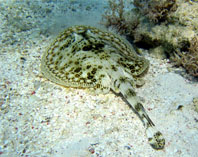
Edge of disk no sharp angles, no dorsal fin. Well-developed caudal fin extends around tip of tail, doubly serrate spine near caudal fin base (Ref. 26938). Disk yellowish, with dark vermiculations and spots that form a variety of patterns on upper surface (Ref. 7251). Lower surface is yellowish, greenish or brownish white, tail with dark spots (Ref.6902).
Body shape (shape guide): other.
Commonly found along sandy beaches to the water's edge, and especially in sandy areas in and around coral reefs (Ref. 7251). Raises front end of disc to attract prey seeking shelter (Ref. 7251). Feeds on shrimps, probably also on small fishes, clams, and worms (Ref. 12951). Known to be capable of inflicting dangerous wounds with its venomous spine. Easily approached (Ref. 9710). A live-bearing species, produces 3 to 4 young (Ref. 26938).
Life cycle and mating behavior
Γεννητική Ωρίμανση | Αναπαραγωγή | Γεννοβολία | Αβγά | Γονιμότητα | Προνύμφες
Male grasps disc margin of female, swings under her and inserts a clasper. Mating pair is surrounded by other males that swim around and nudge them. Dugger (1987) (Ref. 51118) observed both male and female biting the pectoral fin of its mate (Ref. 49562).
Compagno, L.J.V., 1999. Checklist of living elasmobranchs. p. 471-498. In W.C. Hamlett (ed.) Sharks, skates, and rays: the biology of elasmobranch fishes. Johns Hopkins University Press, Maryland. (Ref. 35766)
IUCN Red List Status (Ref. 130435: Version 2025-1)
Threat to humans
Venomous
Human uses
αλιεία: Εμπορικό(ά); Ενυδρείο: Δημόσια ενυδρεία
Εργαλεία
Special reports
Download XML
Διαδικτυακές πηγές
Estimates based on models
Preferred temperature (Αναφ.
123201): 25.8 - 28.1, mean 27.3 °C (based on 482 cells).
Phylogenetic diversity index (Αναφ.
82804): PD
50 = 0.5078 [Uniqueness, from 0.5 = low to 2.0 = high].
Bayesian length-weight: a=0.01047 (0.00559 - 0.01961), b=3.03 (2.86 - 3.20), in cm total length, based on LWR estimates for this species & (Sub)family-body (Ref.
93245).
Τροφικό Επίπεδο (Αναφ.
69278): 3.6 ±0.51 se; based on food items.
Ελαστικότητα (Αναφ.
120179): Πολύ χαμηλό, ελάχιστος χρόνος για διπλασιασμό πληθυσμού > 14 έτη (Preliminary K or Fecundity.).
Fishing Vulnerability (Ref.
59153): Moderate to high vulnerability (50 of 100).
🛈
Nutrients (Ref.
124155): Calcium = 7.17 [0.77, 112.55] mg/100g; Iron = 0.376 [0.030, 3.868] mg/100g; Protein = 20.4 [15.0, 25.6] %; Omega3 = 0.069 [0.021, 0.205] g/100g; Selenium = 24.1 [4.1, 110.7] μg/100g; VitaminA = 47.1 [3.2, 591.0] μg/100g; Zinc = 0.963 [0.062, 10.956] mg/100g (wet weight);