



Pseudobatos productus (Ayres, 1854)
Shovelnose guitarfish
Beobachtung melden im Fish Watcher
| Native range | All suitable habitat | Point map | Year 2050 |

|
| This map was computer-generated and has not yet been reviewed. |
| Pseudobatos productus AquaMaps Data sources: GBIF OBIS |
Hochladen Photos und videos
Bilder | Google Bild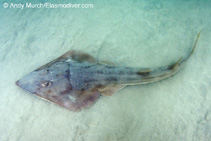 Pseudobatos productus
Photo von Murch, A.
Bilder | Google Bild
Photo von Murch, A.
Klassifizierung / Names Namen | Synonyme | Catalog of Fishes(Gattung, Arten) | ITIS | CoL | WoRMS | Cloffa
Elasmobranchii (Haie und Rochen) (sharks and rays) > Rhinopristiformes (Shovelnose rays) > Rhinobatidae (Guitarfishes)
More on author: Ayres.
More on author: Ayres.
Umwelt: Milieu / Klimazone / Tiefenbereich / Verbreitungsgebiet Ökologie
seewasser; brackwasser demersal; tiefenbereich 1 - 91 m (Ref. 48844), usually 1 - 13 m (Ref. 48844). Tropical; 38°N - 18°N, 123°W - 106°W (Ref. 114953)
Verbreitung Territorien | FAO Gebiete | Ökosysteme | Vorkommen | Punkt Karte | Einführungen | Faunafri
Eastern Pacific: endemic to the eastern Pacific from San Francisco, USA to the Gulf of California, and possibly to Mazatlan, Mexico (Ref. 48844).
Länge bei der ersten Reifung / Größe / Gewicht / Alter
Geschlechtsreife: Lm ?, range 57 - ? cm
Max length : 119 cm TL Männchen/unbestimmt; (Ref. 48844); 170.0 cm TL (female); max. veröff. Gewicht: 9.8 kg (Ref. 40637); max. veröff. Gewicht: 9.8 kg; max. veröff. Alter: 16 Jahre (Ref. 48844)
Max length : 119 cm TL Männchen/unbestimmt; (Ref. 48844); 170.0 cm TL (female); max. veröff. Gewicht: 9.8 kg (Ref. 40637); max. veröff. Gewicht: 9.8 kg; max. veröff. Alter: 16 Jahre (Ref. 48844)
Kurzbeschreibung Bestimmungsschlüssel | Morphologie | Morphometrie
Broad disc is greater in length than width; a relatively smooth dorsal surface except for a single row of thorns around the eyes and extending along the back and tail; a long, pointed snout with a rounded tip; small, rounded, pebble-like teeth; a first dorsal fin that originates closer to the pelvic fin base than to the caudal fin origin; a thick tail and a moderately large caudal fin without a distinct lower lobe. Tooth count: 102-112/98-117. Spiral valve count: 8-10.
Body shape (shape guide): elongated.
Body shape (shape guide): elongated.
Found on sand or mud bottoms of bays, seagrass beds, estuaries, and near rocky reefs. Nomadic and gregarious. Found singly or in aggregations (Ref. 12951). Burrows in sand during the day, feeds on crabs, worms, clams and small fishes at night (Ref. 12951). Ovoviviparous, with 6 to 28 pups in a litter (Ref. 48844). Females mature by 7 years at 87-99 cm TL; males reaches 91-110 cm TL; birth size at 20-24 cm TL (Ref. 114953).
Etymology: The genus comes from the Greek word rhine, meaning shark, and the Latin word batis, meaning ray, in reference to its body form being intermediate between that of a shark and a ray. The species name comes Latin, meaning produced, in reference to its pointed snout (Ref. 48844).
Lebenszyklus und Paarungsverhalten Geschlechtsreife | Fortpflanzung | Ablaichen | Eier | Fruchtbarkeit | Larven
Exhibit ovoviparity (aplacental viviparity), with embryos feeding initially on yolk, then receiving additional nourishment from the mother by indirect absorption of uterine fluid enriched with mucus, fat or protein through specialised structures (Ref. 50449).
Adults of both sexes congregate during the breeding season in shallow bays and estuaries and likewise leave when the pupping season is over after mating (Ref. 48844). Gestation lasts for about 12 months (Ref. 48844).
Hauptreferenz
Laden Sie Ihre Referenzen hoch | Referenzen | Koordinator : McEachran, John | Partner
Eschmeyer, W.N., E.S. Herald and H. Hammann, 1983. A field guide to Pacific coast fishes of North America. Boston (MA, USA): Houghton Mifflin Company. xii+336 p. (Ref. 2850)
IUCN Rote Liste Status (Ref. 130435: Version 2025-2 (Global))
Gefährdung zunehmend (NT) ; Date assessed: 17 December 2014
Bedrohung für Menschen
Harmless (Ref. 2850)
Nutzung durch Menschen
Fischereien: kommerziell; Sportfisch: ja
FAO - Publication: search | FishSource |
Mehr Information
Trophische Ökologie
Lebensmittel (Beutetiere)
Nahrungszusammensetzung
Nahrungsaufnahme
Lebensmittelrationen
Räuber
Lebensmittel (Beutetiere)
Nahrungszusammensetzung
Nahrungsaufnahme
Lebensmittelrationen
Räuber
Populationsdynamik
Wachstumsparameter
Max. Alter/Größen
Länge-Gewicht-Rel.
Länge-Länge-Verhältnis.
Längenhäufigkeiten
Massenkonvertierung
Rekrutierung
Dichte
Wachstumsparameter
Max. Alter/Größen
Länge-Gewicht-Rel.
Länge-Länge-Verhältnis.
Längenhäufigkeiten
Massenkonvertierung
Rekrutierung
Dichte
Lebenszyklus
Fortpflanzung
Geschlechtsreife
Reifung/Kiemen rel.
Fruchtbarkeit
Ablaichen
Laichaggregationen
Eier
Eientwicklung
Larven
Larven Pop.Dyn.
Fortpflanzung
Geschlechtsreife
Reifung/Kiemen rel.
Fruchtbarkeit
Ablaichen
Laichaggregationen
Eier
Eientwicklung
Larven
Larven Pop.Dyn.
Physiologie
Körperliche Zusammensetzung
Nährstoffe
Sauerstoffverbrauch
Schwimmart
Schwimmgeschwindigkeit
Visuelle Pigmente
Fischgeräusche
Krankheiten und Parasiten
Toxizität (LC50s)
Körperliche Zusammensetzung
Nährstoffe
Sauerstoffverbrauch
Schwimmart
Schwimmgeschwindigkeit
Visuelle Pigmente
Fischgeräusche
Krankheiten und Parasiten
Toxizität (LC50s)
Menschenbezogen
Aquakultur-Systeme
Aquakultur Profile
Zuchtlinien
Ciguatera-Fälle
Briefmarken, Münzen, Verschiedenes.
Aquakultur-Systeme
Aquakultur Profile
Zuchtlinien
Ciguatera-Fälle
Briefmarken, Münzen, Verschiedenes.
Tools
Zusatzinformationen
Download XML
Zusammenfassung | Punktdaten | Namen | Photos
Internet Quellen
AFORO (otoliths) | Aquatic Commons | BHL | Cloffa | Websites from users | FishWatcher Einträge suchen | CISTI | Catalog of Fishes: Gattung, Arten | DiscoverLife | ECOTOX | FAO - Publication: search | Faunafri | Fishipedia | Fishtrace | GloBI | Google Books | Google Scholar | Google | IGFA World Record | OneZoom | Open Tree of Life | Otolith Atlas of Taiwan Fishes | Öffentliche Aquarien | PubMed | Reef Life Survey | Socotra Atlas | TreeBase | Tree of Life | Wikipedia: Gehe zu, Suchen | World Records Freshwater Fishing | Zoologischer Rekord
Schätzungen auf der Grundlage von Modellen
Bevorzugte Temperatur (Ref. 123201): 15.3 - 25.9, mean 22.4 °C (based on 149 cells).
Phylogenetischer Diversitätsindex (Ref. 82804): PD50 = 0.5020 [Uniqueness, from 0.5 = low to 2.0 = high].
Bayesian length-weight: a=0.00209 (0.00136 - 0.00320), b=3.10 (2.97 - 3.23), in cm total length, based on LWR estimates for this species & Genus-body shape (Ref. 93245).
Trophische Ebene (Ref. 69278): 3.6 ±0.3 se; based on diet studies.
Generation time: 11.0 ( na - na) years. Estimated as median ln(3)/K based on 2 growth studies.
Widerstandsfähigkeit (Ref. 120179): niedrig, Verdopplung der Population dauert 4,5 - 14 Jahre. (tm=7; tmax=11; K=0.1; Fec = 6).
Nährstoffe (Ref. 124155): Calcium = 32.6 [8.1, 140.3] mg/100g; Iron = 0.666 [0.163, 1.807] mg/100g; Protein = 18.8 [16.7, 20.7] %; Omega3 = 0.146 [0.065, 0.333] g/100g; Selenium = 50.9 [14.7, 138.9] μg/100g; VitaminA = 12.1 [5.5, 26.8] μg/100g; Zinc = 1.03 [0.51, 1.86] mg/100g (wet weight);