>
Gobiiformes (Gobies) >
Gobiidae (Gobies) > Gobiinae
Etymology: Amblygobius: Greek, amblys = darkness + Latin gobius = gudgeon (Ref. 45335).
More on author: Bennett.
Environment: milieu / climate zone / profondeur / distribution range
Écologie
marin; saumâtre récifal; profondeur 1 - 20 m (Ref. 90102). Tropical
Indian Ocean.
Taille / Poids / Âge
Maturité: Lm ? range ? - ? cm
Max length : 11.0 cm TL mâle / non sexé; (Ref. 90102)
Description synthétique
Clés d'identification | Morphologie | Morphométrie
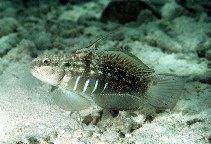
Épines dorsales (Total) : 6 - 7; Rayons mous dorsaux (Total) : 14 - 15; Épines anales: 1; Rayons mous anaux: 14 - 15. Characterized by greenish brown body color with complex pattern consisting of longitudinal rows of small white spots; side of body with five narrow brown bars; presence of dark brown band from snout, through eye, to upper back; cheek with white spots and lines; dark-edged red spots dorsally on head; large brown spot above gill opening; basal part of upper caudal fin with large red-brown to blackish spot; 1-2 small black spot on outer part of caudal fin; prolonged third and fourth dorsal spines as short filaments, first dorsal fin taller than second; rounded caudal fin; longitudinal scale series 60-67; ctenoid scales; cycloid scales on nape, abdomen, and breast; predorsal scales 22-25, extending to interorbital space; scales dorsally on opercle, absent on cheek; depth of body 3.5-4.6 in SL (Ref. 90102).
Body shape (shape guide): fusiform / normal; Cross section: compressed.
Inhabits protected, silty lagoons and estuaries (Ref. 48637). Occurs in pairs, over its burrow beneath rock or rubble; usually hovers a short distance above the bottom. Monogamous (Ref. 52884). Gut contents of a 6.5 cm SL specimen contains mainly fine, unbranched, filamentous algae and harpacticoid copepods, also polychaetes, tanaids, decapod shrimps, amphipods, and nematodes (may have been parasitic).
Life cycle and mating behavior
Maturité | Reproduction | Frai | Œufs | Fécondité | Larves
Monogamous mating is observed as both obigate and social (Ref. 52884).
Randall, J.E. and M. Goren, 1993. A review of the gobioid fishes of the Maldives. Ichthyol. Bull. J.L.B. Smith Inst. Ichthyol. (58):1-37, 5 pls. (Ref. 9360)
Statut dans la liste rouge de l'IUCN (Ref. 130435: Version 2025-1)
Menace pour l'homme
Harmless
Utilisations par l'homme
Outils
Articles particuliers
Télécharger en XML
Sources Internet
Estimates based on models
Preferred temperature (Réf.
123201): 25.7 - 29.3, mean 28.2 °C (based on 685 cells).
Phylogenetic diversity index (Réf.
82804): PD
50 = 0.5000 [Uniqueness, from 0.5 = low to 2.0 = high].
Bayesian length-weight: a=0.01023 (0.00477 - 0.02194), b=3.01 (2.83 - 3.19), in cm total length, based on LWR estimates for this (Sub)family-body shape (Ref.
93245).
Niveau trophique (Réf.
69278): 3.0 ±0.2 se; based on size and trophs of closest relatives
Résilience (Réf.
120179): Haut, temps minimum de doublement de population inférieur à 15 mois (Preliminary K or Fecundity.).
Fishing Vulnerability (Ref.
59153): Low vulnerability (10 of 100).
🛈
Nutrients (Ref.
124155): Calcium = 106 [56, 219] mg/100g; Iron = 0.758 [0.372, 1.368] mg/100g; Protein = 18.9 [17.0, 20.5] %; Omega3 = 0.162 [0.072, 0.294] g/100g; Selenium = 19.1 [9.3, 42.6] μg/100g; VitaminA = 131 [36, 450] μg/100g; Zinc = 2.02 [1.35, 2.98] mg/100g (wet weight);