Elasmobranchii (tubarões e raias) (sharks and rays) >
Lamniformes (Mackerel sharks) >
Alopiidae (Thresher sharks)
Etymology: Alopias: From alopex, Greek for fox, referring to the ancient vernacular “fox shark,” from its supposed cunning (ancients believed that when it took a bait, it swallowed the hook until it got to the cord, which it bit off and so escaped) (See ETYFish); superciliosus: super (L.), over and above; ciliosus (L.), haughty or having a raised eyebrow, referring to enormous upward- looking eyes set high on head and/or marked groove over eyes (See ETYFish).
More on author: Lowe.
Environment: milieu / Zona climática / intervalo de profundidade / distribution range
Ecologia
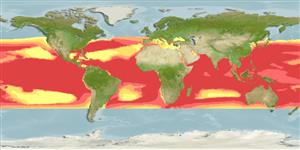
marinhas pelagic-oceanic; oceanódromo (Ref. 51243); intervalo de profundidade 0 - 730 m (Ref. 89423), usually 0 - 100 m (Ref. 43278). Subtropical; 46°N - 40°S, 180°W - 180°E (Ref. 54278)
Circumglobal; tropical and temperate seas. Highly migratory species.
Comprimento de primeira maturação / Tamanho / Peso / Idade
Maturidade: Lm 253.0, range 154 - 341 cm
Max length : 488 cm TL macho/indeterminado; (Ref. 40637); common length : 350 cm TL macho/indeterminado; (Ref. 5217); peso máx. publicado: 363.8 kg (Ref. 40637); idade máx. registrada: 20 anos (Ref. 28081)
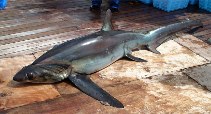
Espinhos dorsais (total) : 0; Espinhos anais: 0. A large thresher with very large eyes, an indented forehead, a broad caudal tip, and curved broad-tipped pectoral fins; 1st dorsal fin further back than in other threshers (Ref. 5578). Upper lobe of caudal fin very long and strap-like almost or quite equal to length of rest of shark; lower lobe short but well developed (Ref. 13570). Purplish grey above, cream below, posterior edges of pectoral and pelvic fins and sometimes first dorsal fin dusky; light color of abdomen not expanded over pectoral-fin bases (Ref. 13570).
Body shape (shape guide): fusiform / normal; Cross section: circular.
Occurs in coastal waters over continental shelves, sometimes close inshore in shallow waters, and on the high seas far from land (Ref. 247, 43278, 58302). Oceanic, pelagic and near bottom at 1->500 m (Ref. 58302). Depth range to at least 500 m (Ref. 247). Feeds on pelagic fishes (lancetfishes, herring, mackerel and small billfishes (Ref. 43278)) and bottom fishes e.g. hake (Ref. 43278)) and squids (Ref. 247). Ovoviviparous, embryos feeding on yolk sac and other ova produced by the mother (Ref. 43278, 50449). Stuns its prey with its long caudal fin (Ref. 247). Utilized for human consumption, liver oil for vitamins, skin for leather, and fins for shark-fin soup (Ref. 247). Marketed fresh and may be broiled, baked or grilled, but unsuitable for steaming, boiling or frying; meat may be salted and dried (Ref. 9987). Also Ref. 33743.
Exhibit ovoviparity (aplacental viviparity), with embryos feeding on other ova produced by the mother (oophagy) after the yolk sac is absorbed (Ref. 50449). With 2-4 young per litter (usually 2) (Ref. 247). Size at birth between 64-106 cm (Ref. 247); 100-140 cm TL (Ref.58048). No fixed mating or birthing season. Distinct pairing with embrace (Ref. 205).
Compagno, L.J.V., 1984. FAO Species Catalogue. Vol. 4. Sharks of the world. An annotated and illustrated catalogue of shark species known to date. Part 1 - Hexanchiformes to Lamniformes. FAO Fish. Synop. 125(4/1):1-249. Rome, FAO. (Ref. 247)
Status na Lista Vermelha da UICN (Ref. 130435: Version 2025-1)
Uso pelos humanos
Pescarias: espécies comerciais; peixe esportivo: sim
Ferramentas
Relatórios especiais
Baixar XML
Fontes da internet
Estimates based on models
Preferred temperature (Ref.
123201): 19.2 - 29, mean 27.1 °C (based on 6320 cells).
Índice de diversidade filogenética (Ref.
82804): PD
50 = 0.7500 [Uniqueness, from 0.5 = low to 2.0 = high].
Bayesian length-weight: a=0.01096 (0.00596 - 0.02017), b=2.90 (2.73 - 3.07), in cm total length, based on LWR estimates for this species & (Sub)family-body (Ref.
93245).
Nível Trófico (Ref.
69278): 4.5 ±0.0 se; based on diet studies.
Resiliência (Ref.
120179): Baixo, tempo mínimo de duplicação da população 4,5 - 14 anos (tm=7; tmax=20; K=0.088; Fec=2-4).
Prior r = 0.23, 95% CL = 0.15 - 0.34, Based on 1 data-limited stock assessment.
Fishing Vulnerability (Ref.
59153): Very high vulnerability (85 of 100).
🛈
Climate Vulnerability (Ref.
125649): High vulnerability (63 of 100).
🛈
Nutrients (Ref.
124155): Calcium = 6.7 [1.9, 34.8] mg/100g; Iron = 0.696 [0.174, 2.034] mg/100g; Protein = 20.5 [18.1, 22.8] %; Omega3 = 0.371 [0.150, 0.897] g/100g; Selenium = 35.9 [11.2, 103.6] μg/100g; VitaminA = 6.18 [2.01, 19.71] μg/100g; Zinc = 0.32 [0.16, 0.59] mg/100g (wet weight);