>
Petromyzontiformes (Lampreys) >
Petromyzontidae (Northern lampreys) > Lampetrinae
Etymology: hubbsi: In honor of American ichthyologist Carl L. Hubbs (1894-1979), “distinguished friend and a keen student of lamprey taxonomy” [placed in Entosphenus by some workers] (See ETYFish).
Eponymy: Professor Carl Levitt (Leavitt) Hubbs (1894–1979) was a giant of American ichthyology. [...] (Ref. 128868), visit book page.
Environment: milieu / climate zone / rango de profundidad / distribution range
Ecología
; agua dulce demersal; no migratorio. Temperate; 38°N - 36°N
North America: East side of San Joaquin Valley in lower Merced, Kaweah, Kings, and San Joaquin rivers in California, USA.
Tamaño / Peso / Age
Madurez: Lm ? range ? - ? cm
Max length : 14.2 cm TL macho / no sexado; (Ref. 89241); common length : 12.9 cm TL macho / no sexado; (Ref. 12193)
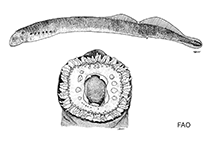
Espinas dorsales (total) : 0; Espinas anales: 0. Characterized by having expanded oral disc narrower than head, usually 52-56 trunk myomeres, 2 supraoral teeth, usually 1-1-1-1 lateral circumoral teeth, 9-12 unicuspid posterior circumoral teeth, 5 infraoral teeth and coloration consisting of gray to brown above, white below, black specks on dorsal and caudal fins, and no black on lateral-line pores (Ref. 86798). Adults: 8.1-14.2 cm TL; body proportions (percentage of TL based on 127 specimens 8.1-14.2 cm TL): 7.8-14.4 prebranchial length, 8.5-12.8 branchial length, 44.6-56.9 trunk length, 24.3-30.8 tail length, 0.8-2.8 eye length and 3.7-8.7 disc length, 8.3-16.7 urogenital papilla length (percentage of branchial length in 9 spawning males 10.6-12.4 cm TL); trunk myomeres, 50-57. Adult dentition: supraoral lamina, 2 unicuspid teeth, rarely 3; infraoral lamina, 4-unicuspid teeth, usually 5; 4 endolaterals on each side, rarely 3; endolateral formula, typically 1-1-1-1, the first endolateral may also be bicuspid, the second and third endolaterals bi- or tricuspid, and the fourth bicuspid, however, no endolateral formula of 2-3-3-2 was encountered in 40 individuals examined; 2 row of anterials, 3-9 unicuspid teeth in total, three of these in the first row; exolaterals absent; 1 row of posterials, 8-12 unicuspid teeth in a continuous (complete) row or discontinuous (incomplete) row of only six unicuspid teeth; transverse lingual lamina, cusps too poorly developed to count, however, the median one not enlarged; longitudinal lingual laminae, cusps too poorly developed to count. Velar tentacles in adults, 3-5, with tubercles; median velar tentacle shorter than the lateral ones immediately next to it; no velar wings; body coloration (preserved), gray-brown on dorsal and lateral aspects, whitish on ventral aspect; extent of caudal fin pigmentation, 1% to <25%; caudal fin shape, rounded (Ref. 89241).
Body shape (shape guide): eel-like.
Inhabits silty backwaters of rivers and spawns in gravel riffles (Ref. 86798). Both the larval and adult stages were originally collected from the Friant-Kern Canal, which is 85% concrete lined and has a discharge greater than 57 m3/sec; an artificial habitat. Occurs in the Merced River, which should be considered typical habitat. Adults nonparasitic (Ref. 89241).
Life cycle and mating behavior
Madurez | Reproducción | Puesta | Huevos | Fecundidad | Larva
Page, L.M. and B.M. Burr, 1991. A field guide to freshwater fishes of North America north of Mexico. Houghton Mifflin Company, Boston. 432 p. (Ref. 5723)
IUCN Red List Status (Ref. 130435: Version 2025-1)
Threat to humans
Harmless
Human uses
Pesquerías: sin interés
Herramientas
Special reports
Download XML
Fuentes de Internet
Estimates based on models
Phylogenetic diversity index (Referencia
82804): PD
50 = 0.6250 [Uniqueness, from 0.5 = low to 2.0 = high].
Bayesian length-weight: a=0.00138 (0.00062 - 0.00310), b=2.97 (2.78 - 3.16), in cm total length, based on LWR estimates for this (Sub)family-body shape (Ref.
93245).
Nivel trófico (Referencia
69278): 3.8 ±0.8 se; based on size and trophs of closest relatives
Resiliencia (Referencia
120179): Bajo, población duplicada en un tiempo mínimo de 4.5-14 años (Semelparous species, assuming tm (= tmax) > 4).
Fishing Vulnerability (Ref.
59153): Low vulnerability (10 of 100).
🛈