



Ichthyomyzon castaneus Girard, 1858
Chestnut lamprey
Загрузить свой Фото и Видео
изображения | Изображение на Google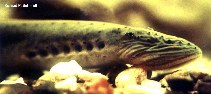 Ichthyomyzon castaneus
Изображение сделано The Native Fish Conservancy
изображения | Изображение на Google
Изображение сделано The Native Fish Conservancy
Классификация / Имена народные названия | синонимы | Catalog of Fishes(род, виды) | ITIS | CoL | WoRMS | Cloffa
> Petromyzontiformes (Lampreys) > Petromyzontidae (Northern lampreys) > Petromyzontinae
Etymology: Ichthyomyzon: ichthys, fish; myzon (Gr.), to suck (borrowed from Petromyzon), i.e., a sucking fish, referring to their suctorial behavior (See ETYFish); castaneus: Latin for chestnut-brown, referring to its “uniform chesnut [sic] tint” (See ETYFish).
More on author: Girard.
Etymology: Ichthyomyzon: ichthys, fish; myzon (Gr.), to suck (borrowed from Petromyzon), i.e., a sucking fish, referring to their suctorial behavior (See ETYFish); castaneus: Latin for chestnut-brown, referring to its “uniform chesnut [sic] tint” (See ETYFish).
More on author: Girard.
Taxonomic Remarks
Hubbs and Trautman (1937) suggested that one adult specimen from Green Bay, near Gladstone, Lake Michigan Basin, might be a hybrid between I. castaneus and I. unicuspis and Starrett et al. (1960) suggested that an adult specimen from the Mississippi River, at Moline, Illinois might be a hybrid between I. castaneus and I. unicuspis (Ref. 89241).
Окружающая среда: среда / климатическая зона / пределы глубины / диапазон распространения экология
; пресноводный демерсальный; мигрирует в реке (Ref. 126106). Subtropical; 50°N - 29°N
распространение Территории | регионы FAO | Экосистемы | места находок | карта точек | интродукции | Faunafri
North America: Hudson Bay, Laurentian Great Lakes and Gulf of Mexico basins.
Длина при первой зрелости / Размер / Вес / Возраст
половая зрелость: Lm 10.1 range ? - ? cm
Max length : 38.0 cm TL самец/пол неопределен; (Ref. 5723); common length : 20.5 cm TL самец/пол неопределен; (Ref. 12193); наибольший возраст (опубликованны данные): 8 годы (Ref. 12193)
Max length : 38.0 cm TL самец/пол неопределен; (Ref. 5723); common length : 20.5 cm TL самец/пол неопределен; (Ref. 12193); наибольший возраст (опубликованны данные): 8 годы (Ref. 12193)
Краткое описание определительные ключи | морфология | морфометрия
Dorsal fin slightly notched; oral disc narrower than head; teeth blunt and poorly; usually 52-56 trunk myomeres; black on lateral-line pores (Ref. 86798). Other diagnostic features: 8.5-36.3 cm TL. Body proportions, as percentage of TL (based on 36 specimens measuring 8.9-26.1 cm TL): prebranchial length, 11.5-15.5; branchial length, 7.3-12.6; trunk length, 44.4-52.9; tail length, 23.9-34.4; eye length, 0.8-2.4; disc length, 5.4 -11.6. The urogenital papilla length, as a percentage of branchial length, in a spawning male 18.3 cm TL, 5.3. Trunk myomeres, 49-58. Dentition: supraoral lamina, 1-5 teeth, usually 2-3; infraoral lamina, 6-13 teeth; typically 4 endolateral teeth on each side, but 5 teeth also occur; 1-8, mode of 6, bicuspid endolaterals in total, the other endolaterals, if any, unicuspid; 2-5 rows of anterials, usually 4; first row of anterials, 3 teeth; 4-10 rows of exolaterals on each side, usually 6-7; 2-3 rows of posterials; first row of posterials, 8-11 usually unicuspid teeth, but one lateralmost may be bicuspid; crest of transverse lingual lamina variable, linear or weakly w-shaped to rarely strongly w-shaped, with numerous cusps, the median one not enlarged; longitudinal lingual laminae number of teeth unrecorded. Additonally, one accessory tooth is occasionally developed inside the ring formed by the supraoral and infraoral laminae and the endolateral teeth. Velar tentacles, 2, smooth. Body coloration (preserved) in adults grading from darker on the upper surface to paler on the lower surface; lateral aspects sometimes mottled; spent adults blue-black. Lateral line neuromasts darkly pigmented beginning around 15 cm TL. Caudal fin pigmentation, 75% or more. Caudal fin shape, rounded. Oral fimbriae, 90-126. Oral papillae, 15-30 (Ref. 89241).
Body shape (shape guide): eel-like.
Body shape (shape guide): eel-like.
Freshwater (Ref. 89241). Adults iInhabit lakes and streams. Ammocoete larvae occur in pools and backwaters (Ref.1998). Ammocoetes more commonly found in firm, relatively stable, sand-silt substrate, in areas with current. Adults occur in still to swift water, clear to brown-tinged, over rocky and weedy substrates, to a maximum depth of 20 m. The usual habitat is large to medium-sized rivers with summer flows 0.8-31 m3/s and summer water temperatures 15.5-22 ˚C. It can also occur in small to large lakes. Generally associated with warm water habitats and tolerant of variation in terms of discharge, water temperature, and substrate. Spawning adults only found in streams. Metamorphosis occurs in October, in Michigan. Adults parasitic on fishes (introduced Cyprinus carpio and native Catostomus commersonii, Ictiobus sp., Moxostoma sp., Esox lucius, Salvelinus fontinalis). Reported scavenging on Catostomus sp. In Manitoba, spawning behavior has been observed on 11-12 June at a water temperature of 16.5 °C and current velocity about 1 m/s. In Michigan, the spawning period is from 28 May to 25 June, at water temperatures between 15.6-22.2 ˚C, with peak spawning activity in early June. Nests (up to 6.2 m X 1 m X 0.05 m) are built with stones 3.5-5 cm in diameter in streams having 6.5-43 m width, 38-90 cm depth, and 1.1-54 m3/s flow. Up to four spawning lampreys have been found in a nest in Michigan and about 50 in Manitoba. Eggs are elliptical with long axis 0.64 mm and short axis 0.56 mm on average. Eggs are preyed upon by Luxilus cornutus. There are reported occurrences in Michigan of communal spawning of Chestnut Lamprey with Sea Lamprey (Pine, Platte, and Muskegon rivers) and of Chestnut Lamprey with Sea Lamprey and American Brook Lamprey (Betsie River) (Ref. 89241). Adults ascend streams to spawn and die soon after egg laying is completed. Semelparous (Ref. 1998). In the Laurentian Great Lakes Basin, it has presumably been negatively affected by control measures directed towards Petromyzon marinus, except for the chemosterilization of males which affects only the latter species (Ref. 89241).
Жизненный цикл и брачное поведение половая зрелость | размножение | нерест | икра | Плодовитость | личинки
Semelparous (Ref. 1998). The female attaches with her oral disc to a rock at the upstream end of the nest. The male attaches to the back of her head using his oral disc and wraps his tail around her trunk region
in such a way as to have each others urogenital papilla in close proximity and through muscular contraction of his body assists in the extrusion of the eggs. They vibrate vigorously for a few seconds. This results in the release of their gametes and disturbance of the substrate, which partially buries the fertilized eggs (Ref. 89241).
Основная ссылка
Загрузите свои рекомендации | ссылки | координатор | соавторы
Page, L.M. and B.M. Burr, 1991. A field guide to freshwater fishes of North America north of Mexico. Houghton Mifflin Company, Boston. 432 p. (Ref. 5723)
Статус Красного Списка МСОП (Ref. 130435: Version 2025-2 (Global))
Не вызывающий беспокойства (LC) ; Date assessed: 17 February 2012
CITES
Not Evaluated
Угроза для людей
Harmless
Использование человеком
FAO - Publication: search | FishSource |
дополнительная информация
Трофическая экология
Пищевые предметы (добыча)
состав пищи
потребление пищи
Продовольственные пайки
хищники
Пищевые предметы (добыча)
состав пищи
потребление пищи
Продовольственные пайки
хищники
Динамика численности населения
Параметры роста
Макс. возраст / размер
Отношение длины к весу.
Отношение длины к длине.
Размерный состав
Преобразование массы
пополнение
численность
Параметры роста
Макс. возраст / размер
Отношение длины к весу.
Отношение длины к длине.
Размерный состав
Преобразование массы
пополнение
численность
Жизненный цикл
размножение
половая зрелость
Зрелость/Жиры относительно.
Плодовитость
нерест
Нерестовые скопления
икра
Развитие икры
личинки
динамика численности личинок
размножение
половая зрелость
Зрелость/Жиры относительно.
Плодовитость
нерест
Нерестовые скопления
икра
Развитие икры
личинки
динамика численности личинок
Физиология
Состав тела
Питательные вещества
Потребление кислорода
Тип плавания
Скорость плавания
Зрительные пигменты
Звук рыбы
Болезни и паразиты
Токсичность (LC50s)
Состав тела
Питательные вещества
Потребление кислорода
Тип плавания
Скорость плавания
Зрительные пигменты
Звук рыбы
Болезни и паразиты
Токсичность (LC50s)
генетика
Геном
генетика
Гетерозиготность
наследуемость
Генетическое разнообразие
Геном
генетика
Гетерозиготность
наследуемость
Генетическое разнообразие
Связанные с человеком
Системы аквакультуры
особенности рыбоводства
степень растяжения
Случаи заболевания сигуатерой
Марки, монеты и прочее.
Системы аквакультуры
особенности рыбоводства
степень растяжения
Случаи заболевания сигуатерой
Марки, монеты и прочее.
инструменты
Органическая викторина | Электронная книга | полевой определитель | определительные ключи | Длина-Частота | онтогенез | карта точек |
Catch-MSY |
Специальные отчеты
Проверить содержание в аквариумах | Проверить опубликованные видовые данные | Проверить опубликованные данные по аквакультуре
Скачать в формате XML
ресурсы в Интернет
AFORO (otoliths) | Alien/Invasive Species database | Aquatic Commons | BHL | Cloffa | Websites from users | Проверить FishWatcher | CISTI | Catalog of Fishes: род, виды | DiscoverLife | ECOTOX | FAO - Publication: search | Faunafri | Fishipedia | Fishtrace | GloBI | Google Books | Google Scholar | Google | IGFA World Record | OneZoom | Open Tree of Life | Otolith Atlas of Taiwan Fishes | PubMed | Reef Life Survey | Socotra Atlas | TreeBase | Tree of Life | Wikipedia: Вперёд, поиск | World Records Freshwater Fishing | Zoobank | Зоологическая летопись
Оценки, основанные на моделях
Индекс филогенетического разнообразия (ссылка 82804): PD50 = 0.5156 [Uniqueness, from 0.5 = low to 2.0 = high].
Bayesian length-weight: a=0.00105 (0.00040 - 0.00275), b=3.03 (2.80 - 3.26), in cm total length, based on LWR estimates for this (Sub)family-body shape (Ref. 93245).
Трофический уровень (ссылка 69278): 4.5 ±0.80 se; based on food items.
устойчивость к внешним воздействиям (ссылка 120179): низкий, минимальное время удвоения популяции 4.5-14 лет (tm=6; Fec = 42,000; tmax=8).