This website uses cookies to enhance your browsing experience and ensure the functionality of our site. For more detailed information about the types of cookies we use and how we protect your privacy, please visit our Privacy Information page.
×
Cookie Settings
This website uses different types of cookies to enhance your experience. Please select your preferences below:
> Scombriformes (Mackerels) > Centrolophidae (Medusafishes)
Etymology: Schedophilus:Name from Greek words 'phylos' (Φίλος), t) meaning 'one who likes' and "s 'shedia' (Σχεδία) which means raft; literally means 'the one who likes rafts'. This probably refers to the lifestyle ot the juveniles of this genus (Michail Ragousis, mar10091@marine.aegean.gr, pers. Comm. 01/16) which are epipelagic and associate with floating jellyfish. More on author: Cuvier.
Entorno: milieu / zona climática / rango de profundidad / gama de distribución Ecología
marino bentopelágico; rango de profundidad 70 - 700 m (Ref. 52180). Subtropical; 52°N - 16°S, 65°W - 36°E
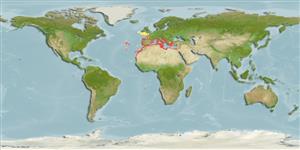
Eastern Atlantic: Spain and throughout most of the Mediterranean southward. Although reported to occur in South Africa (Ref. 4542, 6942), Smith 1995 (Ref. 11228) mentions that the species occurring in southern Africa is not Schedophilus ovalis but Schedophilus velaini. Western Central Atlantic: a small specimen recorded from Bermuda.
Tamaño / Peso / Edad
Madurez: Lm? range ? - ? cm Max length : 100.0 cm TL macho / no sexado; (Ref. 3596); common length : 60.0 cm TL macho / no sexado; (Ref. 3596)
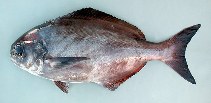
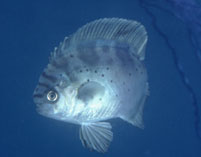
Prefers deep water at the edge of continental shelves and around oceanic islands; larger specimens near the bottom (Ref. 4542). Young are epipelagic and associate with floating jellyfish, including Physalia (Ref. 4542). Adults are caught on hooks baited with fish or squid. Its white flesh is reported to be good-tasting (Ref. 4542).
Ciclo vital y comportamiento de apareamiento Madurez | Reproducción | Puesta | Huevos | Fecundidad | Larva
Haedrich, R.L., 1990. Centrolophidae. p. 1011-1013. In J.C. Quero, J.C. Hureau, C. Karrer, A. Post and L. Saldanha (eds.) Check-list of the fishes of the eastern tropical Atlantic (CLOFETA). JNICT, Lisbon; SEI, Paris; and UNESCO, Paris. Vol. 2. (Ref. 6942)
Situación en la Lista Roja de la UICN (Ref. 130435: Version 2025-2 (Global))
Fisiología Composición corporal Nutrientes Consumo del oxígeno Tipo de natación Velocidad de natación Pigmentos visuales Sonido de peces Enfermedades y parásitos Toxicidad (CL50)
Temperatura preferida (Referencia 123201): 11.8 - 18.8, mean 14.8 °C (based on 221 cells).
Índice de diversidad filogenética (Referencia 82804): PD50 = 0.5039 [Uniqueness, from 0.5 = low to 2.0 = high].
Bayesian length-weight: a=0.00832 (0.00406 - 0.01705), b=3.12 (2.94 - 3.30), in cm total length, based on LWR estimates for this species & (Sub)family-body (Ref. 93245).
Nivel trófico (Referencia 69278): 3.5 ±0.47 se; based on food items.
Resiliencia (Referencia 120179): Bajo, población duplicada en un tiempo mínimo de 4.5-14 años (Preliminary K or Fecundity.).
Vulnerabilidad pesquera (Ref. 59153): High vulnerability (60 of 100). 🛈
Vulnerabilidad climática (Ref. 125649): Moderate vulnerability (39 of 100). 🛈