>
Cypriniformes (Carps) >
Cyprinidae (Minnows or carps) > Labeoninae
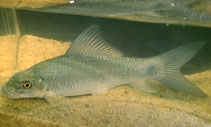
Etymology: Labeo: Latin, labeo = one who has large lips (Ref. 45335); coubie: Named after the vernacular name of the specimens in Cairo (Egypt), which were used for the original description (Ref. 26192).
More on author: Rüppell.
Environment: milieu / climate zone / distribuzione batimetrica / distribution range
Ecologia
; acqua dolce benthopelagico; potamodromo (Ref. 51243). Tropical; 6°N - 6°S
Africa: very widespread, within the drainage basin of the Nile (Ref. 1440, 2801, 28714), Chad, Niger-Bénoué, Volta, Senegal and Gambia basins, as well as Cross River (Ref. 1440, 2940, 81282). Report from Cameroon coastal rivers (Ref. 1440) unconfirmed in Ref 81639. Not reliable known from the Congo River basin (Ref. 1440) and one controversial record from the East coast of Africa (Ref. 1440). Ref. 2801 reports presence in Warri (Nigeria) and Kingani (Tanzania).
Length at first maturity / Size / Peso / Age
Maturità: Lm 22.0, range 22 - ? cm
Max length : 75.0 cm SL maschio/sesso non determinato; (Ref. 2801); peso massimo pubblicato: 5.0 kg (Ref. 3799)
Raggi dorsali molli (totale) : 15 - 19; Raggi anali molli: 8 - 11; Vertebre: 31 - 33. Diagnosis: dorsal profile straight to slightly arched; body dark and dull; rostral lobe poorly developed, its free margin smooth (Ref. 2940, 81282). Distal margin of dorsal fin straight or convex; inner surface of lips with 4-10 transverse folds or costae (Ref. 2940, 28714, 81282). Inferior mouth with well-developed lips forming a sucker-like ring enclosing the jaws; snout typically swollen, as long as or much longer than the postocular part of the head (Ref. 28714). Body not cylindriform, its depth 27-39% of SL (Ref. 28714) or 2.3-3.3 times in SL (Ref. 2940, 81282). Depth of caudal peduncle 0.7-1.3x its length; 26-46 (50-150mm) and 37-47 (150-250mm) gill rakers; scale formula 5.5-7.5/36-40/6.5-7.5; 4.5 scales between lateral line and pelvic-fin base; 16 (18) scales around caudal peduncle (Ref. 2940, 81282). 11-14 dorsal fin branched rays (Ref. 2940, 28714, 81282).
Body shape (shape guide): fusiform / normal; Cross section: compressed.
Inhabit rivers (Ref. 4967).
Tshibwabwa, S.M., 1997. Systématique des espèces africaines du genre Labeo (Teleostei, Cyprinidae) dans les régions ichtyogéographiques de Basse-Guinée et du Congo. II. Presses Universitaires de Namur, Namur, Belgique. 227 p. (Ref. 26192)
IUCN Red List Status (Ref. 130435: Version 2025-1)
Threat to humans
Harmless
Human uses
Pesca: commerciale; Acquario: Acquari pubblici
Strumenti
Special reports
Download XML
Fonti Internet
Estimates based on models
Phylogenetic diversity index (Fonte Biblio.
82804): PD
50 = 0.5000 [Uniqueness, from 0.5 = low to 2.0 = high].
Bayesian length-weight: a=0.00955 (0.00769 - 0.01185), b=3.05 (3.01 - 3.09), in cm total length, based on LWR estimates for this species (Ref.
93245).
Generation time: 5.5 ( na - na) years. Estimated as median ln(3)/K based on 2
growth studies.
Resilienza (Fonte Biblio.
120179): Basso, tempo minimo di raddoppiamento della popolazione 4.5 - 14 anni (K=0.12-0.26; tmax=5; Fec > 10,000).
Fishing Vulnerability (Ref.
59153): Moderate vulnerability (39 of 100).
🛈
Nutrients (Ref.
124155): Calcium = 143 [40, 249] mg/100g; Iron = 0.881 [0.539, 1.555] mg/100g; Protein = 16.5 [15.7, 17.4] %; Omega3 = 0.388 [0.153, 1.012] g/100g; Selenium = 382 [148, 1,055] μg/100g; VitaminA = 11.9 [4.7, 31.4] μg/100g; Zinc = 1.32 [0.71, 2.58] mg/100g (wet weight);