Environment: milieu / climate zone / rango de profundidad / distribution range
Ecología
marino batidemersal; rango de profundidad 55 - 913 m (Ref. 50550). Deep-water
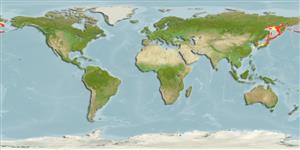
Northeast Pacific: Sea of Okhotsk and Sea of Japan, the Tatar Strait, and the Pacific off Hokkaido and northern Honshu, Japan. Also west Bering Sea (Ref. 44380).
Tamaño / Peso / Age
Madurez: Lm ? range ? - ? cm
Max length : 51.0 cm SL macho / no sexado; (Ref. 83735)
Short description
Claves de identificación | Morfología | Morfometría
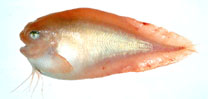
Espinas dorsales (total) : 0; Radios blandos dorsales (total) : 57 - 62; Espinas anales: 0; Radios blandos anales: 50 - 55; Vértebra: 62 - 67. Gill opening extending ventrally in front of 1 to 6 pectoral fin rays; disk length 12.7 to 16.7% of head length; body with cactus-like prickles (Ref. 559). Body uniformly pink; eye and peritoneum silver; stomach dusky (Ref. 559).
Body shape (shape guide): elongated.
Life cycle and mating behavior
Madurez | Reproducción | Puesta | Huevos | Fecundidad | Larva
Masuda, H., K. Amaoka, C. Araga, T. Uyeno and T. Yoshino, 1984. The fishes of the Japanese Archipelago. Vol. 1. Tokai University Press, Tokyo, Japan. 437 p. (text). (Ref. 559)
IUCN Red List Status (Ref. 130435: Version 2025-1)
Threat to humans
Harmless
Human uses
Pesquerías: sin interés
Herramientas
Special reports
Download XML
Fuentes de Internet
Estimates based on models
Preferred temperature (Referencia
123201): 0.1 - 3.6, mean 1.4 °C (based on 207 cells).
Phylogenetic diversity index (Referencia
82804): PD
50 = 0.5000 [Uniqueness, from 0.5 = low to 2.0 = high].
Bayesian length-weight: a=0.00589 (0.00340 - 0.01021), b=3.17 (3.02 - 3.32), in cm total length, based on LWR estimates for this species & Genus-body shape (Ref.
93245).
Nivel trófico (Referencia
69278): 3.3 ±0.49 se; based on food items.
Resiliencia (Referencia
120179): Medio, población duplicada en un tiempo mínimo de 1.4-4.4 años (Preliminary K or Fecundity.).
Fishing Vulnerability (Ref.
59153): Moderate vulnerability (45 of 100).
🛈