>
Cichliformes (Cichlids, convict blennies) >
Cichlidae (Cichlids) > Pseudocrenilabrinae
Etymology: Serranochromis: Latin, serra = saw + Greek, chromis = a fish, perhaps a perch (Ref. 45335).
More on author: Günther.
Environment: milieu / climate zone / εύρος βάθους / distribution range
Οικολογία
; Γλυκού νερού βενθικό(ς); εύρος βάθους 2 - ? m. Tropical; 24°C - 26°C (Ref. 2059); 11°S - 21°S
Africa: Lake Malawi, rivers flowing into it, and the outflowing Shire River and Lake Malombe (Ref. 39192, 52193, 55954, 79521, 97235, 128638). It was introduced from Lake Malawi into the upper Ruo River in Malawi (Ref. 7248), and Sand River Dam in Swaziland (Ref. 7248, 128638), where it established and spread into the Komati River system in South Africa (Ref. 128638); verbal reports from Mozambique indicate the species has recently spread onto the Mozambique coastal plain (Ref. 128638). Serranochromis species in the Luangwa River may be S. robustus based on photographs taken by anglers, but specimens ar nedded to confirm this (Ref. 128638).
Length at first maturity / Μέγεθος / Βάρος / Age
Γεννητική Ωρίμανση: Lm 26.5, range 25 - 27.5 cm
Max length : 56.0 cm TL αρσενικό/απροσδιόριστο; (Ref. 40637); μεγ. δημοσιευμένο βάρος: 6.1 kg (Ref. 7248)
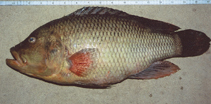
Ραχιαίες άκανθες (συνολικά) : 15 - 16; Μαλακές ραχιαίες ακτίνες (συνολικά) : 13 - 16; Εδρικές άκανθες: 3; Μαλακές εδρικές ακτίνες: 10 - 11. Diagnosis: The presence of four or five scale rows between the posterior margin of the orbit and the ascending arm of the preoperculum, the presence of widely set unicuspid teeth on the jaws, widely separated gill rakers, and anal fins with egg ocelli places this species in Serranochromis (Ref. 128638). Breeding males of S. robustus possess ocelli that are restricted to the posterior 4-5 membranes of the anal fin, which delimits them from all other Serranochromis species, which have ocelli throughout the anal fin in breeding males, with the exception of S. jallae (Ref. 128638). Serranochromis robustus generally has a longer lower jaw than S. jallae, 50.7-59.6% of head length vs. 49.2-52.7%; it is not as deep-bodied as S. jallae as evidenced by the distance between the posterior insertion of the dorsal fin and the posterior insertion of the anal fin, 13.4-15.1% of standard length in S. robustus vs. 14.9-18.4% in S. jallae; additionally, S. robustus has a narrower least caudal peduncle depth than S. jallae, 10.9-12.8% of standard length vs. 11.3-14.2%, the least caudal peduncle depth of all S. robustus was less than 12.8% of standard length while for S. jallae, except for the smallest specimen, the least caudal peduncle depth was greater than 13.2%; Serranochromis robustus has a smaller horizontal eye diameter than S. jallae, 17.7-27.4% of head length vs. 18.6-25.5%; in general, S. robustus has more teeth in the outer row of the left lower jaw than S. jallae, 14-23 vs. 13-14 (Ref. 128638). Adults in breeding colour of Serranochromis robustus are blue/green laterally with a narrow yellow marginal band on the dorsal fin and usually a small yellowish tip to the upper caudal-fin lobe; adults in breeding colour of S. jallae are yellow/green laterally with a bright orange marginal band on the dorsal and caudal fins in fish from the Okavango River system, but creamy yellow bands in fish from the upper Zambezi River system; the throat and belly of S. jallae becomes more intensely yellow-orange in breeding dress hence the local name 'yellow-belly'; rarely, specimens from the Okavango River in Namibia also have yellow rather than orange marginal bands (Ref. 128638).
Body shape (shape guide): fusiform / normal; Cross section: oval.
It occupies mostly complex habitats in water shallower than 10 m; mostly found near river outlets and in the southern part of Lake Malawi; in southern Lake Malawi it is generally associated with the rock/sand interface or, associated with submerged aquatic vegetation and among reed beds in shallow water and inlets (Ref. 5595, 128638). Present in calm coves or slow flowing sections of rivers with vegetation; not common in Lake Malawi, but abundant in larger rivers (Ref. 4967). Piscivore, hunting mbuna and sand-dwelling haplochromines; mouthbrooder (Ref. 5595). Oviparous (Ref. 205). Breeds in summer (Ref. 7248).
Life cycle and mating behavior
Γεννητική Ωρίμανση | Αναπαραγωγή | Γεννοβολία | Αβγά | Γονιμότητα | Προνύμφες
Oviparous (Ref. 205). Females incubate the eggs in the mouth (Ref. 50828).
Snoeks, J. and M. Hanssens, 2004. Identification guidelines to other non-mbuna. p.266-310. In Snoeks, J. (ed.) The cichlid diversity of Lake Malawi/Nyasa/Niassa: identification, distribution and taxonomy. Cichlid Press, El Paso, USA, 360p. (Ref. 55954)
IUCN Red List Status (Ref. 130435: Version 2025-1)
Threat to humans
Harmless
Human uses
αλιεία: Εμπορικό(ά); αλιεία αναψυχής: ναί
Εργαλεία
Special reports
Download XML
Διαδικτυακές πηγές
Estimates based on models
Phylogenetic diversity index (Αναφ.
82804): PD
50 = 0.5000 [Uniqueness, from 0.5 = low to 2.0 = high].
Bayesian length-weight: a=0.01288 (0.00720 - 0.02306), b=3.01 (2.86 - 3.16), in cm total length, based on LWR estimates for this species & (Sub)family-body (Ref.
93245).
Τροφικό Επίπεδο (Αναφ.
69278): 4.1 ±0.67 se; based on food items.
Generation time: 2.2 ( na - na) years. Estimated as median ln(3)/K based on 2
growth studies.
Ελαστικότητα (Αναφ.
120179): Μεσαίο(α), ελάχιστος χρόνος για διπλασιασμό πληθυσμού 1,4 - 4,4 έτη (K=0.51; tm=3).
Fishing Vulnerability (Ref.
59153): Low vulnerability (25 of 100).
🛈