



Coregonus clupeaformis (Mitchill, 1818)
Lake whitefish
Carica il tuo foto e Video
Immagini | Video | Google image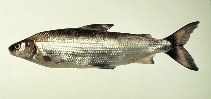 Coregonus clupeaformis
Immagine di Scarola, J.F.
Immagini | Video | Google image
Immagine di Scarola, J.F.
Classificazione / Nomi Nomi Comuni | Sinonimi | Catalog of Fishes(Genere, Specie) | ITIS | CoL | WoRMS | Cloffa
> Salmoniformes (Salmons) > Salmonidae (Salmonids) > Coregoninae
Etymology: Coregonus: Greek, kore = pupils of the eye + Greek, gonia = angle (Ref. 45335); clupeaformis: clupeaformis meaning herring-shaped (Ref. 1998).
More on author: Mitchill.
Etymology: Coregonus: Greek, kore = pupils of the eye + Greek, gonia = angle (Ref. 45335); clupeaformis: clupeaformis meaning herring-shaped (Ref. 1998).
More on author: Mitchill.
Ambiente: milieu / zona climatica / distribuzione batimetrica / gamma di distribuzione Ecologia
; acqua dolce; salmastro benthopelagico; anadromo (Ref. 120291); distribuzione batimetrica 8 - 128 m (Ref. 3849). Temperate; 8°C - 14°C (Ref. 1998); 72°N - 41°N, 149°W - 61°W (Ref. 86798)
Distribuzione Territories | Aree FAO | Ecosistemi | Presenze | Mappa dei ritrovamenti | Introduzioni | Faunafri
North America: Atlantic, Arctic and Pacific basins throughout most of Canada south into New England, the Great Lakes basin, and central Minnesota, USA; Copper and Susitna river drainages in Alaska. Introduced in northwestern USA (Ref. 86798). This species was stocked into high Andean lakes in two countries in southern Latin America (Ref. 1739). Probably conspecific with Coregonus lavaretus (Ref. 7506). Belongs to Coregonus clupeaformis complex (Ref. 27547).
Lunghezza alla prima maturità / Dimensione / Peso / Età
Maturità: Lm ? range ? - ? cm
Max length : 100.0 cm TL maschio/sesso non determinato; (Ref. 9988); common length : 54.1 cm TL maschio/sesso non determinato; (Ref. 12193); peso massimo pubblicato: 19.0 kg (Ref. 28850); Età massima riportata: 50 anni (Ref. 3494)
Max length : 100.0 cm TL maschio/sesso non determinato; (Ref. 9988); common length : 54.1 cm TL maschio/sesso non determinato; (Ref. 12193); peso massimo pubblicato: 19.0 kg (Ref. 28850); Età massima riportata: 50 anni (Ref. 3494)
Breve descrizione Chiavi di identificazione | Morfologia | Morfometria
Spine dorsali (totale) : 0; Raggi dorsali molli (totale) : 11 - 13; Spine anali: 0; Raggi anali molli: 10 - 14; Vertebre: 55 - 64. Adipose fin well developed, often larger in males; axillary process present in pelvic fins (Ref. 27547). Dark brown to midnight blue above fading to silver on sides and wide beneath; no parr marks in young (Ref. 27547).
Body shape (shape guide): fusiform / normal; Cross section: oval.
Body shape (shape guide): fusiform / normal; Cross section: oval.
Inhabits large lakes and large rivers and enters brackish water (Ref. 86798). Primarily a lake dweller (Ref. 27547). Nerito-pelagic (Ref. 58426). Appears to be rather sedentary, at least in the Great Lakes (Ref. 27547). Movement in large lakes generally consists of 4 stages: movement from deep to shallow water in the spring; movement back to deep water in the summer as the shoal water warms; migration to shallow-water spawning areas in the fall and early winter; and post-spawning movement back to deeper water (Ref. 27547). Forms separate populations in large lakes (Ref. 27547). Adults feed mainly on aquatic insect larvae, mollusks and amphipods (Ref. 1091, 3849); also other fishes and fish eggs, including their own (Ref. 1998). Extensive hatchery programs for the propagation have been carried out on the Great Lakes and other areas for years (Ref. 3746, 3849). Valued for its meat as well as for its roe, which is made into an excellent caviar; utilized fresh, smoked, and frozen; eaten steamed, fried, broiled, boiled, microwaved, and baked (Ref. 9988).
Ciclo vitale e comportamento di accoppiamento Maturità | Riproduzione | Deposizione | Uova | Fecondità | Larve
Spawning occurs at night (Ref. 10242, 10344, 28849). A female and one or more males rise to the surface, release eggs and milt and descend separately toward the bottom (Ref. 27547). Spawning fish are very active and may leap completely out of the water (Ref. 1998). Breeds annually in the southern parts of the range, but only every other year or even every third year in the arctic and sub-arctic regions (Ref. 3757).
Riferimento principale
Caricare le referenze | Bibliografia | Coordinatore | Collaboratori
Page, L.M. and B.M. Burr, 2011. A field guide to freshwater fishes of North America north of Mexico. Boston : Houghton Mifflin Harcourt, 663p. (Ref. 86798)
Stato della Lista Rossa IUCN (Ref. 130435: Version 2025-2 (Global))
Least Concern (LC) ; Date assessed: 27 July 2016
CITES
Not Evaluated
Minaccia per l'uomo
Harmless
Usi umani
Pesca: commerciale; Pesce da pesca sportiva: si; Acquario: Acquari pubblici
FAO - pesca: sbarchi, profilo della specie; Publication: search | FishSource |
Informazioni ulteriori
Ecologia trofica
Articoli alimentari (prede)
Alimentazione
Consumo di cibo
Razioni alimentari
Predatori
Articoli alimentari (prede)
Alimentazione
Consumo di cibo
Razioni alimentari
Predatori
Dinamica della popolazione
Parametri di crescita
Età massima / dimensioni massime
Rapporto lunghezza-peso.
Lunghezza-lunghezza rel.
Lunghezza-frequenze
Conversione di massa
Reclutamento
Abbondanza
Parametri di crescita
Età massima / dimensioni massime
Rapporto lunghezza-peso.
Lunghezza-lunghezza rel.
Lunghezza-frequenze
Conversione di massa
Reclutamento
Abbondanza
Ciclo di vita
Riproduzione
Maturità
Maturità/Gli occhielli sono relativi.
Fecondità
Deposizione
Aggregazioni riproduttive
Uova
Sviluppo delle uova
Larve
Dinamica popolazioni larvali
Riproduzione
Maturità
Maturità/Gli occhielli sono relativi.
Fecondità
Deposizione
Aggregazioni riproduttive
Uova
Sviluppo delle uova
Larve
Dinamica popolazioni larvali
Fisiologia
Composizione corporea
Nutrienti
Consumo di ossigeno
Tipo di nuoto
Velocità di nuoto
Pigmenti visivi
Suono del pesce
Malattie e parassiti
Tossicità (LC50)
Composizione corporea
Nutrienti
Consumo di ossigeno
Tipo di nuoto
Velocità di nuoto
Pigmenti visivi
Suono del pesce
Malattie e parassiti
Tossicità (LC50)
Legato all'uomo
Sistemi di acquacoltura
Profili di acquacoltura
Varietà
Casi di Ciguatera
Francobolli, monete, materiale vario.
Sistemi di acquacoltura
Profili di acquacoltura
Varietà
Casi di Ciguatera
Francobolli, monete, materiale vario.
Strumenti
Libro elettronico | Giuda pratica | Chiavi di identificazione | Generatore frequenze di lunghezza | Strumento Parametri Biologici | Mappa dei ritrovamenti |
Cattura-MSY |
Rapporti speciali
Controllo della manutenzione dell'acquario | Verificare la presenza di schede informative sulle specie | Verifica delle schede informative sull'acquacoltura
Scarica XML
Fonti Internet
AFORO (otoliths) | Alien/Invasive Species database | Aquatic Commons | BHL | Cloffa | Websites from users | Check FishWatcher | CISTI | Catalog of Fishes: Genere, Specie | DiscoverLife | ECOTOX | FAO - pesca: sbarchi, profilo della specie; Publication: search | Faunafri | Fishipedia | Fishtrace | GloBI | Google Books | Google Scholar | Google | IGFA World Record | Database Nazionali | OneZoom | Open Tree of Life | Otolith Atlas of Taiwan Fishes | PubMed | Reef Life Survey | Socotra Atlas | TreeBase | Tree of Life | Wikipedia: Go, ricerca | World Records Freshwater Fishing | Record zoologico
Stime basate su modelli
Indice di diversità filogenetica (Fonte Biblio. 82804): PD50 = 0.5000 [Uniqueness, from 0.5 = low to 2.0 = high].
Bayesian length-weight: a=0.00550 (0.00475 - 0.00636), b=3.23 (3.19 - 3.27), in cm total length, based on LWR estimates for this species (Ref. 93245).
Livello trofico (Fonte Biblio. 69278): 3.2 ±0.2 se; based on diet studies.
Generation time: 4.4 (3.9 - 5.5) years. Estimated as median ln(3)/K based on 59 growth studies.
Resilienza (Fonte Biblio. 120179): Basso, tempo minimo di raddoppiamento della popolazione 4.5 - 14 anni (K=0.06-0.19; tmax=50).
Nutrienti (Ref. 124155): Calcium = 11.6 [7.5, 20.7] mg/100g; Iron = 0.279 [0.200, 0.389] mg/100g; Protein = 17.7 [16.5, 18.8] %; Omega3 = 0.96 [0.41, 2.48] g/100g; Selenium = 20.8 [10.7, 46.0] μg/100g; VitaminA = 12.2 [4.7, 31.8] μg/100g; Zinc = 0.538 [0.439, 0.650] mg/100g (wet weight); based on nutrient studies.