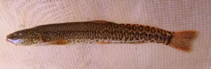
Classification / Names
Nomi Comuni | Sinonimi | Catalog of Fishes(Genere, Specie) | ITIS | CoL | WoRMS | Cloffa
>
Cypriniformes (Carps) >
Nemacheilidae (Brook loaches)
Etymology: Paracobitis: Greek, para = the side of + Greek, kobitis, -idos = a kind of sardine; also related with the voice Greek, kobios, Latin gobius = gudgeon (Ref. 45335).
Environment: milieu / climate zone / distribuzione batimetrica / distribution range
Ecologia
; acqua dolce benthopelagico. Temperate; 10°C - 22°C (Ref. 2059)
Asia.
Size / Peso / Age
Maturità: Lm ? range ? - ? cm
Max length : 20.0 cm TL maschio/sesso non determinato; (Ref. 1441)
Short description
Chiavi di identificazione | Morfologia | Morfometria
Can be diagnosed from all other epigean species of Paracobitis in the Middle East by combination of non-unique characters: flank behind the dorsal-fin base with irregularly set blotches (vs. one or two rows of distinct blotches in P. rhadinaea), slit-shaped posterior nare opening (vs. ovoid or roundish in all congeners except P. rhadinaea and P. vignai) and body completely covered by scales (vs. scaleless or restricted to flank behind dorsal-fin origin in all species except P. rhadinaea) (Ref. 97574).
Body shape (shape guide): elongated.
Life cycle and mating behavior
Maturità | Riproduzione | Deposizione | Uova | Fecundity | Larve
Freyhof, J., H.R. Esmaeili, G. Sayyadzadeh and M. Geiger, 2014. Review of the crested loaches of the genus Paracobitis from the Iran and Iraq with the description of four new species (Teleostei: Nemacheilidae). Ichthyol. Explor. Freshwat. 25(1):11-38. (Ref. 97574)
IUCN Red List Status (Ref. 130435: Version 2025-1)
Threat to humans
Harmless
Human uses
Strumenti
Special reports
Download XML
Fonti Internet
Estimates based on models
Phylogenetic diversity index (Fonte Biblio.
82804): PD
50 = 0.5000 [Uniqueness, from 0.5 = low to 2.0 = high].
Bayesian length-weight: a=0.00794 (0.00462 - 0.01365), b=2.97 (2.83 - 3.11), in cm total length, based on LWR estimates for this species & Genus-body shape (Ref.
93245).
Trophic level (Fonte Biblio.
69278): 2.6 ±0.3 se; based on size and trophs of closest relatives
Resilienza (Fonte Biblio.
120179): Basso, tempo minimo di raddoppiamento della popolazione 4.5 - 14 anni (Preliminary K or Fecundity.).
Fishing Vulnerability (Ref.
59153): Low vulnerability (10 of 100).
🛈