



Gnathonemus petersii (Günther, 1862)
Elephantnose fish
Envoyez vos Photos et vidéos
Images | Images Google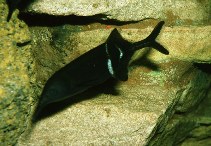 Gnathonemus petersii
Photo de Moreau, J.
Images | Images Google
Photo de Moreau, J.
Classification / Noms Noms communs | Synonymes | Catalog of Fishes(Genre, Espèce) | ITIS | CoL | WoRMS | Cloffa
> Osteoglossiformes (Bony tongues) > Mormyridae (Elephantfishes)
Etymology: Gnathonemus: Greek, gnathos = jaw + Greek, nema = filament (Ref. 45335).
Eponymy: Wilhelm Karl Hartwig Peters (1815–1883) was a German zoologist and traveller who made some very important collections in Mozambique. [...] (Ref. 128868), visit book page.
More on author: Günther.
Etymology: Gnathonemus: Greek, gnathos = jaw + Greek, nema = filament (Ref. 45335).
Eponymy: Wilhelm Karl Hartwig Peters (1815–1883) was a German zoologist and traveller who made some very important collections in Mozambique. [...] (Ref. 128868), visit book page.
More on author: Günther.
Environnement : milieu / zone climatique / profondeur / gamme de distribution Écologie
; eau douce démersal; pH range: 6.0 - 8.0; dH range: 5 - 19. Tropical; 22°C - 28°C (Ref. 1672)
Distribution Territoires | Zones FAO | Écosystèmes | Occurrences | Carte par point | Introductions | Faunafri
Africa: Niger to Congo River basins (Ref. 3203). Widespread in the Congo basin (Ref. 1878, 4910, 11970, 41580, 41591, 106245, 106290). Also reported from Lake Tanganyika (Ref. 114071). Report from the Cuanza in Angola (Ref. 99599) unconfirmed in Ref. 120641. Reports from Lake Kivu are erroneous (Ref. 46152, 107916).
Taille / Poids / Âge
Description synthétique Clés d'identification | Morphologie | Morphométrie
Épines dorsales (Total) : 0; Rayons mous dorsaux (Total) : 25 - 31; Épines anales: 0; Rayons mous anaux: 32 - 36.
Body shape (shape guide): fusiform / normal; Cross section: compressed.
Body shape (shape guide): fusiform / normal; Cross section: compressed.
Occurs close to the bottom where it probes for food with the long snout. Territorial and usually aggressive towards members of its own species. This behavior has been shown to involve electric organ discharge (EOD) activity (Ref. 10011). Feeds mostly at night on worms and insects (Ref. 7020), probably aided by electro-sensory inputs (Ref. 10011). Electroreceptors are distributed over the entire head, the dorsal and ventral regions of the body, but absent from the side and the caudal peduncle where the electric organ is located (Ref. 10011). Sex-related EOD characteristics in this species has been demonstrated in the laboratory with freshly imported samples during the breeding season; such EOD dimorphism changed with time in captivity (Ref. 10764; 10766). Lead nitrate in water significantly increased EOD rate and selectively altered the EOD waveform of this species (Ref. 10469). Dubbed a `hearing specialist' having auditory abilities in the range of 100-2500 Hz, with `best frequencies' between 300 and 600 Hz (Ref. 10830). Aquarium keeping: in groups of 5 or more individuals; minimum aquarium size 150 cm; not recommended for home aquariums (Ref. 51539).
Cycle de vie et comportement reproducteur Maturité | Reproduction | Frai | Œufs | Fécondité | Larves
Référence principale
Téléchargez vos références | Références | Coordinateur | Collaborateurs
Gosse, J.-P., 1984. Mormyridae. p. 63-122. In J. Daget, J.-P. Gosse and D.F.E. Thys van den Audenaerde (eds.) Check-list of the freshwater fishes of Africa (CLOFFA). ORSTOM, Paris and MRAC, Tervuren. Vol. 1. (Ref. 3203)
Statut dans la liste rouge de l'IUCN (Ref. 130435: Version 2025-2 (Global))
Préoccupation mineure (LC) ; Date assessed: 03 September 2019
CITES
Not Evaluated
Menace pour l'homme
Harmless
Utilisations par l'homme
Pêcheries: pêcheries vivrières; Aquarium: Commercial
FAO - Publication: search | FishSource |
Plus d'informations
Écologie trophique
Aliments (proies)
Composition du régime alimentaire
Consommation alimentaire
Rations alimentaires
Prédateurs
Aliments (proies)
Composition du régime alimentaire
Consommation alimentaire
Rations alimentaires
Prédateurs
Dynamique des populations
Paramètres de croissance
Âges / tailles maximales
Longueur-poids rel.
Rel. longueur-longueur.
Fréquences de longueurs
Conversion de masse
Recrutement
Abondance
Paramètres de croissance
Âges / tailles maximales
Longueur-poids rel.
Rel. longueur-longueur.
Fréquences de longueurs
Conversion de masse
Recrutement
Abondance
Cycle de vie
Reproduction
Maturité
Maturité/épines rel.
Fécondité
Frai
Agrégats de frai
Œufs
Développement de l'œuf
Larves
Dynamique des populations larvaires
Reproduction
Maturité
Maturité/épines rel.
Fécondité
Frai
Agrégats de frai
Œufs
Développement de l'œuf
Larves
Dynamique des populations larvaires
Physiologie
Composition corporelle
Nutriments
Consommation d'oxygène
Type de natation
Vitesse de nage
Pigments visuels
Son de poisson
Maladies et parasites
Toxicité (CL50)
Composition corporelle
Nutriments
Consommation d'oxygène
Type de natation
Vitesse de nage
Pigments visuels
Son de poisson
Maladies et parasites
Toxicité (CL50)
Liées à l'homme
Systèmes d'aquaculture
Profils d'aquaculture
Souches
Cas de ciguatera
Timbres, pièces de monnaie, divers
Systèmes d'aquaculture
Profils d'aquaculture
Souches
Cas de ciguatera
Timbres, pièces de monnaie, divers
Outils
Quiz bio | E-book | Guide de terrain | Clés d'identification | Générateur de fréquences de longueur | Outil de dynamique de population | Carte par point |
Capture-MSY |
Articles particuliers
Télécharger en XML
Sources Internet
AFORO (otoliths) | Alien/Invasive Species database | Aquatic Commons | BHL | Cloffa | Websites from users | FishWatcher | CISTI | Catalog of Fishes: Genre, Espèce | DiscoverLife | ECOTOX | FAO - Publication: search | Faunafri | Fishipedia | Fishtrace | GloBI | Google Books | Google Scholar | Google | IGFA World Record | OneZoom | Open Tree of Life | Otolith Atlas of Taiwan Fishes | Aquariums publics | PubMed | Reef Life Survey | Socotra Atlas | TreeBase | Arbre de Vie | Wikipedia: aller à, chercher | World Records Freshwater Fishing | Zoological Record
Estimations basées sur des modèles
Indice de diversité phylogénétique (Réf. 82804): PD50 = 0.5625 [Uniqueness, from 0.5 = low to 2.0 = high].
Bayesian length-weight: a=0.01259 (0.00585 - 0.02711), b=2.87 (2.69 - 3.05), in cm total length, based on LWR estimates for this (Sub)family-body shape (Ref. 93245).
Niveau trophique (Réf. 69278): 3.1 ±0.34 se; based on food items.
Résilience (Réf. 120179): Milieu, temps minimum de doublement de population : 1,4 à 4,4 années (Preliminary K or Fecundity.).
Nutriments (Ref. 124155): Calcium = 169 [84, 395] mg/100g; Iron = 1.59 [0.74, 3.23] mg/100g; Protein = 17.7 [15.3, 20.0] %; Omega3 = 0.518 [0.209, 1.314] g/100g; Selenium = 70.2 [26.4, 176.7] μg/100g; VitaminA = 35.8 [12.9, 96.4] μg/100g; Zinc = 1.74 [1.14, 3.40] mg/100g (wet weight);