



Beobachtung melden im Fish Watcher
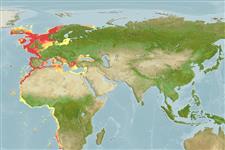
| Native range | All suitable habitat | Point map | Year 2050 |
|
| This map was computer-generated and has not yet been reviewed. |
| Raja clavata AquaMaps Data sources: GBIF OBIS |
Hochladen Photos und videos
Bilder | videos | Google Bild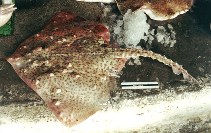 Raja clavata
Photo von Stergiou, K.I.
Bilder | videos | Google Bild
Photo von Stergiou, K.I.
Klassifizierung / Names Namen | Synonyme | Catalog of Fishes(Gattung, Arten) | ITIS | CoL | WoRMS | Cloffa
Elasmobranchii (Haie und Rochen) (sharks and rays) > Rajiformes (Skates and rays) > Rajidae (Skates)
Etymology: Raja: Latin, raja, -ae = a sting ray (Raja sp.) (Ref. 45335).
More on author: Linnaeus.
Etymology: Raja: Latin, raja, -ae = a sting ray (Raja sp.) (Ref. 45335).
More on author: Linnaeus.
Umwelt: Milieu / Klimazone / Tiefenbereich / Verbreitungsgebiet Ökologie
seewasser demersal; tiefenbereich 5 - 1020 m (Ref. 114953). Subtropical; 70°N - 38°S, 25°W - 50°E
Verbreitung Territorien | FAO Gebiete | Ökosysteme | Vorkommen | Punkt Karte | Einführungen | Faunafri
Eastern Atlantic and Southwest Indian Ocean: Iceland to Madagascar, including the Mediterranean Sea.
Länge bei der ersten Reifung / Größe / Gewicht / Alter
Geschlechtsreife: Lm 76.6, range 47 - 87.5 cm
Max length : 105 cm TL Männchen/unbestimmt; (Ref. 53748); 139.0 cm TL (female); common length : 85.0 cm TL Männchen/unbestimmt; (Ref. 9987); max. veröff. Gewicht: 18.0 kg (Ref. 35388); max. veröff. Alter: 15 Jahre (Ref. 41305)
Max length : 105 cm TL Männchen/unbestimmt; (Ref. 53748); 139.0 cm TL (female); common length : 85.0 cm TL Männchen/unbestimmt; (Ref. 9987); max. veröff. Gewicht: 18.0 kg (Ref. 35388); max. veröff. Alter: 15 Jahre (Ref. 41305)
Kurzbeschreibung Bestimmungsschlüssel | Morphologie | Morphometrie
Rückenflossenstacheln (insgesamt) : 0; Afterflossenstacheln: 0. Sub-rhomboid in shape with pointed wing-tips; disc-width 1,25 to 1,36 times in its length, its length 1,70 to 1,83 times in total length. Short rostrum, rounded at his extremity; pectoral fins with clear angles on lateral side; triangular pelvic fins (Ref. 39246). Dorsally prickly; large females also prickly throughout their ventral surface; juveniles and large males prickly along the margins of their discs and the underside of their snout. 30-50 thorns form a median row from the nape to the first dorsal fin; additional large 'buckler' thorns with swollen bases scattered on upper surface of disc in adults (Ref. 3167). Coloration is highly variable, with the dorsal surface having all shades of brown with dark and light spots and blotches; ventral surface white (Ref. 3167, 58137).
Body shape (shape guide): other; Cross section: flattened.
Body shape (shape guide): other; Cross section: flattened.
Inhabits shelf and upper slope waters. Reported depth ranges varies, from 10-300 m (Ref. 4426, 82319, 88187), and from 300-577 m in the eastern Ionian Sea (Ref. 56504); most common in coastal waters between 10-60 m depth (Ref. 58137). Tolerates low salinities (Ref. 88171). Found on mud, sand and gravel bottoms, rarely on rougher bottoms (Ref. 6808, 58137). Nocturnal species. Feeds on all kinds of bottom animals, preferably crustaceans (Ref. 3167) and fishes (Ref. 114953). Undertakes migrations with mean distances of 54-117 km per month; shows a clear annual migration cycle (Ref. 89017, 89018), moves from deeper offshore waters (10-30 m) in autumn and winter to shallower areas (<10 m) in spring (Ref. 82319). Young are non-migratory, inhabiting inshore nursery grounds (Ref. 89019, 89020, 89022); in the Bay of Douarnenez (France) they are found to remain in shallow waters for at least 2 years (Ref. 89023). Maturity age 7-8 years (Ref. 114953). Oviparous. Young may tend to follow large objects, such as their mother (Ref. 205). Detects weak electric fields generated by other organisms (prey detection and predator avoidance) but may also generate its own weak electric fields (Ref. 10311, 88171). Utilized fresh and frozen (Ref. 9987).
Lebenszyklus und Paarungsverhalten Geschlechtsreife | Fortpflanzung | Ablaichen | Eier | Fruchtbarkeit | Larven
Oviparous. Distinct pairing with embrace. Polyandrous species (Ref. 89024). Paired eggs are laid and deposited on shallow sand, mud, pebble or gravel bottoms (Ref. 205, 89025). Up to 170 egg cases can be laid by a single female in a year (Ref. 3167), but average fecundity is much lower (around 48-74 eggs) (Ref. 3603, 31302). In northwestern Europe, egg cases are laid during spring (Ref. 3167) and in the Mediterranean during winter and spring (Ref. 3167). Egg cases are oblong capsules with stiff pointed horns at the corners, each containing one embryo (Ref. 205). Capsules are 5.0-9.0 cm long without the horns (Ref. 41250, 88187) and 3.4-6.8 cm wide (Ref. 41250). Egg cases are anchored with an adhesive film (Ref. 82399). Embryos feed solely on yolk (Ref. 50449). Egg cases hatch after about 4-5 months and pups are about 11-13 cm TL (Ref. 88864). Mating season from February to September, peaking in June (Ref. 74501). Adults observed to form same-sex aggregations during the mating season with females moving to shallower inshore waters approximately a month before the males (Ref 3603, 58137, 74501). Mating does not occur in the Baltic Sea (Ref. 82311).
Hauptreferenz
Laden Sie Ihre Referenzen hoch | Referenzen | Koordinator : McEachran, John | Partner
McEachran, J.D. and K.A. Dunn, 1998. Phylogenetic analysis of skates, a morphologically conservative clade of elasmobranchs (Chondrichthyes: Rajidae). Copeia 1998(2):271-290. (Ref. 27314)
IUCN Rote Liste Status (Ref. 130435: Version 2025-2 (Global))
Gefährdung zunehmend (NT) (A2bd); Date assessed: 15 April 2023
CITES
Not Evaluated
Bedrohung für Menschen
Harmless
Nutzung durch Menschen
Fischereien: kommerziell; Sportfisch: ja
FAO - Fischereien: landungen; Publication: search | FishSource | Das Meer um uns herum
Mehr Information
Trophische Ökologie
Lebensmittel (Beutetiere)
Nahrungszusammensetzung
Nahrungsaufnahme
Lebensmittelrationen
Räuber
Lebensmittel (Beutetiere)
Nahrungszusammensetzung
Nahrungsaufnahme
Lebensmittelrationen
Räuber
Populationsdynamik
Wachstumsparameter
Max. Alter/Größen
Länge-Gewicht-Rel.
Länge-Länge-Verhältnis.
Längenhäufigkeiten
Massenkonvertierung
Rekrutierung
Dichte
Wachstumsparameter
Max. Alter/Größen
Länge-Gewicht-Rel.
Länge-Länge-Verhältnis.
Längenhäufigkeiten
Massenkonvertierung
Rekrutierung
Dichte
Lebenszyklus
Fortpflanzung
Geschlechtsreife
Reifung/Kiemen rel.
Fruchtbarkeit
Ablaichen
Laichaggregationen
Eier
Eientwicklung
Larven
Larven Pop.Dyn.
Fortpflanzung
Geschlechtsreife
Reifung/Kiemen rel.
Fruchtbarkeit
Ablaichen
Laichaggregationen
Eier
Eientwicklung
Larven
Larven Pop.Dyn.
Physiologie
Körperliche Zusammensetzung
Nährstoffe
Sauerstoffverbrauch
Schwimmart
Schwimmgeschwindigkeit
Visuelle Pigmente
Fischgeräusche
Krankheiten und Parasiten
Toxizität (LC50s)
Körperliche Zusammensetzung
Nährstoffe
Sauerstoffverbrauch
Schwimmart
Schwimmgeschwindigkeit
Visuelle Pigmente
Fischgeräusche
Krankheiten und Parasiten
Toxizität (LC50s)
Menschenbezogen
Aquakultur-Systeme
Aquakultur Profile
Zuchtlinien
Ciguatera-Fälle
Briefmarken, Münzen, Verschiedenes.
Aquakultur-Systeme
Aquakultur Profile
Zuchtlinien
Ciguatera-Fälle
Briefmarken, Münzen, Verschiedenes.
Tools
Bio-Quiz | E-Book | Feldführer | Bestimmungsschlüssel | Längenhäufigkeits Tool | Lebensdaten Tool | Punkt Karte |
Catch-MSY |
Zusatzinformationen
Download XML
Zusammenfassung | Punktdaten | Namen | Photos
Internet Quellen
AFORO (otoliths) | Aquatic Commons | BHL | Cloffa | Websites from users | FishWatcher Einträge suchen | CISTI | Catalog of Fishes: Gattung, Arten | DiscoverLife | DORIS | ECOTOX | FAO - Fischereien: landungen; Publication: search | Faunafri | Fishipedia | Fishtrace | GloBI | Google Books | Google Scholar | Google | IGFA World Record | Nationale Datenbanken | OneZoom | Open Tree of Life | Otolith Atlas of Taiwan Fishes | Öffentliche Aquarien | PubMed | Reef Life Survey | Socotra Atlas | TreeBase | Tree of Life | Wikipedia: Gehe zu, Suchen | World Records Freshwater Fishing | Zoobank | Zoologischer Rekord
Schätzungen auf der Grundlage von Modellen
Bevorzugte Temperatur (Ref. 123201): 7.1 - 15.8, mean 10.7 °C (based on 474 cells).
Phylogenetischer Diversitätsindex (Ref. 82804): PD50 = 0.5000 [Uniqueness, from 0.5 = low to 2.0 = high].
Bayesian length-weight: a=0.00204 (0.00179 - 0.00233), b=3.26 (3.23 - 3.29), in cm total length, based on LWR estimates for this species (Ref. 93245).
Trophische Ebene (Ref. 69278): 3.8 ±0.2 se; based on diet studies.
Generation time: 7.8 (5.4 - 10.4) years. Estimated as median ln(3)/K based on 16 growth studies.
Widerstandsfähigkeit (Ref. 120179): niedrig, Verdopplung der Population dauert 4,5 - 14 Jahre. (K=0.09-0.14; tm=10; tmax=23; Fec=150).
Prior r = 0.18, 95% CL = 0.12 - 0.26, Based on 4 full stock assessments.
Nährstoffe (Ref. 124155): Calcium = 9.22 [1.18, 176.74] mg/100g; Iron = 0.628 [0.060, 7.651] mg/100g; Protein = 17.2 [14.4, 19.5] %; Omega3 = 0.571 [0.265, 1.295] g/100g; Selenium = 39.7 [7.5, 183.1] μg/100g; VitaminA = 5.22 [0.40, 59.91] μg/100g; Zinc = 0.47 [0.03, 5.30] mg/100g (wet weight); based on nutrient studies.