>
Eupercaria/misc (Various families in series Eupercaria) >
Lutjanidae (Snappers) > Etelinae
Etymology: Pristipomoides: Greek, pristis = saw + Greek, poma, -atos = cover, operculum + Greek, oides = similar to (Ref. 45335).
Eponymy: Dr Harry Wyman Freeman (1923–2012) was Professor of Biology at College of Charleston, his alma mater. [...] (Ref. 128868), visit book page.
Environment: milieu / Zona climática / intervalo de profundidade / distribution range
Ecologia
marinhas demersal; intervalo de profundidade 50 - 220 m (Ref. 47377), usually 50 - 150 m (Ref. 9626). Tropical; 35°N - 36°S, 86°W - 33°W (Ref. 55)
Western Atlantic: southeastern USA to Uruguay (Ref. 9626).
Tamanho / Peso / Idade
Maturidade: Lm ? range ? - ? cm
Max length : 23.3 cm TL macho/indeterminado; (Ref. 47377); common length : 21.0 cm TL macho/indeterminado; (Ref. 9626)
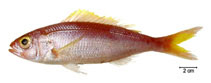
Espinhos dorsais (total) : 10; Raios dorsais (total) : 12; Espinhos anais: 3; Raios anais : 8. Interorbital space flat. Eye large. Pectoral fins not reaching level of anus. Scale rows on back parallel to lateral line. Back and upper sides yellow-orange or pinkish; lower sides and belly silvery white; the caudal fin and the distal edge of the dorsal fin yellowish or orange; the remainder of the dorsal and other fins translucent or whitish.
Body shape (shape guide): fusiform / normal; Cross section: oval.
Although the habitat is poorly known, most specimens have been trawled from relatively deep water at the upper edge of the continental shelf. Reported to occur on soft or semi-hard bottoms (Ref. 5217).
Ciclo de vida ou comportamento de acasalamento
Maturidade | Reprodução | Desova | Ovos | Fecundidade | Larvas
Allen, G.R., 1985. FAO Species Catalogue. Vol. 6. Snappers of the world. An annotated and illustrated catalogue of lutjanid species known to date. FAO Fish. Synop. 125(6):208 p. Rome: FAO. (Ref. 55)
Status na Lista Vermelha da UICN (Ref. 130435: Version 2025-1)
Ameaça para os humanos
Harmless
Uso pelos humanos
Pescarias: pouco comercial
Ferramentas
Relatórios especiais
Baixar XML
Fontes da internet
Estimates based on models
Preferred temperature (Ref.
123201): 17.2 - 26.3, mean 22.2 °C (based on 127 cells).
Índice de diversidade filogenética (Ref.
82804): PD
50 = 0.5005 [Uniqueness, from 0.5 = low to 2.0 = high].
Bayesian length-weight: a=0.01514 (0.00722 - 0.03173), b=2.97 (2.80 - 3.14), in cm total length, based on LWR estimates for this species & Genus-body shape (Ref.
93245).
Nível Trófico (Ref.
69278): 3.7 ±0.5 se; based on size and trophs of closest relatives
Resiliência (Ref.
120179): Elevada, tempo mínimo de duplicação da população menor que 15 meses (Preliminary K or Fecundity.).
Fishing Vulnerability (Ref.
59153): Low vulnerability (13 of 100).
🛈