>
Eupercaria/misc (Various families in series Eupercaria) >
Lutjanidae (Snappers) > Etelinae
Etymology: Pristipomoides: Greek, pristis = saw + Greek, poma, -atos = cover, operculum + Greek, oides = similar to (Ref. 45335).
More on author: Valenciennes.
Environment: milieu / climate zone / profondeur / distribution range
Écologie
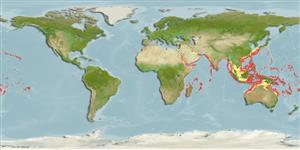
marin benthopélagique; profondeur 40 - 400 m (Ref. 11888), usually 180 - 270 m (Ref. 9821). Deep-water; 35°N - 26°S, 31°E - 144°W (Ref. 55)
Indo-Pacific: East Africa to Hawaii and Tahiti, north to southern Japan, south to eastern Australia and Lord Howe Island.
Length at first maturity / Taille / Poids / Âge
Maturité: Lm 52.0, range 37 - ? cm
Max length : 100.0 cm TL mâle / non sexé; (Ref. 5484); common length : 50.0 cm SL mâle / non sexé; (Ref. 9821); poids max. publié: 8.2 kg (Ref. 4887); âge max. reporté: 44 années (Ref. 92301)
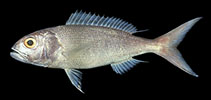
Épines dorsales (Total) : 10; Rayons mous dorsaux (Total) : 11; Épines anales: 3; Rayons mous anaux: 8. This species is distinguished by the following characters: body elongate, laterally compressed; jaws about equal or lower jaw protruding slightly; premaxillae protrusible. maxilla extending to vertical through about anterior margin of pupil; upper and lower jaws both with an outer row of conical to small canine teeth and an inner band of villiform teeth, the caniniform teeth at anterior ends of jaws are not appreciably enlarged; teeth on vomer triangular patch, maxilla without scales or longitudinal ridges; interorbital region flattened. Gill rakers on first gill arch 7-8 + 15-18 = 22-26; last soft ray of both dorsal and anal fins well
produced, longer than next to last ray; caudal fin forked; pectoral fins long, about equal to or somewhat shorter than head length; membranes of dorsal and anal fins without scales; tubed
lateral-line scales 57-62. Colour variable, ranging from brownish to lavender or reddish
purple; snout and interorbital space with narrow yellow lines and blue spots often persisting as dark spots when preserved; dorsal and caudal fins light blue or lavender with reddish orange margins (Ref. 9821).
Body shape (shape guide): elongated; Cross section: compressed.
Adults occur over rocky bottoms (Ref. 30573); off Guam, caught most abundantly between 180 and 270 m (Ref. 9821). At night, they migrate vertically to the upper part of its habitat to feed (Ref. 11888). They feed on small fishes, shrimps, crabs, amphipods, ascidians and salps. Marketed fresh (Ref. 55). Caught mainly with bottom longlines and deep handlines, marketed main fresh and a good quality food fish (Ref. 9821).
Life cycle and mating behavior
Maturité | Reproduction | Frai | Œufs | Fécondité | Larves
Allen, G.R., 1985. FAO Species Catalogue. Vol. 6. Snappers of the world. An annotated and illustrated catalogue of lutjanid species known to date. FAO Fish. Synop. 125(6):208 p. Rome: FAO. (Ref. 55)
Statut dans la liste rouge de l'IUCN (Ref. 130435: Version 2025-1)
Menace pour l'homme
Harmless
Utilisations par l'homme
Pêcheries: hautement commercial; pêche sportive: oui
Outils
Articles particuliers
Télécharger en XML
Sources Internet
Estimates based on models
Preferred temperature (Réf.
123201): 12.2 - 22.6, mean 15 °C (based on 199 cells).
Phylogenetic diversity index (Réf.
82804): PD
50 = 0.5005 [Uniqueness, from 0.5 = low to 2.0 = high].
Bayesian length-weight: a=0.01072 (0.00752 - 0.01527), b=2.93 (2.83 - 3.03), in cm total length, based on LWR estimates for this species (Ref.
93245).
Niveau trophique (Réf.
69278): 4.2 ±0.4 se; based on diet studies.
Generation time: 4.4 (3.5 - 10.0) years. Estimated as median ln(3)/K based on 14
growth studies.
Résilience (Réf.
120179): Milieu, temps minimum de doublement de population : 1,4 à 4,4 années (K=0.16-0.31; tmax=18).
Prior r = 0.58, 95% CL = 0.39 - 0.88, Based on 1 full stock assessment.
Fishing Vulnerability (Ref.
59153): Moderate vulnerability (43 of 100).
🛈
Climate Vulnerability (Ref.
125649): High to very high vulnerability (75 of 100).
🛈
Nutrients (Ref.
124155): Calcium = 12.9 [6.3, 32.6] mg/100g; Iron = 0.303 [0.131, 0.673] mg/100g; Protein = 16.9 [14.9, 18.7] %; Omega3 = 0.221 [0.100, 0.484] g/100g; Selenium = 23.1 [9.1, 58.0] μg/100g; VitaminA = 16.3 [3.2, 89.0] μg/100g; Zinc = 0.299 [0.191, 0.484] mg/100g (wet weight);